LiDAR in Mapping Market Size - By Platform, By Ranging Principle, By Scanning Architecture, By Component, By Application, Growth Forecast, 2026-2035

Report ID: GMI4461
   |
Published Date: February 2026
 | 
Report Format: PDF

Download Free PDF

LiDAR in Mapping Market Size

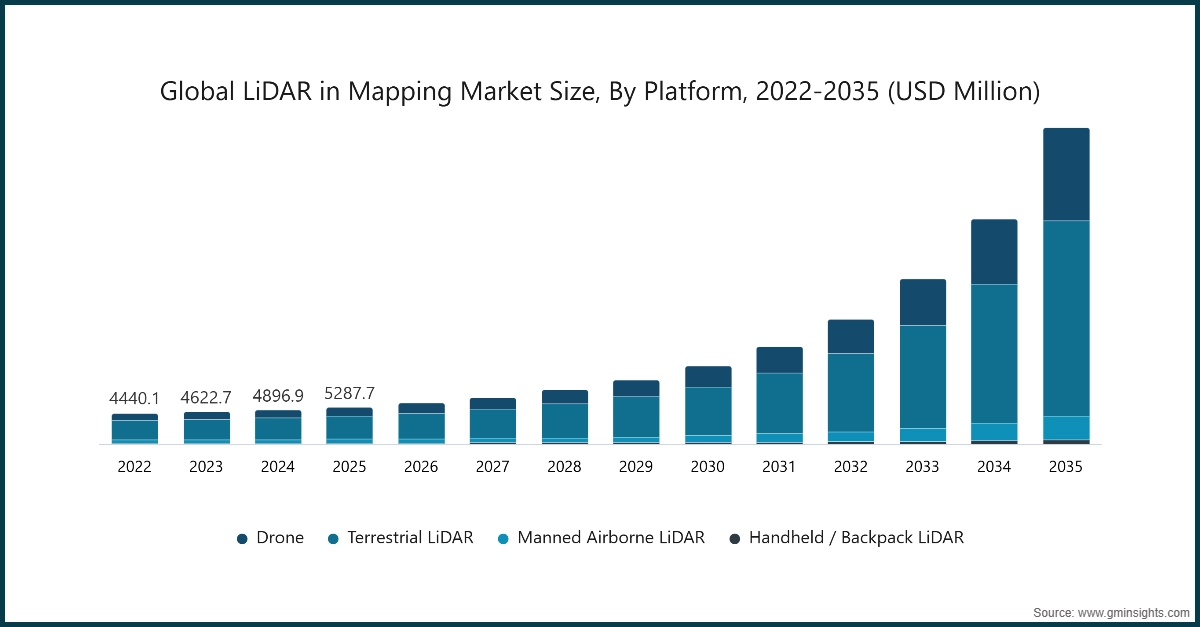
The global LiDAR in mapping market was valued at USD 5.3 billion in 2025. The market is expected to grow from USD 5.9 billion in 2026 to USD 45.8 billion in 2035, at a CAGR of 25.6% during the forecast period according to the latest report published by Global Market Insights Inc.

LiDAR in Mapping Market Research Report

The market for LiDAR in mappings is expanding, owing to the growth driven by rising LiDAR’s integration with AI, GIS, and emerging digital twin platforms is transforming mapping workflows by enabling real‑time spatial analytics and automated feature extraction.
 

In context to smart city planners around the world, around 21% of urban planners and municipal authorities globally use LiDAR‑driven spatial data within smart infrastructure models for utilities and traffic analysis, enhancing decision‑making and operational efficiency. For instance, AI‑enhanced point‑cloud classification and predictive modeling are reducing manual processing bottlenecks of LiDAR or 3D spatial data, while digital twins built on LiDAR data support continuous asset management across infrastructure, utilities, and construction sectors in regions such as North America, Europe, and APAC. This convergence accelerates deployment of intelligent mapping solutions across various industries.
 

Moreover, the rise of subscription and mapping‑as‑a‑service (MaaS) offerings are making LiDAR mapping accessible to a broader range of users by removing upfront hardware costs. Cloud‑based platforms enable collaborative project management and real‑time data sharing across distributed teams, supporting geospatial workflows from capture to delivery.
 

The model is increasingly being adopted in North America and Europe, where small to mid‑sized enterprises leverage scalable LiDAR data processing without heavy capital expenditure. Furthermore, cloud infrastructure also facilitates large‑scale mapping projects and integration with enterprise GIS systems, increasing recurring revenues for providers and expanding the user base in utilities, urban planning, and environmental monitoring, thus overall increasing market adoption rate for LiDAR technology.

LiDAR in Mapping Market Trends

  • A major trend influencing the LiDAR in Mapping industry is the integration of LiDAR with UAVs, autonomous vehicles, and digital twin platforms, driven by government agencies and private enterprises aiming to streamline large-scale mapping and real-time geospatial analytics.
     
  • In 2025, Nottingham, UK, deployed a full-city 3D digital twin using high-resolution LiDAR data, enabling urban planners to simulate infrastructure development, traffic, and utility networks in real time. This initiative highlights the shift toward AI-enhanced LiDAR mapping for smart city planning and predictive asset management.
     
  • LiDAR manufacturers are increasingly embedding solid-state and UAV-compatible LiDAR sensors in portable and mobile mapping systems, enabling faster, safer, and more precise surveys for construction, forestry, and corridor mapping applications.
     
  • Advancements in cloud-based geospatial platforms and AI-driven point-cloud processing are enhancing interoperability, predictive analytics, and automation, accelerating adoption in infrastructure, environmental, and disaster management sectors.
     
  • Deployment of LiDAR solutions in urban development projects, transportation corridors, coastal monitoring, and environmental assessments is rising globally, as governments and enterprises seek high-resolution, scalable geospatial data to optimize planning, reduce operational risks, and support climate resilience initiatives.

LiDAR in Mapping Market Analysis
Global LiDAR in Mapping Market Size, By Platform, 2022-2035 (USD Million)

On the basis of platform, the market is segmented into Drone, Terrestrial LiDAR, Manned Airborne LiDAR, and Handheld / Backpack LiDAR.
 

  • The terrestrial LiDAR segment is anticipated to reach USD 13.4 billion by 2035. The segment is driven by growing adoption in infrastructure, construction, and urban planning. High-precision mapping of buildings, roads, and utilities allows engineers to reduce project errors, optimize material usage, and accelerate project timelines. Governments in North America, Europe, and Asia-Pacific increasingly mandate LiDAR for urban development and smart city initiatives.
     

  • Additionally, advances in mobile and handheld terrestrial LiDAR systems are expanding accessibility for mid-sized firms. Integration with AI-powered point-cloud processing, BIM, and GIS platforms enhances real-time decision-making and predictive maintenance, creating new use cases in utilities, industrial plants, and environmental monitoring. These factors collectively support robust long-term market growth.
     
  • The drone segment was valued at USD 1.3 billion in 2025 and is anticipated to grow at a CAGR of 27.7% over the forecast years. The growth is driven by its ability to perform rapid, high-resolution aerial surveys in inaccessible or large-scale areas. Adoption is fueled by UAV integration in construction, forestry, mining, and infrastructure projects, lower operational costs than manned aircraft, and increasing regulatory support for commercial drone operations in North America, Europe, and Asia-Pacific.
     

Global LiDAR in Mapping Market Revenue Share, By Component, 2025 (%)

On the basis of component, the lidar in mapping market is divided into hardware and software.
 

  • The hardware segment held a market share of 80.4% in 2025 due to their cost-effectiveness, proven durability, and widespread regulatory acceptance. The hardware segment dominates due to the high demand for advanced LiDAR sensors and scanning equipment across airborne, terrestrial, and UAV applications. Precision mapping, infrastructure monitoring, and environmental analysis require specialized LiDAR hardware capable of capturing dense point-cloud data, ensuring accuracy and reliability in North America, Europe, and Asia-Pacific projects.
     
  • Furthermore, the dominance is supported by continuous technological advancements in solid-state, multi-rotor UAV, and mobile LiDAR units, which reduce survey time, enhance portability, and improve data acquisition efficiency. Organizations increasingly invest in hardware as a long-term asset to support recurring mapping, urban planning, and smart city initiatives globally.
     
  • The software segment is anticipated to grow at a CAGR of 27.1% during the forecast period 2026 – 2035, driven by increasing demand for AI-powered point-cloud processing, GIS integration, and digital twin applications, enabling rapid analysis, visualization, and predictive modeling. Cloud-based LiDAR software platforms enhance accessibility, automate workflows, and support infrastructure, environmental, and urban planning projects, particularly across North America, Europe, and Asia-Pacific.
     

On the basis of application, the LiDAR in mapping market is divided into corridor mapping, construction & surveying, agriculture & forestry, mining & quarrying, education, environmental, transport, emergency services, and others.
 

  • The corridor mapping segment held a market share of 37.5% in 2025. Airline-owned LiDAR in mappings remain widely used driven by its critical role in linear infrastructure projects, including roads, railways, pipelines, and power lines. LiDAR enables precise topographic surveys, volumetric analysis, and route alignment optimization, reducing construction risks and improving operational efficiency, particularly across North America, Europe, and Asia-Pacific.
     
  • Additionally, the adoption is supported by airborne and UAV-mounted LiDAR systems, which allow rapid, high-resolution corridor data acquisition over long distances. Integration with GIS, digital twins, and predictive analytics helps planners and engineers monitor infrastructure, maintain compliance, and plan upgrades efficiently, reinforcing the segment’s market dominance globally.
     
  • The transport segment is anticipated to grow at a CAGR of 28.9% during the forecast period 2026 - 2035. The transport segment is driven by the increasing need for high-precision mapping and monitoring of roadways, railways, and airports. LiDAR enables route optimization, infrastructure inspection, and safety analysis. Rapid urbanization and smart city initiatives across North America, Europe, and Asia-Pacific are fueling adoption, supporting long-term transport planning and operational efficiency.
     

North America LiDAR in Mapping Market

U.S. LiDAR in Mapping Market Size, 2022-2035 (USD Million)

The North America LiDAR in mapping market accounted for 49.8% of the revenue share in 2025.
 

  • North America’s growth is driven by large-scale infrastructure development, urbanization, and transportation projects across the United States and Canada. Government initiatives for smart cities, flood mapping, and asset management increasingly rely on LiDAR for accurate topographic and geospatial data, enhancing planning, operational efficiency, and long-term urban resilience.
     
  • Furthermore, the region benefits from high adoption of UAV and airborne LiDAR systems and strong investments in R&D by major LiDAR manufacturers such as Trimble, Hexagon, and Teledyne. Integration with GIS, BIM, and AI-powered digital twin platforms accelerates the deployment of advanced mapping solutions across utilities, construction, and environmental monitoring sectors.
     

The U.S. LiDAR in mapping market was valued at USD 1.8 billion and USD 1.9 billion in 2022 and 2023, respectively. The market size reached USD 2.1 billion in 2025, growing from USD 2 billion in 2024.
 

  • The U.S. LiDAR market is expanding due to rapid infrastructure modernization, highway expansions, and smart city programs. Federal initiatives such as the U.S. National Map updates and floodplain mapping projects drive adoption of high-accuracy LiDAR data for planning, monitoring, and decision-making across transportation, utilities, and urban development sectors.
     
  • Rising adoption in U.S. is also fueled by UAV-based and mobile LiDAR systems, which reduce survey time and improve precision. Companies and agencies leverage LiDAR for projects like airport expansion surveys, pipeline monitoring, and urban digital twins in cities such as Boston and San Francisco, strengthening operational efficiency and long-term asset management.
     

Europe LiDAR in Mapping Market

Europe LiDAR in mapping industry accounted for USD 1.2 billion in 2025 and is anticipated to show lucrative growth over the forecast period.
 

  • Europe’s LiDAR market growth is propelled by strict environmental regulations and climate resilience programs. Countries like the Netherlands, Norway, and Sweden are investing in LiDAR for floodplain mapping, coastal erosion monitoring, and renewable energy planning, ensuring compliance with EU directives while enabling accurate long-term environmental and urban infrastructure planning.
     
  • Additionally, cross-border infrastructure projects and heritage site preservation are driving LiDAR adoption. High-resolution mapping is used for railway networks, smart transport corridors, and historic city centers in France, Italy, and Germany, supporting both modernization and cultural conservation efforts. Advanced software integration and EU-funded initiatives further accelerate market penetration across the region.
     
  • Germany dominates the Europe market, due to its advanced automotive and geospatial industries, strong government support for smart infrastructure, high investment in R&D, widespread adoption of autonomous vehicles, and presence of leading LiDAR technology companies, enabling precise, large-scale mapping solutions across various sectors.
     

Asia Pacific LiDAR in Mapping Market

The Asia Pacific LiDAR in mapping industry is anticipated to hold significant share of 22.7% in 2025 and is expected to grow at the highest CAGR of 28.7 % during the forecast period.
 

  • The Asia Pacific LiDAR in mapping industry is experiencing rapid growth due to large-scale national mapping programs, high-speed rail and metro expansion, and aggressive infrastructure development in China, India, and Southeast Asia. Strong demand for 3D city modeling, flood risk mapping, corridor mapping, and coastal monitoring for climate resilience further strengthens regional adoption across public and private sectors.
     
  • The highest CAGR is driven by falling LiDAR sensor costs, local manufacturing capabilities, and rapid integration with AI, drones, and autonomous systems. Government-backed digital twin projects, precision agriculture growth, mining automation in Australia and Indonesia, and expanding UAV regulations are accelerating commercial deployment and long-term market growth across the region.
     
  • China LiDAR in mapping industry is estimated to grow with a CAGR of 29.4%, in the Asia Pacific LiDAR in mapping market. The country remains a key growth engine within Asia-Pacific, due to the country’s aggressive push toward digital land administration, real-time infrastructure monitoring, and national geospatial data platforms. Rising demand for high-precision elevation data for flood control, renewable energy site planning, and mega construction projects, combined with strong integration of LiDAR with AI and cloud analytics, positions China as a dominant growth engine within the Asia-Pacific mapping ecosystem.
     

Latin American LiDAR in Mapping Market

  • The Latin America particulate matter monitoring market, valued at USD 153.4 million in 2025. Latin America represents an emerging growth market for LiDAR in mappings, by rising air-quality regulations, urban pollution monitoring initiatives, and increasing deployment of remote sensing technologies. Government-led environmental surveillance programs, mining and industrial emission tracking, and expanding smart city projects drive demand. Additionally, growing adoption of drone- and vehicle-mounted LiDAR systems improves particulate dispersion modelling and supports data-driven environmental policy enforcement across the region.
     

Middle East and Africa LiDAR in Mapping Market

UAE LiDAR in mapping industry to experience substantial growth in the Middle East and Africa LiDAR in mapping market in 2025.
 

  • The Middle East & Africa LiDAR in mapping industry is driven by large-scale infrastructure modernization, smart city megaprojects, and national vision programs such as Saudi Vision 2030 and UAE digital transformation initiatives. Rising demand for high-accuracy terrain modeling in desert environments, oil and gas pipeline monitoring, and renewable energy site assessment supports adoption. Additionally, investments in drone-based surveying, urban expansion mapping, and disaster risk management strengthen regional demand for advanced LiDAR mapping solutions. routes.
     

LiDAR in Mapping Market Share

The LiDAR in mapping industry is moderately consolidated, led by key technology providers such as Trimble Inc., Hexagon AB, SICK AG, Topcon, and Ouster Inc., which together account for a significant 31.3% share of global demand. These companies benefit from strong expertise in geospatial technologies, long-standing relationships with government and enterprise clients, and comprehensive portfolios spanning airborne, terrestrial, and mobile LiDAR solutions. Continuous investments in sensor accuracy, software analytics, and system integration support high-precision mapping across infrastructure, construction, and surveying applications.
 

Despite the presence of dominant players, the market remains partially fragmented, with regional vendors and specialized firms addressing niche use cases such as corridor mapping, forestry, mining, and drone-based surveys. Smaller companies compete through cost-efficient systems, customized deployments, AI-enabled data processing, and localized service models. This competitive environment accelerates innovation in sensor miniaturization, real-time data capture, and cloud-based mapping platforms, supporting sustained global market growth.
 

LiDAR in Mapping Market Companies

Prominent players operating in the LiDAR in mapping industry are as mentioned below:

  • Trimble Inc.
  • Hexagon AB
  • SICK AG
  • Topcon
  • Ouster Inc.
  • RIEGL
  • FARO
  • Quanergy Solutions, Inc.
  • Teledyne Technologies Inc.
  • Valeo
  • NV5 Global, Inc.
  • Shanghai Slamtec Co., Ltd.
  • Vaisala
  • Hesai Group.
  • Pix4D SA
     
  • Trimble Inc.

Trimble Inc. is a well-established leader in the LiDAR in mapping market, holding an estimated share of ~9%. The company offers advanced LiDAR sensors, positioning technologies, and integrated geospatial solutions widely used across surveying, construction, agriculture, and infrastructure mapping. Strong investments in R&D, proprietary software platforms, and long-term relationships with government agencies and enterprise clients strengthen its competitive position across terrestrial, mobile, and airborne mapping applications.
 

Hexagon AB is a leading global provider of advanced measurement, positioning, and reality-capture technologies, including high-performance airborne and hybrid LiDAR mapping solutions under its Leica Geosystems brand. Its portfolio features airborne sensors like TerrainMapper-3, CityMapper-2, and Coastal Mapper that deliver efficient, integrated LiDAR and imagery data for 3D city, topographic, and bathymetric mapping workflows. Hexagon’s solutions focus on comprehensive data capture, processing throughput, and scalable mapping productivity for infrastructure, environmental, and national-scale projects, reinforcing its competitive position in the global LiDAR mapping market.
 

SICK AG is a global leader in industrial sensor technology, offering robust 2D and 3D LiDAR sensors that provide precise real‑time detection, localization, and environment mapping for automation and mobile platforms. Its products, including the multiScan100 3D LiDAR, generate high‑resolution 3D point clouds for mapping, object detection, and navigation across industrial vehicles and autonomous systems. SICK’s LiDAR solutions are highly configurable, rugged, and designed for reliable integration in diverse industrial applications worldwide.
 

LiDAR in Mapping Industry News

In September 2022, FARO Technologies, Inc., a global provider of 4D digital reality solutions, strategically acquired GeoSLAM, a UK-based leader in mobile scanning solutions with proprietary high-efficiency simultaneous localization and mapping (SLAM) software. Established in 2012, GeoSLAM enhances FARO’s capabilities in generating 3D models for Digital Twin applications. This acquisition is expected to expand FARO’s addressable market in mobile scanning solutions and accelerate growth in the rapidly evolving geospatial and 3D mapping sector.
 

In September 2024, Teledyne Geospatial plans to highlight its comprehensive portfolio of geospatial solutions for inspection, maritime, and mapping applications at INTERGEO 2024 in Stuttgart, Germany. The company’s integrated hardware and software workflows deliver end-to-end mapping capabilities, providing real-time, actionable geospatial insights across diverse sectors. Key highlights include the Galaxy Edge airborne LiDAR system, featuring parallel scan lines with real-time processing and control, enabling direct plane-to-production workflows.
 

In April 2024, Marelli, a leading automotive mobility technology supplier, announced a strategic collaboration with Hesai Group, a global provider of automotive-grade LiDAR solutions, to integrate Marelli’s advanced headlamp systems with Hesai’s next-generation ATX LiDAR technology. This integration enables enhanced object detection and improved vehicle safety while maintaining aerodynamic and aesthetic design standards. The ATX LiDAR is a compact, long-range, and highly customizable sensor specifically engineered for automotive applications. The new generation ATX achieves a ~60% reduction in volume compared to its predecessor, facilitating seamless integration into headlamp assemblies. This collaboration positions both companies to meet growing demand for advanced driver-assistance systems (ADAS) and next-generation autonomous vehicle technologies.
 

The LiDAR in mapping market research report includes in-depth coverage of the industry with estimates and forecast in terms of revenue in USD Billion from 2022 – 2035 for the following segments:

Market, By Platform

  • Drone
    • Fixed wing drones
    • Single rotor drones
    • Multi rotor drones
  • Terrestrial LiDAR
    • Stationary
    • Mobile
  • Manned Airborne LiDAR
  • Handheld / Backpack LiDAR
     

Market, By Ranging Principle

  • Time-of-Flight (ToF) LiDAR
  • Phase Shift LiDAR
  • Frequency-Modulated Continuous Wave (FMCW)
     

Market, By Scanning Architecture

  • Mechanical Scanning
  • Solid-State Scanning
     

Market, By Component

  • Hardware
  • Software
     

Market, By Application

  • Corridor mapping
  • Construction & Surveying
  • Agriculture & Forestry
  • Mining & Quarrying
  • Education
  • Environmental
  • Transport
  • Emergency services
  • Others
     

The above information is provided for the following regions and countries:

  • North America
    • U.S.
    • Canada
  • Europe
    • Germany
    • UK
    • France
    • Spain
    • Italy
    • Netherlands
  • Asia Pacific
    • China
    • India
    • Japan
    • Australia
    • South Korea
  • Latin America
    • Brazil
    • Mexico
    • Argentina
  • Middle East and Africa
    • South Africa
    • Saudi Arabia
    • UAE
Authors: Suraj Gujar, Ankita Chavan
LiDAR in Mapping Market Scope
  • LiDAR in Mapping Market Size
  • LiDAR in Mapping Market Trends
  • LiDAR in Mapping Market Analysis
  • LiDAR in Mapping Market Share
Authors: Suraj Gujar, Ankita Chavan

For inquiries regarding discounts, bulk purchases, or customization requests, please contact us at [email protected]

Trust Factor 1
Trust Factor 2
Trust Factor 1

Immediate Delivery Available

Premium Report Details

Base Year: 2025

Companies covered: 14

Tables & Figures: 365

Countries covered: 19

Pages: 180

Download Free PDF

Top