Summary
Table of Content

Integrated Systems Market
Get a free sample of this report
Form submitted successfully!
Error submitting form. Please try again.
Thank you!
Your inquiry has been received. Our team will reach out to you with the required details via email. To ensure that you don't miss their response, kindly remember to check your spam folder as well!
Request Sectional Data
Thank you!
Your inquiry has been received. Our team will reach out to you with the required details via email. To ensure that you don't miss their response, kindly remember to check your spam folder as well!
Form submitted successfully!
Error submitting form. Please try again.
Integrated Systems Industry Analysis
The global integrated systems market was estimated at USD 42.3 billion in 2025. The market is expected to grow from USD 48.3 billion in 2026 to USD 171.8 billion by 2035, at a CAGR of 15.1% during the forecast period of 2026–2035, according to latest report published by Global Market Insights Inc.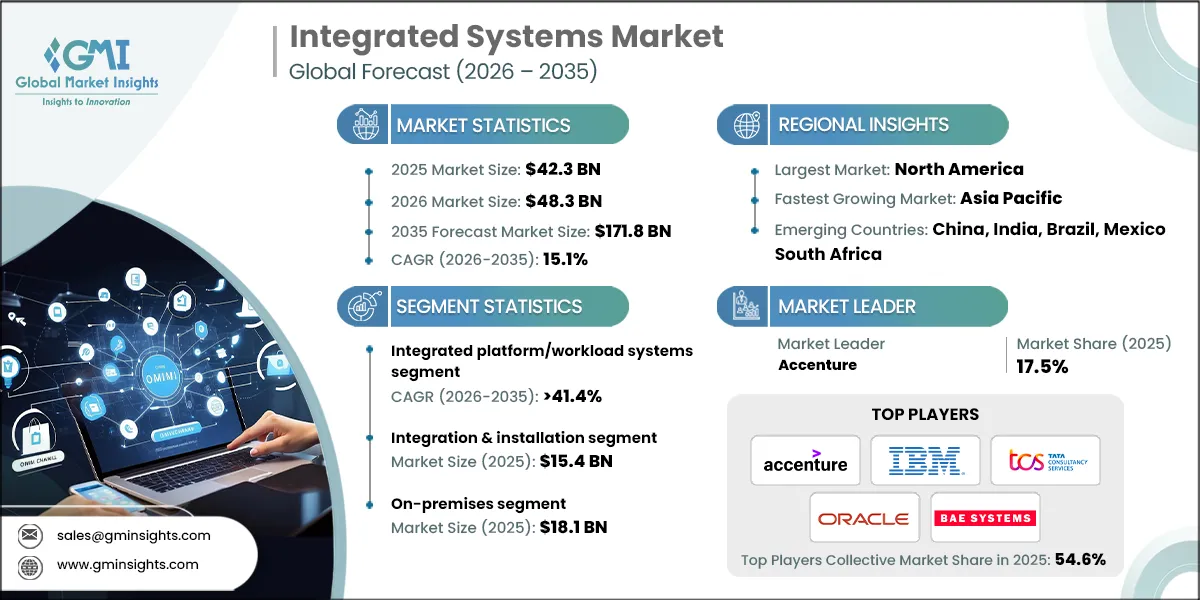
To get key market trends
This growth is driven as integrated solutions are being adopted more frequently throughout numerous industries to drive digital transformation, increase efficiency through automating processes, and provide organizations with the ability to interoperate between systems worldwide, this trend will continue to accelerate.
Integrated systems are allowing companies to support digital transformation by updating their operational infrastructure and process, thus improving productivity and efficiency of operations. As organizations utilize Integrated Systems as a means to integrate their IT, Operational and Data Platforms into one seamless unit, they will gain new efficiencies by allowing faster data access, reducing manual intervention into business processes and providing real-time information to allow for better decision-making throughout all areas and departments of the organization. For instance, in January 2026, Siemens partnered with Nvidia to develop industrial AI operating systems.
The adoption of AI-based Automation and the resultant growth in demand for AI-Integrated Systems will further drive the trend towards adopting integrated system solutions. Organizations utilizing integrated systems will benefit from using automation and predictive maintenance to increase their productivity, while also gaining Intelligent Insights into their operations, allowing them to be more precise and timelier in their responses and decisions to create efficiencies in complex manufacturing operations. For instance, in August 2025, The U.S. National Science Foundation expanded AI infrastructure with new data systems and resources.
Moreover, the cloud- and SaaS-based deployment models are quickly being adopted as the preferred method for delivering integrated systems to organizations, due to their flexibility and ongoing costs to maintain the infrastructure associated with on-premises deployments. Organizations utilizing integrated systems deployed via the cloud is expected to able to centralize their data across their enterprise in near real-time and gain remote access to their data thus providing them with greater capabilities to manage remote locations as their business model continues to grow. For instance, in November 2025, Broadcom partnered with NEC to develop a modern private cloud using VMware Cloud Foundation (VCF).
Between 2022 and 2024, the integrated systems market experienced significant growth, rising from USD 28.1 billion in 2022 to USD 37.1 billion in 2024. A major trend during this period was increased presence of IoT devices in various industry sectors such as manufacturing, energy, transportation, and smart building infrastructure has driven the demand for integrated systems as the means to connect, manage, and analyze the data between multiple, connected devices throughout the supply chain and across the enterprise. For instance, in June 2025, Blynk partnered with milesight to develop IoT products as a low-code IoT software platform for businesses and developers.
Organizations are becoming more reliant on integrated systems due to the fragmentation of various processes across departments and systems within an enterprise. By integrating departmental processes into a single unified platform, integrated systems help minimize inefficiencies by improving coordination and reducing employee downtime, optimizing the use of available resources, as well as reducing operational costs (hence increasing organizational performance. For instance, in September 2025, Elma partnered with TEWS to inaugurate open standards innovation in embedded systems.
As integration of systems becomes increasingly prevalent and facilitates the sharing of information across multiple organizations, there is also an increase in the level of risk associated with cyber threats faced by organizations. Integrated systems incorporate the capability of integrating disparate functions such as monitoring incidents, administering access controls, protecting data, and managing compliance via a single system. The combined capabilities of the components allow for improved detection of cyber threats, greater compliance to existing regulations, and more efficient management of critical infrastructure and systems(IT assets) within the organization. For instance, in April 2025, Exein partnered with integral system to develop IoT Cybersecurity of connected devices in France.
Integrated Systems Market Report Attributes
| Key Takeaway | Details |
|---|---|
| Market Size & Growth | |
| Base Year | 2025 |
| Market Size in 2025 | USD 42.3 Billion |
| Market Size in 2026 | USD 48.3 Billion |
| Forecast Period 2026-2035 CAGR | 15.1% |
| Market Size in 2035 | USD 171.8 Billion |
| Key Market Trends | |
| Drivers | Impact |
| Rise in digital transformation initiatives across industries | Rise in digital transformation initiatives across industries around 35% of market demand. Widespread digital transformation across manufacturing, BFSI, healthcare, and government sectors is driving demand for integrated systems to connect applications, data, and operations into unified, efficient digital environments. |
| Growing adoption of automation, AI, and data analytics | Rise in automation, AI, and advanced analytics adoption 20% to market growth. Growing adoption of automation and AI is fueling demand for integrated systems that link intelligent tools with enterprise platforms, supporting faster decision-making, process automation, and improved operational intelligence. |
| Increase in cloud computing and hybrid IT environments | Increase in cloud computing and hybrid IT environments attained 20% of market growth. Expansion of cloud and hybrid IT models is driving demand for integrated systems that enable seamless connectivity, workload portability, centralized management, and secure data exchange across on-premises and cloud infrastructures. |
| Rising demand for real-time data integration and visibility | Rising demand for real-time data integration and visibility drives about 15% market expansion. Organizations require real-time access to data across systems to improve monitoring, forecasting, and responsiveness, driving adoption of integrated platforms that deliver unified visibility and actionable insights. |
| Growing focus on operational efficiency and cost optimization | Growing focus on operational efficiency and cost optimization contributes approximately 10% of market growth. Enterprises are prioritizing cost optimization and efficiency improvements, boosting demand for integrated systems that reduce system silos, minimize downtime, optimize resource usage, and streamline end-to-end operations. |
| Pitfalls & Challenges | Impact |
| High initial implementation and integration costs | High upfront costs associated with hardware, software, customization, and deployment are hampering adoption of integrated systems, especially among small and medium enterprises. Budget constraints and uncertain return on investment often delay large-scale integration projects despite long-term operational benefits. |
| Complexity of integrating legacy systems | Many organizations rely on legacy IT and operational systems that lack standard interfaces. Integrating these outdated systems with modern platforms is complex, time-consuming, and risky, leading to implementation delays, higher costs, and operational disruptions that limit integrated systems adoption. |
| Opportunities: | Impact |
| Expansion of IoT and connected infrastructure | The rapid expansion of IoT and connected infrastructure presents a lucrative opportunity for the integrated systems market. Organizations require integrated platforms to manage, analyze, and secure data from connected devices, enabling real-time monitoring, predictive maintenance, improved asset utilization, and enhanced operational visibility across industries. |
| Growth in smart manufacturing and Industry 4.0 adoption | Rising adoption of smart manufacturing and Industry 4.0 is creating strong opportunities for integrated systems. Manufacturers are deploying connected machines, automation, and analytics, driving demand for integrated platforms that enable system interoperability, real-time production insights, improved efficiency, and data-driven decision-making. |
| Market Leaders (2025) | |
| Market Leader |
17.5% market share in 2025 |
| Top Players |
Collective market share is 54.6% in 2025 |
| Competitive Edge |
|
| Regional Insights | |
| Largest Market | North America |
| Fastest growing market | Asia Pacific |
| Emerging countries | China, India, Brazil, Mexico, South Africa |
| Future outlook |
|
What are the growth opportunities in this market?
Integrated Systems Market Trends
- As evidenced by current market trends, integrated systems are on the rise due to the increasing demand for a unified, scalable, intelligent platform across all markets of the world. The application of enterprise applications, cloud services, Internet of Things (IoT) devices, and analytics solutions in enabling operational efficiencies, real-time decision-making, and interdepartmental collaboration has led to the creation of huge revenue streams for IT service providers of all types, such as manufacturing, healthcare, banking, finance, security, intelligent infrastructure, and integrated systems providers.
- The integrated systems market has also seen an upsurge in demand for the supply of high-performance, highly reliable integrated systems in today's digital transformation, automation, and sophisticated data management age. Companies that embrace and adopt powerful middleware-based solutions, hybrid integration platforms, and proprietary analytics tools can consolidate their highly complex IT and Operational environments into unified Integrated Systems serving their wide-ranging enterprises by allowing them to achieve increased operational efficiencies and effectiveness, improved agility, and improved resiliency of large enterprises.
- For instance, in 2026, Cloud Works partnered with TechNova Systems launch of the next-generation cloud platform, which integrates Cloud, AI, and IoT Technologies to provide a complete solution for businesses in optimizing their processes, accessing real-time intelligence on data, and expediting their digital transformation initiatives.
- Businesses are utilizing integrated system platforms to meet the demand for real-time data processing, predictive analytics, and automated workflows as the number of cloud platforms and hybrid integration platforms continues to grow. the increasing efficiency of managing more complex business processes, and the acceleration of developing advanced integrated system platforms that provide an easy way to connect and standardise processes globally across different business units and regions, will contribute to further accelerating the utilization of advanced integrated system platforms.
Integrated Systems Market Analysis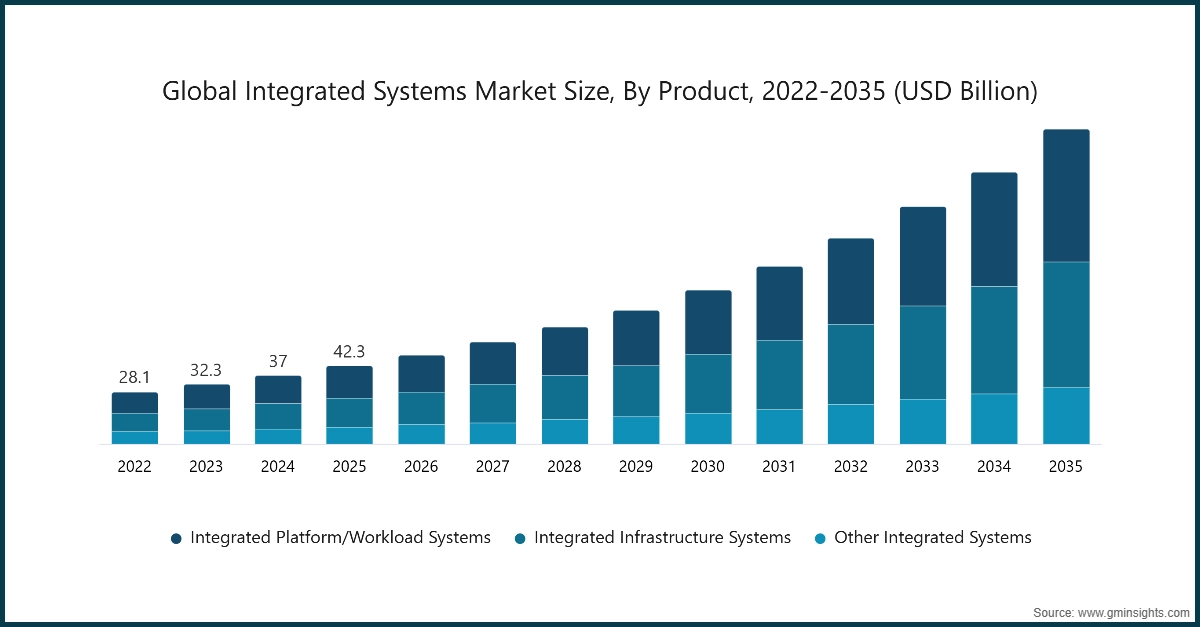 Learn more about the key segments shaping this market
Learn more about the key segments shaping this market
Based on product, the market is segmented into integrated platform/workload systems, integrated infrastructure systems, and other integrated systems. The integrated platform/workload systems segment is estimated to register a significant growth rate of over 41.4% of the market in 2025.
- The integrated platform/workload systems segment holds the largest share in the integrated systems market, driven by increasing adoption of unified platforms that combine computing, storage, and networking capabilities. These systems enable seamless workload management, improved operational efficiency, real-time data processing, and simplified IT infrastructure, supporting digital transformation across multiple industries globally.
- Manufacturers should focus on developing integrated systems that combine computing, storage, and networking capabilities. Emphasizing seamless workload management, real-time data processing, and simplified IT infrastructure will enhance operational efficiency and support digital transformation across industries. Innovation in unified platforms can drive adoption and strengthen competitiveness in the global market.
- The integrated infrastructure systems segment in the integrated systems market is expected to witness significant growth, projected to expand at a CAGR of 16% during the forecast period. This growth is driven by rising adoption of unified platforms that combine computing, storage, and networking capabilities, enabling efficient workload management, real-time data processing, and simplified IT infrastructure. Enterprises across industries are increasingly investing in these systems to enhance operational efficiency, support digital transformation initiatives, and ensure scalability, reliability, and seamless integration of their IT environments globally.
- Manufacturers should focus on developing unified infrastructure systems that integrate computing, storage, and networking. Prioritizing efficient workload management, real-time data processing, and simplified IT environments can help enterprises enhance operational efficiency, support digital transformation, and achieve scalable, reliable, and seamlessly integrated IT infrastructure across industries globally.
Based on services, the integrated systems market is segmented into integration & installation, consulting, maintenance & support, and training. The integration & installation segment dominated the market in 2025 with a revenue of USD 15.4 billion.
- The integration & installation segment holds the largest share of the market, driven by its ability to provide seamless deployment of complex IT infrastructures. It ensures efficient system setup, optimized performance, reduced downtime, and smooth interoperability, enabling enterprises to quickly implement unified solutions and support their digital transformation initiatives.
- Manufacturers should focus on offering robust integration and installation services that enable seamless deployment of complex IT infrastructures. By ensuring efficient setup, optimized performance, minimal downtime, and smooth interoperability, they can help enterprises rapidly implement unified systems, enhance operational efficiency, and effectively support digital transformation across industries globally.
- The consulting segment in the integrated systems market is expected to witness substantial growth, projected to expand at a CAGR of 16.7% and reach USD 52 billion by 2035. This growth is driven by increasing demand for expert guidance in designing, implementing, and optimizing integrated IT solutions. Organizations are seeking consulting services to navigate complex infrastructure requirements, ensure seamless system integration, enhance operational efficiency, adopt advanced technologies, and support digital transformation initiatives, enabling them to achieve scalable, reliable, and future-ready IT environments globally.
- Manufacturers should focus on providing consulting services that guide organizations in designing, implementing, and optimizing integrated IT solutions. By helping enterprises navigate complex infrastructures, ensure seamless integration, adopt advanced technologies, and enhance operational efficiency, they can support digital transformation and enable scalable, reliable, and future-ready IT environments globally.
Learn more about the key segments shaping this market
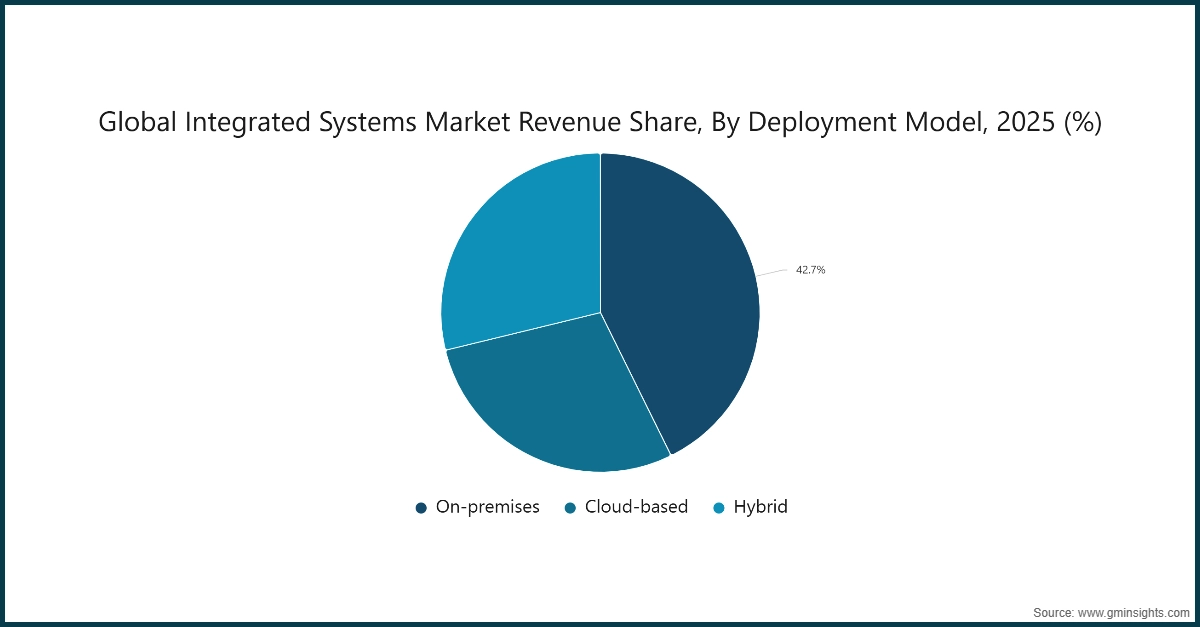
Based on the deployment model, the integrated systems market is segmented into on-premises, cloud-based, and hybrid. The on-premises segment dominated the market in 2025 with a revenue of USD 18.1 billion.
- The on-premises segment holds the largest share of the market, driven by its ability to offer organizations greater control, security, and customization over their IT infrastructure. It enables efficient data management, regulatory compliance, and optimized performance, making it a preferred choice for enterprises seeking reliable and scalable solutions.
- Manufacturers should focus on developing on-premises integrated systems that provide organizations with enhanced control, security, and customization. By enabling efficient data management, regulatory compliance, and optimized performance, they can deliver reliable, scalable solutions that meet enterprise requirements and strengthen adoption of on-premises infrastructure across industries globally.
- The cloud-based segment in the integrated systems market is anticipated to witness significant growth, projected to expand at a CAGR of 16.6% and reach USD 55.3 billion by 2035. Growth is driven by increasing adoption of scalable, flexible, and cost-efficient cloud solutions that enable remote access, real-time data processing, and seamless collaboration. Enterprises are leveraging cloud-based systems to enhance operational efficiency, accelerate digital transformation, reduce IT infrastructure costs, and support innovation, making cloud integration a critical component of modern business strategies globally.
- Manufacturers should focus on developing scalable, flexible, and cost-efficient cloud-based integrated systems. By enabling remote access, real-time data processing, and seamless collaboration, they can help enterprises enhance operational efficiency, reduce IT costs, accelerate digital transformation, and drive innovation, making cloud integration a key component of modern business strategies.
North America Integrated Systems Market
The North America market dominated with a market share of 35.5% in 2025.
- The North American industry is rapidly expanding due to increasing adoption of advanced integrated systems, growing investment in IT infrastructure, and rising demand for digital transformation across enterprises. Technological advancements, robust cloud and on-premises solutions, and the presence of key market players are further driving growth in the region.
- Manufacturers should focus on delivering advanced integrated systems and robust IT infrastructure solutions in North America. By supporting digital transformation, leveraging cloud and on-premises technologies, and adopting innovative solutions, they can meet growing enterprise demand, capitalize on technological advancements, and strengthen their presence in this rapidly expanding regional market.
Looking for region specific data?
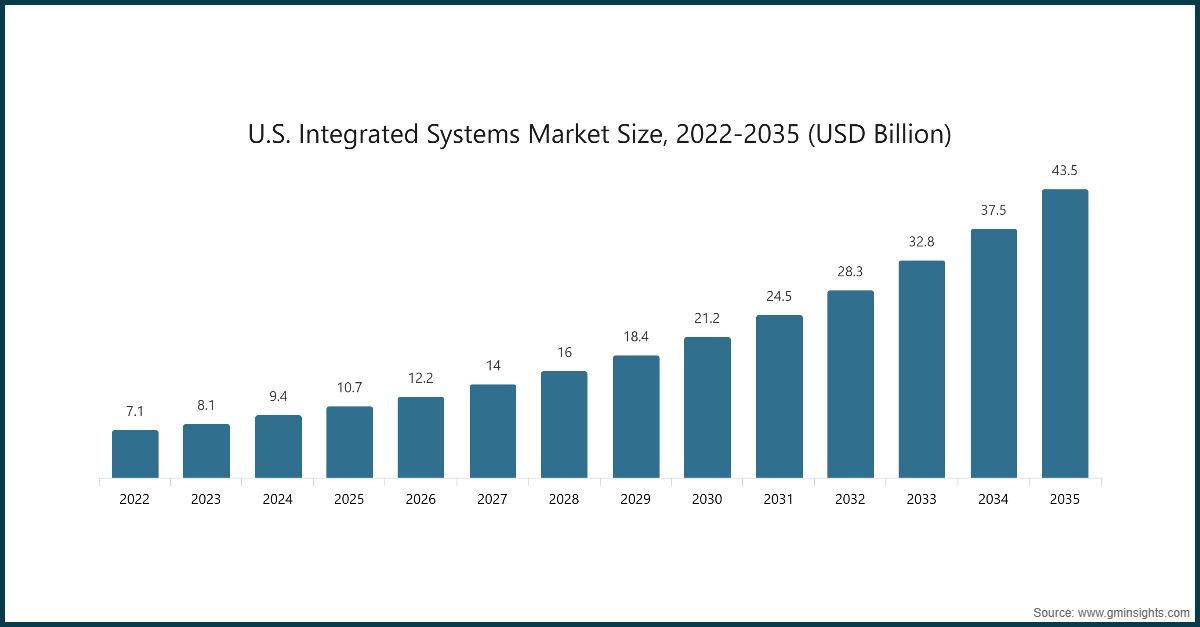
The U.S. integrated systems market was valued at USD 7.1 billion in 2022 and USD 8.1 billion in 2023, reaching USD 10.7 billion in 2025, up from USD 9.4 billion in 2024.
- The U.S. continues to dominate the market, fueled by strong investments in IT infrastructure, widespread adoption of advanced cloud and on-premises solutions, and a high demand for digital transformation across industries. Technological innovation and the presence of leading market players further strengthen its market leadership.
- Manufacturers should focus on providing advanced cloud and on premises integrated systems in the U.S., supporting digital transformation and efficient IT infrastructure. By leveraging technological innovation and collaborating with leading market players, they can meet growing enterprise demand, enhance system performance, and strengthen their position in the country’s dominant market.
Europe Integrated Systems Market
The Europe market accounted for USD 12.0 billion in 2025 and is anticipated to witness strong growth over the forecast period.
- Europe holds a significant share of the integrated systems market, driven by increasing adoption of advanced IT infrastructure, rising digital transformation initiatives across industries, and strong investment in cloud and on-premises solutions. Supportive government policies, technological innovation, and presence of key market players further contribute to the region’s robust market growth.
- Manufacturers should focus on delivering advanced cloud and on premises integrated systems in Europe. By supporting digital transformation, leveraging technological innovations, and aligning with government initiatives, they can help enterprises optimize IT infrastructure, enhance operational efficiency, and strengthen their presence in this region, which holds a significant market share.
Germany dominates the Europe integrated systems market, showcasing strong growth potential.
- Germany holds a substantial share in the market, driven by strong industrial sectors, high demand for advanced IT infrastructure, cloud and on-premises solutions, and investments in digital transformation initiatives. The country’s focus on technological innovation and industrial automation further strengthens its contribution to Europe’s market growth.
- Manufacturers should focus on developing robust, scalable integrated systems for Germany, targeting cloud, on-premises, and hybrid IT solutions. Collaborating with local enterprises, technology providers, and research institutions can enhance innovation, ensure compliance with regional standards, and strengthen market presence across industrial, commercial, and government sectors.
Asia-Pacific Integrated Systems Market
The Asia-Pacific market is expected to grow at the highest CAGR of 17.3% during the analysis period.
- The Asia-Pacific market is witnessing rapid growth, driven by increasing adoption of advanced IT infrastructure, rising digital transformation initiatives, and growing investments in cloud and on-premises solutions. Strong industrial expansion, technological innovation, and supportive government policies further accelerate market development across key countries in the region.
- Manufacturers should focus on providing advanced cloud, on-premises, and hybrid integrated systems in the Asia-Pacific region. By supporting digital transformation, leveraging technological innovations, and aligning with industrial expansion and government initiatives, they can help enterprises optimize IT infrastructure, enhance efficiency, and capture growth opportunities in this rapidly expanding market.
The China integrated systems market is estimated to grow at a significant CAGR of 16.7% from 2026 to 2035.
- China leads the market, driven by rapid adoption of advanced IT infrastructure, growing investments in cloud, on-premises, and hybrid solutions, and expansion of digital transformation initiatives across industries. Government support, technological innovation, and increasing automation further strengthen China’s market leadership in the region.
- Manufacturers should focus on developing robust, scalable integrated systems for cloud, on-premises, and hybrid IT solutions. Leveraging government initiatives, technological advancements, and automation can help strengthen market presence, optimize enterprise IT infrastructure, and meet growing demand across commercial, industrial, and government sectors in China.
Latin America Integrated Systems Market
The Latin America market, valued at USD 12.0 billion in 2025, is driven by growing digital transformation initiatives, increasing adoption of cloud and on-premises solutions, and rising investment in IT infrastructure.
Middle East and Africa Integrated Systems Market
The Middle East and Africa market, projected to reach USD 9.1 billion by 2035, is driven by increasing adoption of advanced IT infrastructure, digital transformation initiatives, cloud solutions, and government-supported technological advancements.
In Saudi Arabia, the market is set to experience substantial growth in 2025.
- Saudi Arabia is emerging as a key growth hub for the integrated systems market, driven by increasing investments in IT infrastructure, adoption of advanced cloud and on-premises solutions, digital transformation initiatives, and expansion of industrial automation across commercial and government sectors.
- Manufacturers should focus on developing robust, scalable integrated systems for Saudi Arabia. Leveraging partnerships with local enterprises, technology providers, and research institutions, while targeting commercial, industrial, and government applications, will strengthen market presence, enhance adoption, and drive growth in this rapidly expanding regional market.
Integrated Systems Market Share
The competitive landscape of the market is witnessing significant growth, fueled by rising demand for advanced IT infrastructure, cloud, on-premises, and hybrid solutions across commercial, industrial, and government sectors. Major players, including Accenture, IBM Corporation, Tata Consultancy Services Limited, Oracle Corporation, and BAE Systems, collectively hold a 54.6% market share, driving innovation through collaborations with enterprises, technology providers, and research institutions. These partnerships enhance system performance, reliability, and versatility across multiple applications.
Emerging startups and niche providers are introducing high-performance, scalable, and energy-efficient integrated systems for mission-critical enterprise applications. Leveraging technological advancements, R&D, and strategic collaborations, these innovations improve operational efficiency, security, and adoption of advanced IT solutions globally.
Integrated Systems Market Companies
Some of the prominent market participants operating in the market include:
- Accenture
- IBM Corporation
- Tata Consultancy Services Limited
- Oracle Corporation
- BAE Systems
- Wipro Limited
- Cognizant
- Deloitte Touche Tohmatsu Limited
- Infosys Limited
- MDS Systems Integration (MDS SI)
- HCL Technologies
- Capgemini
- Atos SE
- Fujitsu Limited
- Cisco Systems, Inc.
- Hewlett Packard Enterprise (HPE)
- SAP SE
- NEC Corporation
- Siemens AG
- CGI Inc.
- DXC Technology
- Tech Mahindra
- Hitachi Ltd.(Vantara)
Accenture is a leading player in the market, holding an estimated market share of 17.5%. The company provides high-performance, reliable integrated IT solutions, including cloud, on-premises, and hybrid systems, supported by strong R&D and a broad portfolio that strengthens its competitive position across commercial, industrial, and government sectors.
IBM Corporation holds a significant share of 13.2% in the market, offering advanced integrated systems solutions for enterprise IT, cloud, and hybrid deployments, supported by technological innovation, strong R&D, and a wide range of scalable offerings for diverse industry applications.
Tata Consultancy Services Limited
Tata Consultancy Services Limited plays a crucial role in the integrated systems market by delivering reliable cloud, on-premises, and hybrid IT solutions for commercial, industrial, and government enterprises, supported by robust R&D, global presence, and expertise in implementing scalable, high-performance integrated systems.
Integrated Systems Industry News
- In January 2026, Oracle Corporation expanded its cloud and AI infrastructure offerings focusing on integrated suites that support enterprise cloud transformation and AI workloads, with frequent product updates and sector‑specific deployments.
- In February 2025, Cisco Systems, Inc. partnered with Hitachi Vantara to develop infrastructure solution integrating Cisco compute and networking with Hitachi’s storage platforms and Red Hat OpenShift for modern enterprise application deployment. This collaboration bolsters hybrid and integrated IT solutions adoption.
- In August 2022, Accenture, Deloitte, partnered with Tata Consultancy Services were recognized for high scores in cloud IT transformation and system modernization capabilities, reflecting leadership in delivering complex integrated solutions and managed services.
- In January 2025, HCLTech acquired HPE’s Telco Solutions unit, enhancing its engineering, AI, and cloud‑native offerings for telecom and enterprise clients a strategic move that can expand its integrated systems services footprint.
- In February 2024, Wipro and IBM have expanded their partnership to offer new AI-driven services, providing clients with advanced solutions that enhance automation, analytics, and operational efficiency across industries.
The integrated systems market research report includes in-depth coverage of the industry, with estimates & forecast in terms of revenue (USD billion) from 2022 to 2035, for the following segments:
Market, By Product
- Integrated Platform/Workload Systems
- Integrated Infrastructure Systems
- Other Integrated Systems
Market, By Service
- Integration & Installation
- Consulting
- Maintenance & Support
- Training
Market, By Deployment Model
- On-premises
- Cloud-based
- Hybrid
Market, By End Use
- Automotive
- Aerospace and Defense
- IT and Telecom
- BFSI
- Healthcare
- Oil and Gas
- Energy
- Manufacturing
- Retail
- Others
The above information is provided for the following regions and countries:
- North America
- U.S.
- Canada
- Europe
- Germany
- UK
- France
- Italy
- Spain
- Netherlands
- Rest of Europe
- Asia-Pacific
- China
- Japan
- India
- South Korea
- Australia
- Rest of Asia-Pacific
- Latin America
- Brazil
- Mexico
- Argentina
- Rest of Latin America
- MEA
- Saudi Arabia
- UAE
- South Africa
- Rest of MEA
Frequently Asked Question(FAQ) :
What was the revenue of the integration & installation services segment in 2025?
The integration & installation services segment dominated the market in 2025, generating a revenue of USD 15.4 billion.
What was the market share of the integrated platform/workload systems segment in 2025?
The integrated platform/workload systems segment accounted for over 41.4% of the market in 2025, reflecting its significant growth potential.
What is the projected size of the integrated systems market in 2026?
The market is expected to grow to USD 48.3 billion in 2026.
What was the market size of the integrated systems market in 2025?
The market size was USD 42.3 billion in 2025, driven by the increasing demand for unified, scalable, and intelligent platforms across various industries.
What is the projected value of the integrated systems industry by 2035?
The market is expected to reach USD 171.8 billion by 2035, growing at a CAGR of 15.1% during the forecast period of 2026–2035.
Which region led the integrated systems market in 2025?
North America was the largest market in 2025, holding a 35.5% market share, driven by strong technological adoption and industrial infrastructure.
What are the upcoming trends in the integrated systems industry?
Key trends include the adoption of middleware-based solutions, hybrid integration platforms, proprietary analytics tools, and the increasing demand for high-performance, reliable integrated systems to enhance operational efficiency and agility.
Who are the key players in the integrated systems market?
Major players include Accenture, IBM Corporation, Tata Consultancy Services Limited, Oracle Corporation, BAE Systems, Wipro Limited, Cognizant, Deloitte Touche Tohmatsu Limited, Infosys Limited, MDS Systems Integration (MDS SI), HCL Technologies, and Capgemini.
Integrated Systems Market Scope
Related Reports