Summary
Table of Content

Crystal Oscillator Market
Get a free sample of this report
Form submitted successfully!
Error submitting form. Please try again.
Thank you!
Your inquiry has been received. Our team will reach out to you with the required details via email. To ensure that you don't miss their response, kindly remember to check your spam folder as well!
Request Sectional Data
Thank you!
Your inquiry has been received. Our team will reach out to you with the required details via email. To ensure that you don't miss their response, kindly remember to check your spam folder as well!
Form submitted successfully!
Error submitting form. Please try again.
Crystal Oscillator Market Size
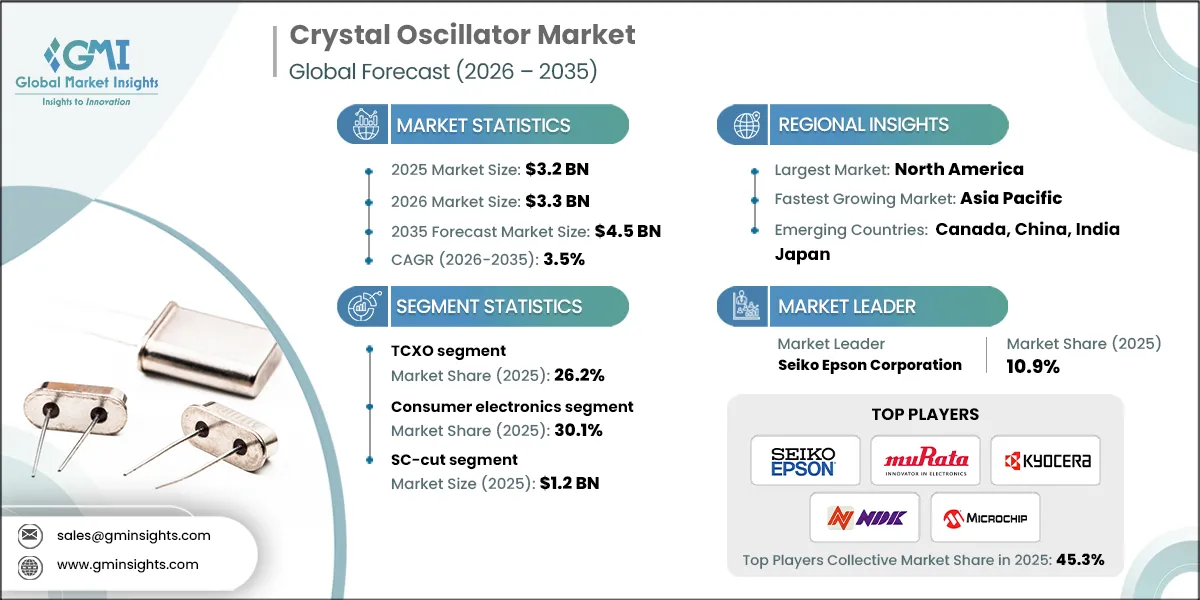
The global crystal oscillator market was valued at USD 3.2 billion in 2025. The market is expected to grow from USD 3.3 billion in 2026 to USD 3.8 billion in 2031 & USD 4.5 billion in 2035, at a CAGR of 3.5% during the forecast period according to the latest report published by Global Market Insights Inc.
To get key market trends
The growth of the crystal oscillator market is attributed to a higher demand for high-frequency stability in RF circuits, more TCXO and OCXO usage in telecom equipment, and a broader application of temperature-stable oscillators in automotive ECUs. The need for low phase-noise oscillators in network equipment and accurate clock synchronization in base stations is also driving market growth.
The crystal oscillator market is driven by the expanding use of temperature‑stable crystal oscillators in automotive ECUs as vehicles integrate more electronic systems for ADAS, infotainment, and powertrain control. The U.S. Bureau of Transportation Statistics reports that in the year 2023, Americans drove a total of 3.26 trillion vehicle miles. This shows that there is a high usage of vehicles with electronic control systems. The high usage of vehicles as depicted by the statistics illustrates the demand for reliable and temperature-stable oscillators in the ECUs to ensure consistent performance, safety, and long-term reliability in various operating conditions.
The market is further fueled by the rising consumption of TCXO and OCXO in telecommunication equipment due to the need for frequency accuracy and temperature correction in telecommunication systems for synchronization. According to the European 5G Observatory (European Commission), 51 % of the global population is now covered by 5G networks, reflecting rapid ongoing wave of next‑generation mobile infrastructure deployment. This widespread 5G rollout heightens demand for stable, precision timing solutions like TCXO/OCXO, strengthening demand for advanced crystal oscillators in telecom systems.
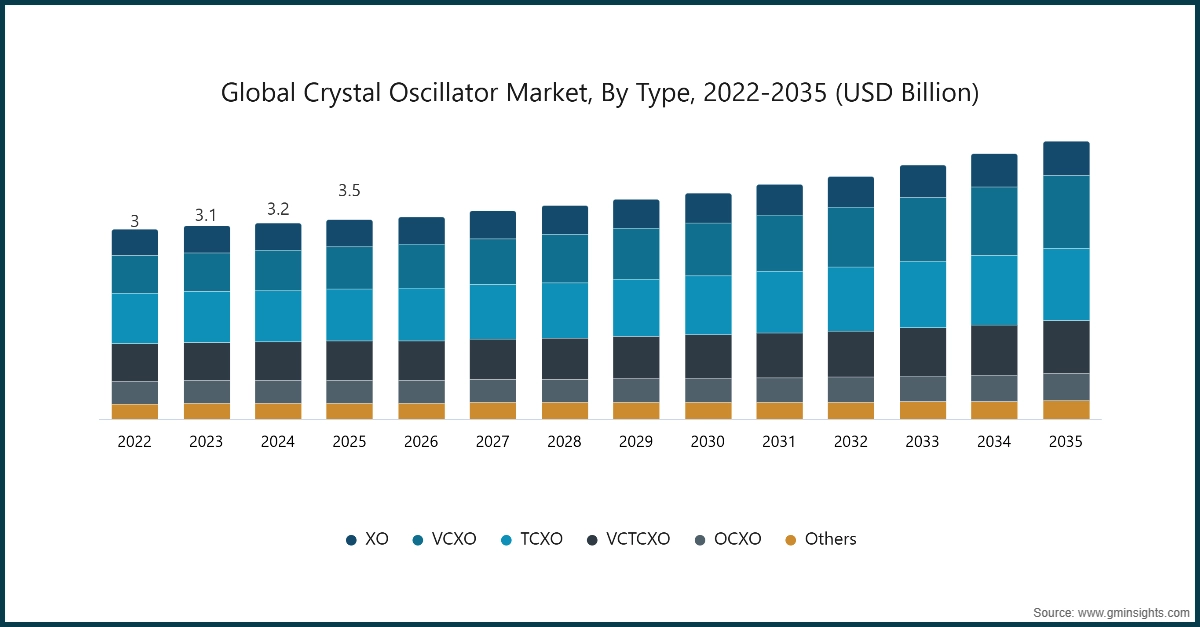
Between 2022 and 2024, the market witnessed considerable growth, increasing from USD 3.1 billion in 2022 to USD 3.2 billion in 2024. The gradual rise reflects steady adoption in telecom, automotive, and industrial applications, where precise timing and frequency control are essential but deployment cycles are long. Upgrades in base stations, automotive ECU units, and IoT-enabled devices played an incremental role in supporting demand. Advances in energy-efficient and small oscillators promoted cautious market development during this phase
Crystal Oscillator Market Report Attributes
| Key Takeaway | Details |
|---|---|
| Market Size & Growth | |
| Base Year | 2025 |
| Market Size in 2025 | USD 3.2 Billion |
| Market Size in 2026 | USD 3.3 Billion |
| Forecast Period 2026-2035 CAGR | 3.5% |
| Market Size in 2035 | USD 4.5 Billion |
| Key Market Trends | |
| Drivers | Impact |
| Demand for high-frequency stability in RF circuits | Drives 21% growth as wireless communication, radar, and RF front-end modules require precise and consistent signal generation to minimize interference and signal degradation. |
| TCXO and OCXO adoption in telecom equipment | Supports 24% growth because tight frequency tolerance and temperature compensation are critical for maintaining network reliability and meeting stringent telecom standards. |
| Automotive ECUs requiring temperature-stable oscillators | Contributes 20% growth by ensuring reliable performance of ADAS, powertrain, and in-vehicle networking systems under wide operating conditions. |
| Network equipment demand for low phase-noise oscillators | Adds 17% growth by enabling higher data throughput, improved signal clarity, and reduced timing errors in routers, switches, and transmission systems. |
| Clock synchronization needs in base stations | Accounts for 18% growth as accurate timing is essential for network coordination, spectrum efficiency, and seamless handovers in 4G and 5G networks. |
| Pitfalls & Challenges | Impact |
| Miniaturization impacting frequency stability performance | Restrains market growth as shrinking crystal packages increases sensitivity to temperature variations, mechanical stress, and aging effects, requiring advanced packaging, tighter manufacturing tolerances, and higher-quality materials, which raise production complexity and costs. |
| Competition from MEMS-based timing solutions | Limits growth because MEMS oscillators offer advantages in shock resistance, programmability, and integration with ICs, leading OEMs in cost-sensitive and space-constrained applications to evaluate alternatives, slowing crystal oscillator adoption in select end-use segments. |
| Opportunities: | Impact |
| Growing low-power oscillator demand in IoT | Presents strong growth potential since devices like battery-operated sensors, smart meters, and connected wearables require ultra-low power consumption and stable timing, driving adoption of optimized crystal oscillators to extend device lifespan and enable reliable wireless communication. |
| High-reliability oscillators for aerospace navigation systems | Offers high-value opportunity through increasing demand for avionics, satellite communication, and navigation platforms that require extreme frequency accuracy, long-term stability, and resistance to harsh environmental conditions, supporting premium pricing and long lifecycle demand for specialized crystal oscillator solutions. |
| Market Leaders (2025) | |
| Market Leader |
10.9% Market Share |
| Top Players |
Collective Market Share in 2025 is 45.3% |
| Competitive Edge |
|
| Regional Insights | |
| Largest Market | North America |
| Fastest growing market | Asia Pacific |
| Emerging countries | Canada, China, India, Japan |
| Future outlook |
|
What are the growth opportunities in this market?
Crystal Oscillator Market Trends
- Ultra-miniaturized crystal oscillator packaging technology is allowing for thinner and lighter electronic products to be developed. This technology started to take hold around 2021, as companies sought ways to incorporate smaller items into their offerings. This technology may continue to evolve until 2030, as there is a drive for smaller electronic products to be available. This will lead to increased demand for better packaging and manufacturing capability.
- The demand for automotive-grade crystal oscillators is influencing the requirements of time components for safety-critical systems. It started gaining pace in 2020 based on the increasing demand for ECUs and car electrification solutions and will continue in the coming years as autonomous driving solutions spread in the automotive industry beyond 2030. This will increase the demand for AEC-Q200 compliance, long lifecycle support, and temperature-stable oscillator solutions.
- The trend of replacing discrete crystals with oscillator modules is leading to improved design complexity and timing integrity. The replacement started in around 2019 because of increasing complexity in systems, including requirements in terms of accurate clocks. The trend is expected to spread through 2028 because of the fast time-to-market requirement. This will favor suppliers offering integrated, low-jitter, factory-calibrated oscillator solutions.
Crystal Oscillator Market Analysis
Learn more about the key segments shaping this market
The market size reached USD 3.2 billion in 2025, growing from USD 3.2 billion in 2024.
Based on the type, the global crystal oscillator market is divided into XO (clock oscillators), VCXO (voltage controlled crystal oscillators), TCXO (temperature compensated crystal oscillators), VCTCXO (voltage controlled temperature compensated crystal oscillators), OCXO (oven controlled crystal oscillators), and others.
- The TCXO segment accounted for 26.2% of the market share in 2025. TCXOs dominate the crystal oscillator market due to their ability to maintain a fixed frequency, which is independent of temperature variations. They are highly essential for telecom communication, RF modules, and other electronic applications requiring high accuracy. They support applications in 4G/5G communication, industrial automation, and automotive ECUs due to their high reliability and ability to work in long-term applications.
- The VCXO segment is anticipated to grow at a CAGR of 5.8% over the forecast period. The increased demand for tunable frequency control in networking, communication, and RF applications propels the growth of the industry. VCXOs offer precise, adjustable frequency outputs that helps system designers to meet changing synchronization needs, improve signal performance, and incorporate flexible timing solutions in new technologies like IoT and high-speed data links.
Learn more about the key segments shaping this market
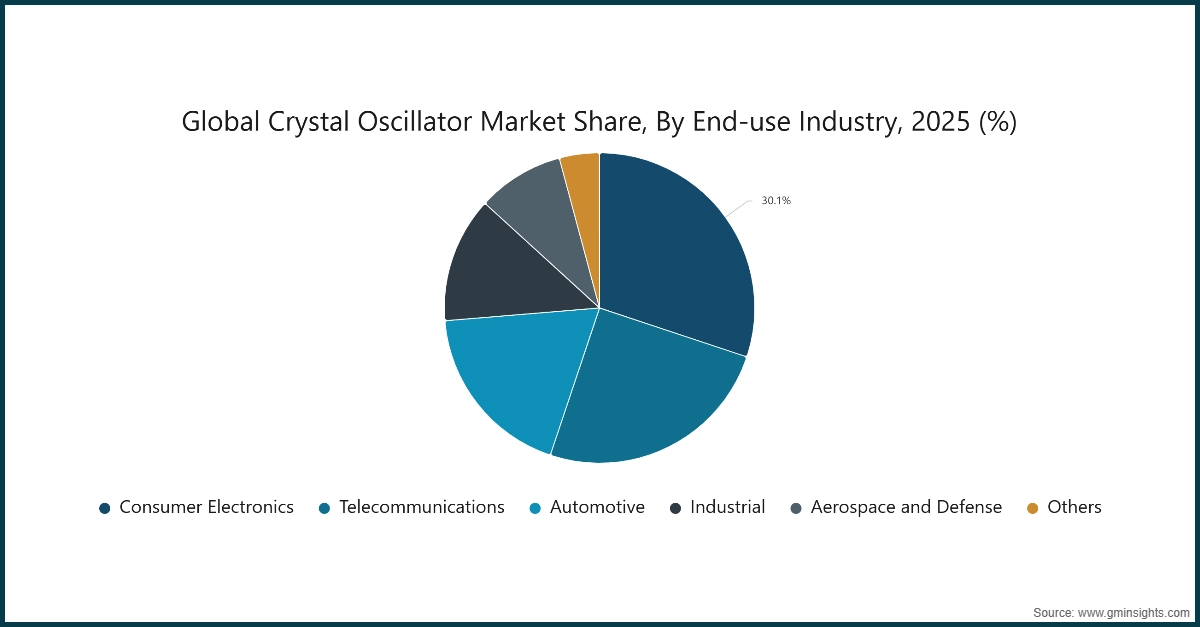
Based on the end-use industry, the global crystal oscillator market is divided into consumer electronics, telecommunications, automotive, industrial, aerospace and defense, and others.
- The consumer electronics segment led the market in 2025 with a revenue share of 30.1% as crystal oscillators find extensive applications in the manufacture of smartphones, laptops, wearable electronics, and other consumer electronics. The importance of precise time measurement, small size, and reliability in maintaining signal integrity in crystals makes this segment the leading contributor to the market.
- The automotive segment is expected to register at a CAGR of 4.1% during the forecast period because automotive applications are increasingly incorporating advanced electronic control units (ECUs), automotive driver assistance systems (ADAS) modules, and automotive infotainment modules. A temperature-stable and highly reliable oscillator plays a pivotal role within the automotive industry for safety features, automotive connectivity solutions, and autonomous vehicles. The rising demand for electric and connected vehicles, along with stricter automotive safety standards, is driving the quick adoption of crystal oscillators in this segment.
Based on the cut, the global crystal oscillator market is divided into AT, BT, SC, CT, and others.
- The SC-cut segment dominated the market in 2025 and valued at USD 1.2 billion because of its use in applications requiring high accuracy for frequency control. SC-cut crystal oscillators have a stable temperature performance and a long term reliability. Such oscillators are therefore essential for use in networking applications, industry, and automobile ECUs. Their stability and functionality for high-end applications ensure a steady demand for crystal oscillators in various applications.
- The AT-cut segment is expected to witness growth at a CAGR of 4.8% during the forecast period due to the increasing application of the AT-cut device in smaller low-power designs that are cost-effective. The AT-cut oscillators are commonly used in consumer products, IoT, and wireless communication devices. For these applications, frequency stability does not require high accuracy, making the device easy to manufacture and miniaturize.
Looking for region specific data?
North America Crystal Oscillator Market
The North America held a market share of 35.2% of crystal oscillator market in 2025.
- In North America, the crystal oscillator market is growing steadily mainly driven by the demand for precise timing functions in telecommunication, industrial automation, and automobile electronics. The North American region is witnessing an increasing trend towards TCXO, VCXO, and OCXO technologies for 5G, IoT, and connected vehicles. This shift is driven by the need for stable frequency, low phase noise, and synchronized system operations.
- Government and investment-grade funding in telecommunication infrastructure, smart grids, and auto electronics is providing stimulus to the industry. Applications in industry segments, automobiles, and communications are estimated to drive the market in this region through 2035. Ongoing upgrades to 5G networks, autonomous vehicles, and connected industrial systems will contribute to this expansion.
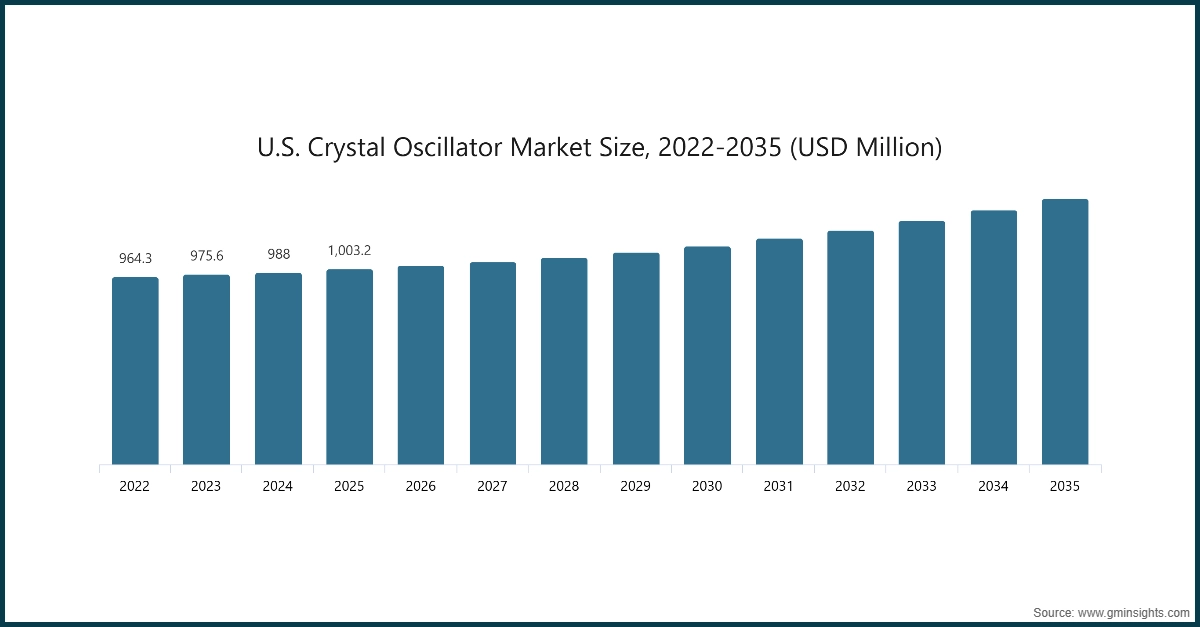
The U.S. crystal oscillator market was valued at USD 964.3 million and USD 975.6 million in 2022 and 2023, respectively. The market size reached USD 1 billion in 2025, growing from USD 988 million in 2024.
- The US crystal oscillator market is fueled by the ever-growing usage of 5G networks and equipment requiring highly accurate timing functions. According to the Federal Communications Commission (FCC), a minimum of 97% of the US population had access to at least one 5G provider offering a minimum speed capability in an outdoor environment by the end of December 2023. The extensive development of 5G networks enhances the usage requirements for high-stability and low phase-noise crystal oscillators in base stations, telecom equipment, and consumer devices.
- Along with investments in the development of 5G and IoT connectivity, growing adoption of precision timing solutions in industrial automation, autos ECU solutions, as well as networking synchronization is making the U.S. a prominent market within North America. The heavy reliance on both 5G networks and IoT technology necessitates advanced oscillators to provide precise frequency control.
Europe Crystal Oscillator Market
Europe crystal oscillator market accounted for USD 711.7 million in 2025 and is anticipated to show lucrative growth over the forecast period.
- Europe’s crystal oscillator market is expanding Industry 4.0 and digital manufacturing driven by digital transformation and automation in key manufacturing hubs such as Germany, France, the Netherlands, and the UK. This modernization increases utilization of connected systems and precision oscillators for real‑time control and synchronization across smart factories.
- Regions such as Germany, UK, France, Italy, and Spain are expanding the adoption of high-performance oscillators in precision electronics and connection systems. The German automobile sector and the industrial automation sector in the country are the key adopters of high-performance oscillators, and the overall investments of the EU in digital transformation are fueling the demand for timing and synchronization in the region.
UK dominates the Europe crystal oscillator market, showcasing strong growth potential.
- The United Kingdom is identified as a prominent market in the European region because of the growing acceptance of crystal oscillators in telecommunications, industrial automation, and the automobile industry. This is attributed to the implementation of 5G networks in the UK, as well as smart grids and smart transportation systems. In such systems, high accuracy and low phase noise are required in TCXO, VCXO, and OCXO.
- Demand is further increased by government initiatives that support digital infrastructure, Industry 4.0 adoption, and automotive electrification. The integration of IoT-enabled industrial systems, network synchronization, and autonomous vehicle technologies creates opportunities for high-stability oscillators, positioning the UK as one of Europe’s leading adopters of advanced timing solutions
Asia Pacific Crystal Oscillator Market
The Asia Pacific crystal oscillator market is anticipated to grow at the highest CAGR of 4.5% during the forecast period.
- The Asia Pacific crystal oscillator market is growing because of its applications in highly complex systems in industries such as automation, aerospace, and the defense sector. Crystal oscillators of high precision have emerged as essential components in robotics and smart factories. Reliable timing and low jitter have become core aspects in terms of operational effectiveness and operational safety for such applications.
- The regional government is encouraging technological independence in semiconductor components like oscillators. Countries such as China, Japan, and South Korea are emphasizing scientific research in timing solutions of space, railway, and medical applications. The shift to more advanced applications ensures sustained market growth and establish APAC as a center for high-performance oscillator development.
China crystal oscillator market is estimated to grow with a significant CAGR, in the Asia Pacific market.
- The crystal oscillator industry in China has been propelled by the rapid modernization of railway systems, satellite guides, and intelligent power grids. High-performance oscillators play an essential role in safe and real-time control activities. With the growing digital control systems in the railway and power industries, there exists a massive demand for rugged and reliable oscillators that can function effectively in challenging environments.
- Strong domestic manufacturing policies and investments in semiconductor components are boosting local adoption of high-performance oscillators. Government support in developing domestic components and the growing demand for timing solutions in medical diagnostic and test instruments are giving China recognition as a prominent force in the demand for crystal oscillators in the Asia-Pacific market.
Middle East and Africa Crystal Oscillator Market
Saudi Arabia crystal oscillator market to experience substantial growth in the Middle East and Africa crystal oscillator market.
- Saudi Arabia’s crystal oscillator market is being shaped by strong government initiatives to build a local semiconductor and electronics ecosystem under Vision 2030. The kingdom has established the National Semiconductor Hub with approximately USD 266 million investment support and plan is establish 50 semiconductor design companies. The purpose of this move is to promote innovation in chips and timing devices in the country rather than importing them.
- The increase in the installation of 5G technology and digital transformation initiatives has driven the demand for high-accuracy oscillators in the telecom and networking industry. The Saudi government committed USD 15 billion toward 5G network deployment, targeting extensive urban coverage and enabling advanced IoT, industrial connectivity, and smart infrastructure adoption that relies on accurate timing components.
Crystal Oscillator Market Share
The crystal oscillator market is led by players such as Seiko Epson Corporation, Murata Manufacturing Co., Ltd., Kyocera Corporation, Nihon Dempa Kogyo (NDK), and Microchip Technology Inc. These five companies cumulatively accounted for 45.3% market share in 2025 indicating their dominance as well as their presence in sectors like telecommunication, consumer electronics, automotive, and industrial segments. Their diversified product offerings, capabilities, and geographical reach enable them to cater to different markets with high performance, low noise, and stable temperature oscillators.
These companies maintain themselves in the competition by constantly investing in research and development in frequency control, as well as in the development of smaller energy-efficient designs. Their integration with telecom networks, automotive ECUs, and IoT devices, along with meeting industry standards, strengthens their market position. Additionally, the developments in TCXO, OCXO, and VCXO further help these companies to cater to the increasing demand in high precision applications.
Crystal Oscillator Market Companies
Prominent players operating in the crystal oscillator market are as mentioned below:
- Abracon LLC
- Bliley Technologies, Inc.
- CTS Corporation
- Daishinku Corp.
- Greenray Industries Inc.
- Hosonic Electronic Co. Ltd
- IQD Frequency Products
- Kyocera Corporation
- Mercury Inc.
- Microchip Technology Inc.
- Murata Manufacturing Co. Ltd
- NEL Frequency Controls Inc.
- Nihon Dempa Kogyo (NDK) Co. Ltd
- Rakon Ltd
- River Electec Corporation
- Seiko Epson Corporation
- SiTime Corporation
- Siward Crystal Technology Co. Ltd
- TXC Corporation
- Seiko Epson Corporation
Seiko Epson develops and specializes in its own technologies that employ micro-electro-mechanical systems (MEMS) and miniaturization to enable oscillators that consume less and produce more stable clocks for portable applications and other industries.
- Murata Manufacturing Co., Ltd.
Murata has a broad range of products for TCXO, VCXO and OCXO applications. It is well known for its small-size solutions and high-frequency stability and is committed to energy-saving solutions for IoT, 5G communication infrastructures, and automotive ECUs.
- Kyocera Corporation
Kyocera focuses on designing high-reliability crystal oscillators for industrial, aerospace, and automotive applications. Its product line includes TCXO, OCXO, and VCTCXO solutions with excellent temperature stability, low phase noise, and long-lasting durability.
- Nihon Dempa Kogyo (NDK)
NDK offers high-performance XO, TCXO, and OCXO products that find application in telecommunications and industrial automation as well as consumer electronics. NDK emphasizes its strong R&D and provides resistant, low jitter, and stable oscillators.
- Microchip Technology Inc.
Microchip Technology offers several products within its timing solutions line, which include crystal oscillators, MEMS oscillators, and programmable clock oscillators. These solutions stretch into industrial, automotive, and consumer markets.
Crystal Oscillator Industry News
- In August 2025, Seiko Epson Corporation launched a new line of ultra-miniature crystal oscillators with the frequency stability of ±10 ppm. The new series is intended for 5G mobile phones and IoT applications offering better timing accuracy and lower power consumption. It will also benefit the next generation of mobile phones and IoT applications. The innovation strengthens Epson’s positioning in high‑growth portable electronics and telecom applications.
- In June 2025, Murata Manufacturing Co., Ltd. added new temperature-resistant crystal oscillators for automotive applications, which operate within the range of −40° C to 125° C. These crystal oscillators are designed for electric vehicles as well as advanced driver assistant systems and demonstrate excellent performance in challenging environments. This launch supports increasing demand for reliable automotive timing solutions.
- In May 2025, Nihon Dempa Kogyo (NDK) developed the world’s smallest class high‑precision OCXOs named “NH7050XA” and “NH9070XB”. These are designed for 5G base stations and data centers, with the ability to operate at temperatures up to +105 °C while maintaining low phase noise and a compact size. This launch supports the growth of 5G infrastructure and high-speed network equipment.
The crystal oscillator market research report includes in-depth coverage of the industry with estimates and forecast in terms of revenue (USD Million) from 2022 – 2035 for the following segments:
Market, By Type
- Clock oscillators (XO)
- Voltage controlled crystal oscillator (VCXO)
- Temperature compensated crystal oscillator (TCXO)
- Voltage controlled temperature compensated crystal oscillator (VCTCXO)
- Oven controlled crystal oscillator (OCXO)
- Others
Market, By Cut
- AT
- BT
- SC
- CT
- Others (IT, GT, XY)
Market, By Frequency
- Low
- Medium
- High
Market, By End-use Industry
- Consumer Electronics
- Telecommunications
- Automotive
- Industrial
- Aerospace and Defense
- Others
The above information is provided for the following regions and countries:
- North America
- U.S.
- Canada
- Europe
- Germany
- UK
- France
- Russia
- Italy
- Asia Pacific
- China
- India
- Japan
- Australia
- Latin America
- Brazil
- Mexico
- Argentina
- Middle East and Africa
- South Africa
- Saudi Arabia
- UAE
Frequently Asked Question(FAQ) :
Who are the key players in the crystal oscillator market?
Key players include Seiko Epson Corporation, Murata Manufacturing Co., Ltd., Kyocera Corporation, Nihon Dempa Kogyo (NDK), Microchip Technology Inc., Abracon LLC, Bliley Technologies Inc., CTS Corporation, Daishinku Corp., Greenray Industries Inc., and SiTime Corporation.
What is the growth outlook for the VCXO segment from 2026 to 2035?
VCXO (voltage controlled crystal oscillator) is anticipated to grow at a CAGR of 5.8% through 2035, driven by increased demand for tunable frequency control in networking, communication, and RF applications.
Which region leads the crystal oscillator market?
North America held 35.2% share in 2025, with steady growth driven by demand for precise timing in telecommunications, industrial automation, and automotive electronics, along with 5G infrastructure investments.
What are the upcoming trends in the crystal oscillator market?
Key trends include ultra-miniaturized packaging technology, increasing demand for automotive-grade oscillators for safety-critical systems, and replacement of discrete crystals with integrated oscillator modules for improved timing integrity.
What was the valuation of the SC-cut segment in 2025?
SC-cut segment was valued at USD 1.2 billion in 2025, dominating the market due to its use in applications requiring high accuracy and stable temperature performance.
What is the current crystal oscillator market size in 2026?
The market size is projected to reach USD 3.3 billion in 2026.
How much market share did the TCXO segment hold in 2025?
TCXO (temperature compensated crystal oscillator) accounted for 26.2% of the market in 2025, dominating due to its ability to maintain fixed frequency independent of temperature variations.
What is the projected value of the crystal oscillator market by 2035?
The crystal oscillator market is expected to reach USD 4.5 billion by 2035, propelled by expanding 5G networks, increasing demand for precise timing in automotive electronics, and rising adoption of IoT and connected devices.
What is the market size of the crystal oscillator in 2025?
The market size was USD 3.2 billion in 2025, with a CAGR of 3.5% expected through 2035 driven by demand for high-frequency stability in RF circuits, TCXO/OCXO adoption in telecom equipment, and temperature-stable oscillators in automotive ECUs.
Crystal Oscillator Market Scope
Related Reports