Summary
Table of Content

Camping Equipment Market
Get a free sample of this report
Form submitted successfully!
Error submitting form. Please try again.
Thank you!
Your inquiry has been received. Our team will reach out to you with the required details via email. To ensure that you don't miss their response, kindly remember to check your spam folder as well!
Request Sectional Data
Thank you!
Your inquiry has been received. Our team will reach out to you with the required details via email. To ensure that you don't miss their response, kindly remember to check your spam folder as well!
Form submitted successfully!
Error submitting form. Please try again.
Camping Equipment Market Size
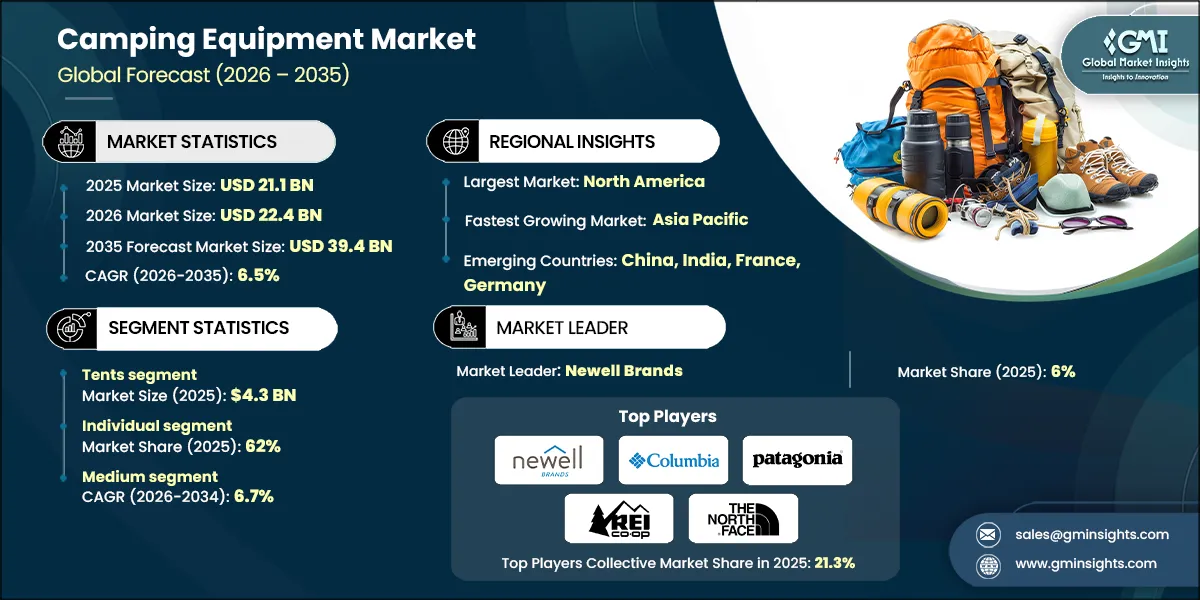
The global camping equipment market was estimated at USD 21.1 billion in 2025. The market is expected to grow from USD 22.4 billion in 2026 to USD 39.4 billion in 2035, at a CAGR of 6.5% according to latest report published by Global Market Insights Inc.
To get key market trends
The market for camping equipment is growing because of the growing popularity of outdoor sports such as camping. Consumers today value their physical as well as mental wellbeing; therefore, they are looking for outdoor activities such as camping that offer positive benefits for their well-being.
The increasing trend of adventure tourism and eco-tourism has increased the demand for camping products. The governments as well as corporate bodies are encouraging outdoor recreation by launching certain programs and campaigns to make more people experience nature by camping.
As reported in OIA, outdoor recreation in America increased by 3 percent for the year 2024 – a record-breaking 181.1 million participants. This represents nearly 60 percent of all Americans aged six and older. Teens aged 18-24 years old, senior citizens aged 65 and older. High school grads not seeking a college degree. High-income families. African American and Hispanic recreational participants are all getting outside at levels not experienced before.
Advancements in technology in camping products have therefore been essential in driving market expansion. Various manufacturers are embracing innovation and producing new products like lightweight tents, portable stove cooking equipment, and high-quality sleeping bags that provide greater convenience and comfort to people going camping. This is in response to changing consumer preferences, especially among millennials and Generation Z.
The rise in disposable income of customers, especially in emerging markets, is another major driving force in the growth of the market. This means that more people are in a position to afford investment in better camping equipment, thus resulting in increased sales of different camping gear products. The development of e-commerce sites has also made it simple for customers to get access to different camping gear products.
Camping Equipment Market Report Attributes
| Key Takeaway | Details |
|---|---|
| Market Size & Growth | |
| Base Year | 2025 |
| Market Size in 2025 | USD 21.1 Billion |
| Market Size in 2026 | USD 22.4 Billion |
| Forecast Period 2025-2035 CAGR | 6.5% |
| Market Size in 2035 | USD 39.4 Billion |
| Key Market Trends | |
| Drivers | Impact |
| Increasing interest in outdoor recreational activities | The growing focus on health and wellness has led to a surge in outdoor activities, directly boosting the demand for camping equipment. |
| Rising disposable incomes | Higher disposable incomes enable consumers to allocate more funds toward leisure and adventure, driving market growth. |
| Pitfalls & Challenges | Impact |
| Seasonal demand fluctuations | The market experiences uneven sales patterns, with peaks during specific seasons, which can affect inventory management and revenue consistency. |
| Competition of alternative leisure activities | Urban entertainment and international travel options may divert consumer spending, posing a challenge to market growth. |
| Opportunities: | Impact |
| Expansion of e-commerce platforms | Online retail channels provide a convenient purchasing option, increasing product accessibility and driving market growth. |
| Demand for customized and innovative camping gear | Tailored products that meet diverse consumer needs can enhance customer satisfaction and create new revenue streams. |
| Market Leaders (2025) | |
| Market Leader |
6% market share |
| Top Players |
Collective market share in 2025 is 21.3% |
| Competitive Edge |
|
| Regional Insights | |
| Largest Market | North America |
| Fastest growing market | Asia Pacific |
| Emerging countries | China, India, France, Germany |
| Future outlook |
|
What are the growth opportunities in this market?
Camping Equipment Market Trends
- The market for camping gear is expanding at a rapid pace because of the growing inclination towards adventurous tourism activities. The awakening awareness of the health benefits that come with engaging in outdoor activities like hiking and camping has also driven the market.
- Another thing that is already a developed trend is glamping, which is the short form for “luxury camping,” which will just continue to grow in the future as well. Many people feel that the time spent in the city is just too much for them, so they wish to find a method for leaving the city without giving up their lifestyle altogether. Glamping is designed for people who like the outdoors but don’t wish to abandon such convenient amenities as the internet.
- In addition, technological improvements that have affected the camping sector include improvements in camping gear, such as the development of light yet strong materials.
- Moreover, the integration of smart features, including solar-powered light solutions and portable charging stations, is luring tech-savvy individuals. The increasing popularity of eco-friendly and sustainable camping equipment is another major trend as eco-sensitive individuals are also choosing camping equipment made from recycled or biodegradable materials.
- One of the most prevalent tendencies in the camping industry is the use of sustainable practices. Nature conservation is an important issue for many camping tourists. Currently, there is a rising need for camping sites and products that not only minimize the impacts associated with camping but also help in the conservation of the environment. Modern camping sites will consider sustainable practices.
- The e-commerce sites have been the key drivers in the rapid growth of the market by providing a broad range of products and facilitating easy consumer purchasing. The provision of in-depth product information and favorable prices on e-commerce sites has increased sales.
- Regionally, the emerging market in the Asia-Pacific region can be attributed to the growing middle-class populace and their rising affinity for adventure tourism. Although the market presents optimistic prospects, certain factors such as price fluctuations for raw materials and the seasonal nature of camping adventures can potentially hinder the growth of the market.
Camping Equipment Market Analysis
Learn more about the key segments shaping this market
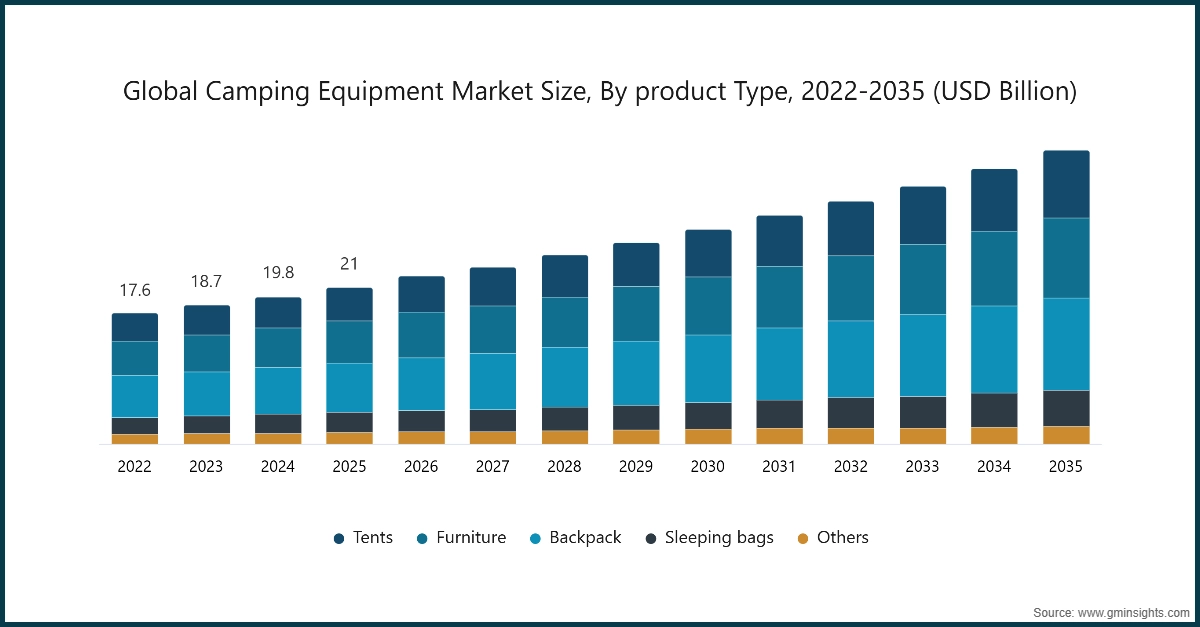
Based on the product type, the camping equipment market is divided into tents, furniture, backpack, sleeping bags, cooking systems and others. In 2025, tents dominated the market generating revenue of USD 4.3 billion and were expected to grow at a CAGR of 7.1% during the forecast period.
- The camping equipment market is witnessing significant growth as manufacturers focus on developing furniture that is not only robust, lightweight, and versatile but also meets the evolving demands of consumers. The integration of environmentally friendly materials and ergonomic designs has further enhanced the appeal of these products, catering to the growing consumer preference for sustainability and comfort.
- Additionally, the backpack segment within the market is expanding rapidly due to the increasing demand for durable and multifunctional storage solutions. Outdoor enthusiasts, including campers and hikers, are seeking backpacks equipped with advanced features such as integrated water storage systems, multiple compartments for better organization, and ergonomic designs that ensure comfort during extended use. These innovations are driving the growth of the camping equipment market, making it more appealing to a broader range of consumers.
Learn more about the key segments shaping this market
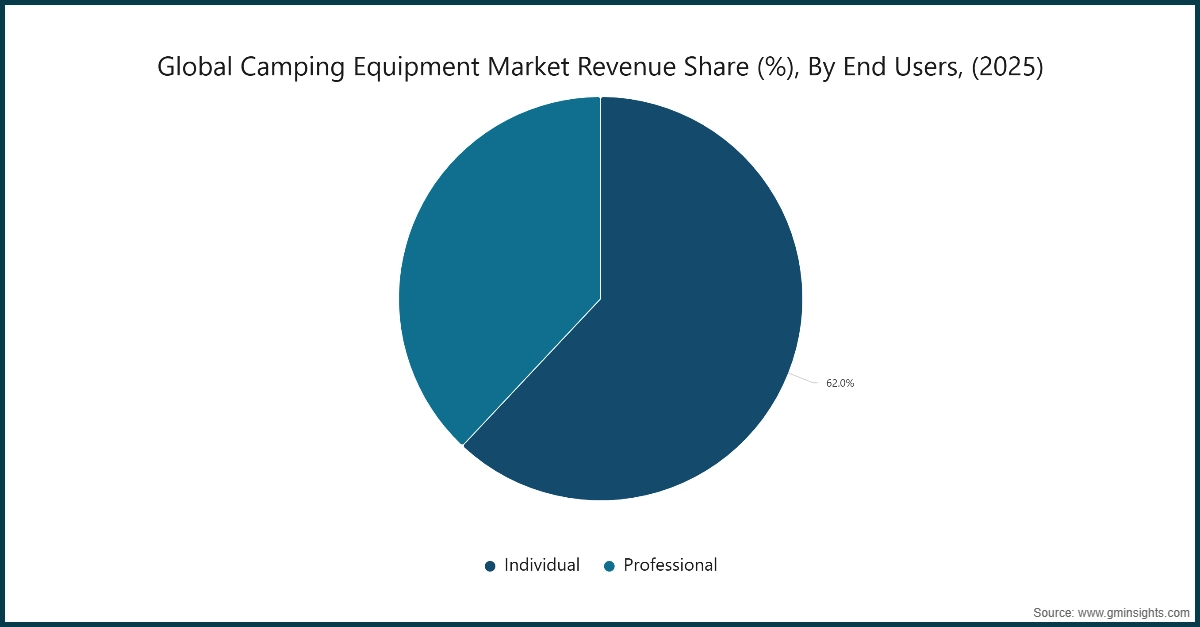
Based on end users, the camping equipment market is segmented into individual and professional. In 2025, individual segment dominates the market with 62% market share, and the segment is expected to grow at a CAGR of 6.8% from 2026 to 2035.
The Individual User category is also likely to see a steady increase during the forecast period. A growing interest in undertaking outdoor activities such as trekking and camping is fueling the demand for camping products. A rising level of disposable income and increasing interest in Eco-tourism also play a part.
Innovations in camping equipment that are lightweight and portable are luring individual consumers in pursuit of convenience and efficiency. The use of digital platforms, which offer simple access to a broad range of camping products, propelling the adoption of camping equipment.
The professional user sector is expected to show considerable growth during the forecasting period. The increasing demand for superior and long-lasting camping gear among professionals such as adventure tour operators, sports adventurers, and the military drives this sector.
Based on price, the camping equipment market is segmented into low, medium and high. In 2025, the medium segment dominates the market and is expected to grow at a CAGR of 6.7% from 2026 to 2035.
The mid-range sector is expected to register a strong growth rate during the forecast period, driven by the increasing demand for value-based offerings. Customers from this sector are looking for a balance between quality and price, thus making it a favorable option for serious campers. The manufacturers are developing new technologies to meet the demands of such customers.
The low-end market of the camping gear industry is expected to register a steady growth rate during the period of forecasting. The reason for such a rise in market growth can be attributed to the surging demand from budget-conscious customers.
Product pricing in the market has been relatively favorable, making these products more accessible to the general public, especially in emerging regions. The industry has also been concentrating on enhancing the quality of low-end equipment to lure more consumers.
Looking for region specific data?
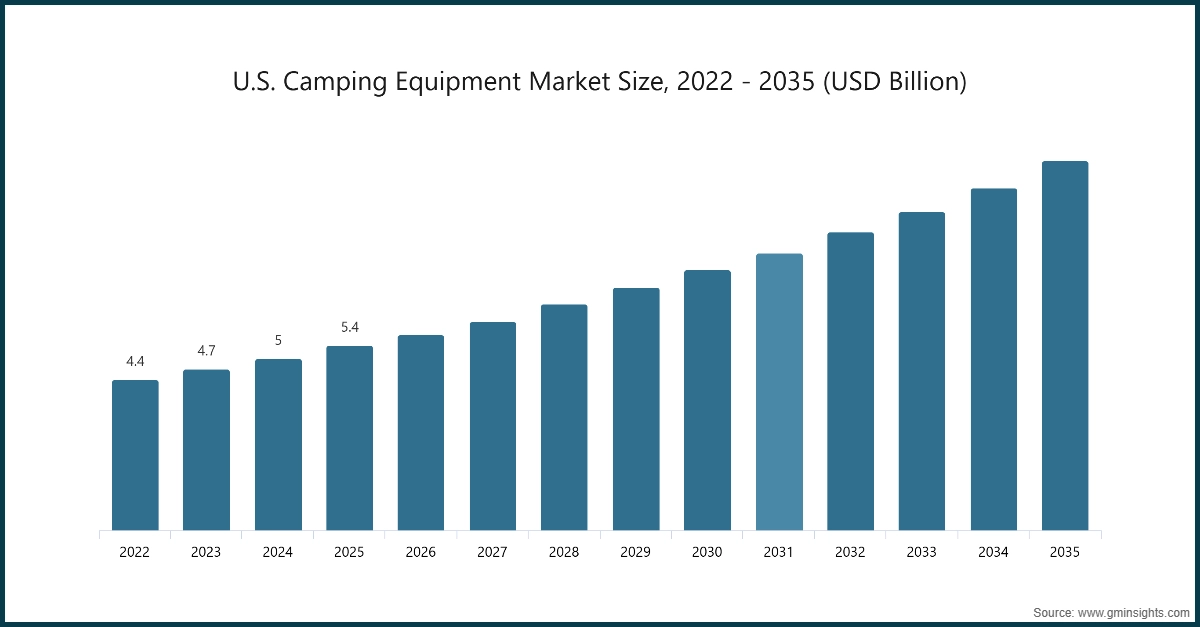
In terms of country, the United States led the camping equipment market with 80% of the North American market share and estimated USD 5.4 billion in revenue during 2025.
The major factor responsible for the growth in the camping equipment market in the United States is the increasing demand for camping, which has been driven by the health benefits offered by camping in the outdoors.
Rising incidents of adventure tourism and a growing demand for camping as a budget-friendly travel choice are adding to the demand for this market. This market is also benefiting from technological advancements in camping products, for example, lightweight and tough materials.
The growing use of eco-friendly and sustainable camping equipment is in line with environmentally conscious consumer preferences, thereby contributing to growing demand in the market. The retail and manufacturing industry is making use of e-commerce platforms with growing demands for camping equipment.
Challenges such as market fluctuations due to raw material prices and competition from substitute forms of leisure activities could prove restrictive. Nevertheless, the market in the USA is forecasted to exhibit a positive growth trajectory.
The Europe camping equipment market was valued at USD 6.3 billion in 2025 and is projected to grow at a CAGR of 6.5% between 2026 and 2035.
Rise in interest for outdoor leisure activities, growth in disposable income, and awareness regarding health and wellness are some of the factors fueling the growth of the market. Germany, France, and the United Kingdom are among the key contributors for the camping market.
In addition, there are innovations in light and durable camping equipment, attracting more customers. The market is also driven by the increasing trend for eco-friendly and sustainable products, which align with the preferences of the customers.
The Asia Pacific camping equipment market was valued at USD 5.4 billion in 2025 and is projected to grow at a CAGR of 6.1% between 2026 and 2035.
Raising per capita disposables, increased interest in outdoor recreation activities, and enhanced health and wellness understanding are fueling the growth of the market.
Urbanization and the attraction towards adventure tourism are leading to the increased demand in the Japanese, Indian, and Chinese markets.
The Middle East and Africa camping equipment market was valued at USD 1.3 billion in 2025 and is projected to grow at a CAGR of 5.6% between 2026 and 2035.
Innovations in camping equipment that is light as well as strong are gaining popularity among consumers. This is supplemented by the varied geographical conditions as well as the regional government's efforts to develop tourism.
Regions like South Africa, UAE, and Saudi Arabia are experiencing a major increase in demand for camping equipment brought about by increasing interest among tourists regarding adventure and eco-tourism.
The region's favorable climate, along with varying landscapes, has also attracted local as well as foreign tourists, thus increasing market expansion. Use of lightweight camping equipment is also gaining popularity, as people value convenience as well as quality.
Camping Equipment Market Share
- The top 5 companies in the camping equipment market are Columbia Sportswear, Newell Brands, Patagonia, REI, and The North Face collectively hold a share of 21.3% in the market.
- These companies continue to acquire and merge with others, expand facilities, and make various collaborations to increase their product offerings, access customer bases, and secure their market positions.
- Columbia Sportswear is also growing its market share through its use of innovative technologies in outdoor equipment such as Omni-Heat and Omni-Tech. The company has focused on making its products more durable and comfortable while being affordable. Columbia Sportswear has a strong retail infrastructure in place, in addition to its marketing strategies that also strengthen its position in the camping equipment market.
- Newell Brands is increasing market share with its diversified range of camping gear sold under brand names such as Coleman. Newell Brands focuses on innovation and affordable prices. By catering to a broad market and increasing distribution, Newell Brands is strengthening its position in the market for camping equipment.
- Patagonia is able to capture market share with their emphasis on sustainable and environmentally friendly practices. The company’s focus on providing high-quality and long-lasting camping equipment appeals to environmentally friendly consumers. Additionally, their direct-to-consumer business strategy and brand loyalty contribute to their market expansion in the camping equipment industry.
- REI is expanding market share by providing customers with a full range of camping gears of the highest caliber. The fact that customers also become members of the company’s cooperative allows the company to retain their loyalty, and the company’s commitment to being environmentally responsible and providing education programs in the wilderness further enhances the company’s reputation in the camping equipment industry.
Camping Equipment Market Companies
Major players operating in the camping equipment market are:
- Big Agnes
- Clarus
- Columbia
- Decathlon
- Garmin
- Johnson Outdoors
- Marmot
- MSR
- Nemo
- Newell (Coleman)
- Patagonia
- REI Co-op
- Sea to Summit
- The North Face
- YETI Holdings
To improve the product and market share key players are constantly investing in technological activities and are also entering into partnerships to provide improved and better solutions for the customers. These investments are benefiting both companies and customers as they help develop and offer solutions as per the changing technological trends and thus the customer requirements.
Columbia Sportswear Company is one of the prominent companies in the production of outdoor wear and equipment. The firm is known for producing innovative products. Moreover, the products made by Columbia Sportswear Company have the capacity to withstand extreme weather conditions. These attributes made it a popular brand among outdoor enthusiasts.
Garmin is a global leader in GPS and outdoor navigation devices. The company provides products ranging from GPS and wearables designed specifically for camping and outdoor use. The technological advancements and functionality of the devices by Garmin have made them a favorite among adventurers in search of a reliable GPS device.
Patagonia is a well-known company that provides outdoor clothing and equipment. It endeavors to be environmentally responsible and has been doing so for many years. It provides excellent camping equipment and clothing to maximize the outdoor experience. The company’s close ties with environmentally responsible manufacturing and long-lasting products have always helped it to retain its loyal customers from all around the globe.
REI Co-op is a popular consumer goods store with a focus on outdoor products and camping gear. The company provides diverse outdoor products, such as tents, sleeping bags, and more, catering to diverse outdoor requirements. The cooperative nature of REI and its customer-centric approach make it a popular brand for camping gear.
Camping Equipment Market Industry News
- In March 2025, Big Agnes collaborated with Hyosung, a global sustainable textile solution provider, in the development of its new Sweetwater UL (Ultralight) pack program. While offering the same strength and durability as conventional nylon, regen Ocean Robic Nylon has a 56% lower carbon footprint than virgin nylon. This collaboration highlights Hyosung’s commitment to delivering sustainable textile solutions and underscores its dedication to minimizing environmental impact.
- In January 2025, Garmin announced a new Montana series the Montana 710, Montana 710i and robust Montana 760i, to its collection of handheld GPS navigators. All three handhelds feature durable, easy-to-view, 5-inch color touchscreen displays that are glove-friendly.
- In December 2024, Kith and Columbia launch new camping gear might convert even the most ‘inside’ of people. The collaboration includes a range of colorful apparel, accessories, and even tents. The collection, which draws inspiration from natural landscapes, will allow campers to hike, fish, and sleep in streetwear-inspired swag.
- In March 2024, REI Co-op announced the launch of its new spring line of gear and apparel. Highlights include the Active Pursuits collection, the brand’s first nongendered apparel assortment for adults. Additionally, REI Co-op shared plans for its in-house brand to move beyond a gender-specific designation where it makes sense.
The camping equipment research report includes in-depth coverage of the industry with estimates & forecasts in terms of revenue (USD Billion) and volume (Thousand Units) from 2022 to 2035, for the following segments:
Market, By Product Type
- Tents
- Furniture
- Backpack
- Sleeping bags
- Cooking systems
- Stoves and burners
- Utensils
- Others (coolers, etc.)
- Others (gears, survival kit, etc.)
Market, By Price
- Low
- Medium
- High
Market, By End Users
- Individual
- Professional
Market, By Distribution Channel
- Online
- E-commerce
- Company websites
- Offline
- Supermarkets/hypermarket
- Specialty retail stores
- Others (independent retailer etc.)
The above information is provided for the following regions and countries:
- North America
- U.S.
- Canada
- Eupope
- UK
- Germany
- France
- Italy
- Spain
- Asia Pacific
- China
- India
- Japan
- South Korea
- Australia
- Latin America
- Brazil
- Mexico
- Argentina
- MEA
- South Africa
- Saudi Arabia
- UAE
Frequently Asked Question(FAQ) :
Who are the key players in the camping equipment market?
Key players include Big Agnes, Clarus, Columbia, Decathlon, Garmin, Johnson Outdoors, Marmot, MSR, and Nemo.
What are the upcoming trends in the camping equipment industry?
Key trends include the rise of glamping, advancements in lightweight and durable materials, integration of smart features like solar-powered solutions, and growing demand for eco-friendly and sustainable camping gear.
Which region leads the camping equipment market?
The United States led the market with 80% of the North American market share, generating USD 5.4 billion in revenue in 2025. Factors such as increasing demand for camping and advancements in camping gear drive the region's dominance.
What was the market size of the camping equipment market in 2025?
The market size was USD 21.1 billion in 2025, with a CAGR of 6.5% expected through 2035, driven by increasing interest in adventure tourism and the rising popularity of outdoor activities.
What was the valuation of the individual end-user segment?
The individual segment held a 62% market share in 2025 and is expected to grow at a CAGR of 6.8% from 2026 to 2035.
What is the projected value of the camping equipment market by 2035?
The market is expected to reach USD 39.4 billion by 2035, fueled by advancements in camping gear, growing demand for eco-friendly products, and the rise of glamping.
What is the projected size of the camping equipment market in 2026?
The market is expected to reach USD 22.4 billion in 2026.
How much revenue did the tents segment generate?
The tents segment generated USD 4.3 billion in 2025, dominating the market and projected to grow at a CAGR of 7.1% during the forecast period.
Camping Equipment Market Scope
Related Reports