Summary
Table of Content

Vector Database Market
Get a free sample of this report
Form submitted successfully!
Error submitting form. Please try again.
Thank you!
Your inquiry has been received. Our team will reach out to you with the required details via email. To ensure that you don't miss their response, kindly remember to check your spam folder as well!
Request Sectional Data
Thank you!
Your inquiry has been received. Our team will reach out to you with the required details via email. To ensure that you don't miss their response, kindly remember to check your spam folder as well!
Form submitted successfully!
Error submitting form. Please try again.
Vector Database Market Size
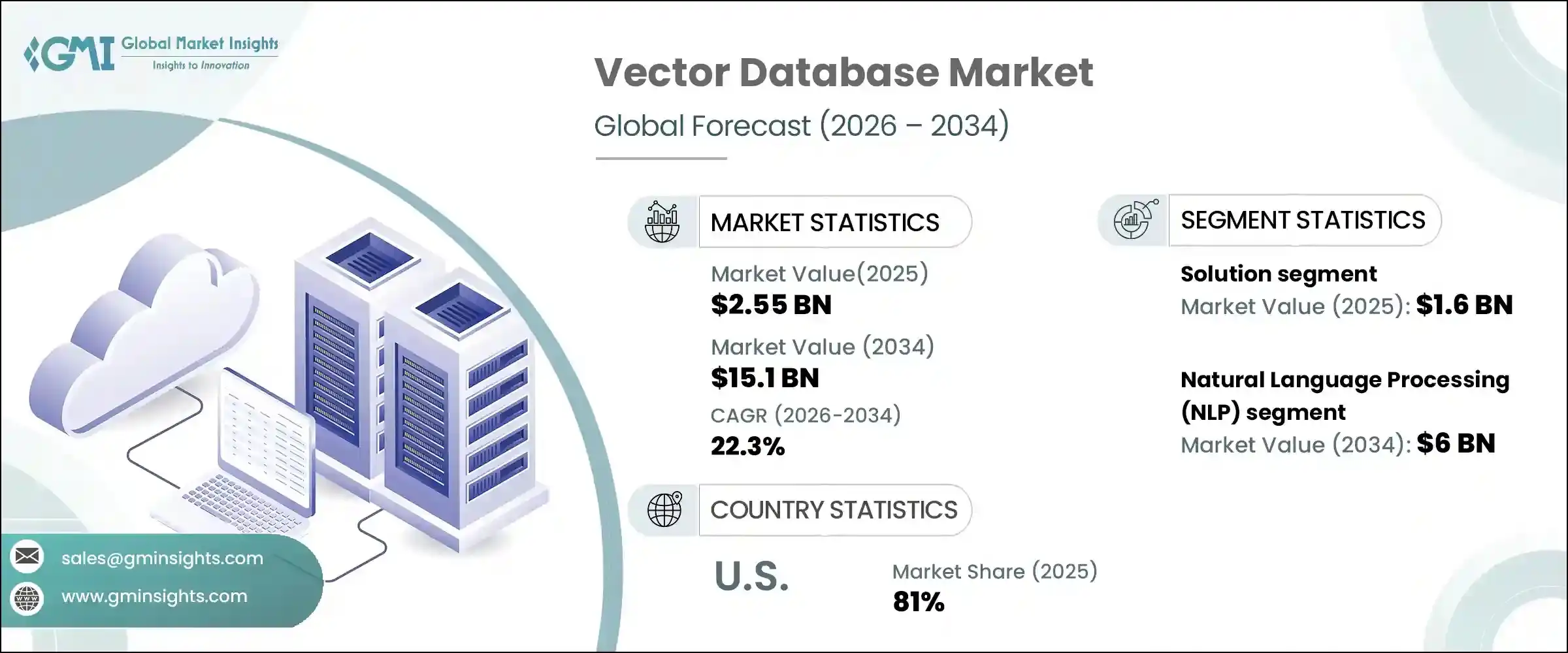
The global vector database market size was valued at USD 2.55 billion in 2025 and is projected to grow at a CAGR of 22.3% between 2026 and 2034. AI is propelling the market by leveraging machine learning and deep learning algorithms that rely on vector-based representations. Vector databases are crucial for AI applications due to their capability to efficiently process and manage high-dimensional data. AI's demand for quick, complex computations and its reliance on vector-based data representations have increased the need for scalable & efficient vector databases, consequently driving market expansion to meet these evolving AI requirements.
To get key market trends
For instance, in September 2023, Oracle introduced an integrated vector database for generative AI. This database is designed specifically to optimize the performance and storage of vectors, supporting the intricate demands of generative AI algorithms.
Vector Database Market Report Attributes
| Key Takeaway | Details |
|---|---|
| Market Size & Growth | |
| Base Year | 2025 |
| Market Size in 2025 | USD 2.55 Billion |
| Forecast Period 2026-2034 CAGR | 22.30% |
| Market Size in 2034 | USD 15.1 Billion |
| Key Market Trends | |
| Growth Drivers |
|
| Pitfalls & Challenges |
|
What are the growth opportunities in this market?
Cloud platforms fuel the vector database provide scalable, flexible, and cost-effective environments conducive to managing high-dimensional data. They also offer infrastructure for hosting and managing vector databases, enabling seamless storage, accessibility & processing of complex data. This innovative solution provides a smarter approach to managing high-dimensional data, catering specifically to AI-driven operations and analytics.
Vector Database Market Trends
The vector database industry is undergoing a structural shift as open-source platforms gain rapid traction across industries. This trend reflects growing demand for cost-effective, transparent, and scalable vector database solutions, particularly for generative AI, LLM applications, and advanced vector search workloads. Open-source vector databases lower entry barriers for enterprises by reducing licensing costs while offering high flexibility and customization key factors accelerating vector database adoption among startups, mid-sized firms, and innovation-driven enterprises.
A defining advantage of open-source solutions is their strong community ecosystem. Continuous contributions from developers enhance performance, expand features, and accelerate innovation, aligning closely with evolving AI vector database trends. As a result, these platforms increasingly compete with proprietary systems, challenging traditional pricing models and encouraging broader market accessibility.
A notable example is Qdrant, which launched a managed cloud platform for its open-source vector search database in February 2023. This move simplified deployment and scalability, allowing organizations to adopt vector search capabilities without the operational complexity of self-managed infrastructure. Such developments are strengthening the role of open-source platforms within vector search market trends, especially for cloud-native and AI-first architectures.
Despite rapid innovation, the high cost of commercial vector databases remains a key market constraint. Premium pricing limits adoption among smaller enterprises and slows large-scale implementation. In response, open-source alternatives and emerging vendors are reshaping competitive dynamics by offering more accessible pricing and scalable architectures. This pressure is driving established providers to reassess their cost structures, accelerating the market’s evolution toward more inclusive, enterprise-ready vector databases for generative AI and LLM-driven use cases.
Vector Database Market Analysis The market is segmented by component into solutions and services, with solutions forming the core revenue base. In 2025, the solution segment accounted for USD 1.6 billion, driven by rising enterprise demand for scalable, high-performance systems that can manage complex, high-dimensional data. As AI, machine learning (ML), and big data workloads expand across industries, organizations increasingly adopt specialized vector database solutions tailored to specific deployment needs. This includes a growing mix of open-source, cloud-based, and proprietary platforms, reflecting varied preferences around flexibility, control, and performance. These trends highlight key factors driving the vector database market revenue, particularly the need to support real-time similarity search and AI-native applications. From a technology perspective, the vector database industry analysis classifies the market into natural language processing (NLP), computer vision, and recommendation systems. Among these, the NLP segment is projected to reach USD 6 billion by 2034, emerging as a major growth engine. NLP applications rely heavily on efficient storage and retrieval of text embeddings and semantic vectors, making vector databases a foundational technology for large-scale language models and enterprise AI tools. As NLP adoption accelerates across sectors such as IT, BFSI, healthcare, and e-commerce, demand continues to rise for vector databases optimized for text-based workloads. This directly influences vector database applications and use cases, from intelligent search and chatbots to personalization engines. Collectively, these trends shape the vector database competitive landscape and inform ongoing vector database deployment analysis, as enterprises prioritize performance, scalability, and AI readiness. U.S. vector database market accounted for 81% of the revenue share in 2025. The growth is driven by expanding AI & ML applications across various industries. With the region being an early adopter of advanced technologies, the demand for high-dimensional data management solutions including vector databases is on the rise. North America's robust technological infrastructure and inclination toward innovative solutions are key drivers contributing to the region's anticipated significant expansion in the vector database sector. The European region is witnessing growing adoption of vector databases due to its strong emphasis on data compliance and advanced AI integration. Governments and enterprises are leveraging vector databases to enhance natural language processing, image recognition, and recommendation systems, particularly in industries like retail and healthcare. Furthermore, Europe’s push for ethical AI and robust data security regulations has driven organizations to invest in advanced database solutions, ensuring scalability while maintaining compliance with stringent privacy norms. In the Asia-Pacific region, the rapid digitization across sectors such as e-commerce, manufacturing, and telecommunications is fueling the adoption of vector databases. APAC’s tech giants and startups are utilizing these systems to process vast amounts of unstructured data for AI-driven applications like fraud detection, personalized recommendations, and predictive analytics. Additionally, increasing investments in AI research and development by countries like China, India, and Japan are further accelerating the demand for high-performance vector database solutions. In 2024, MongoDB, Redis, DataStax, KX, Qdrant, Pinecone, and Zilliz collectively accounted for around 45% of the global market share, highlighting a moderately concentrated yet competitive ecosystem. These players are widely recognized as top vector database vendors due to their strong focus on scalability, AI readiness, and enterprise adoption. MongoDB has reinforced its position as a leading vector database provider by embedding AI-driven data processing capabilities into its core NoSQL platform. Continuous investments in research and development support enhanced scalability, low-latency performance, and real-time analytics key factors driving vector database market growth. Seamless integration with popular machine learning frameworks makes MongoDB a preferred vector database company for AI-based and data-intensive applications. In addition, cloud-native deployment options and strategic collaborations enable MongoDB to efficiently support modern enterprise workloads, sustaining its competitive share in the evolving vector database landscape. Redis focuses on optimizing its high-performance, in-memory architecture for vector data processing. By introducing capabilities such as RedisAI, the company accelerates deep learning inference and embeddings-based search, addressing rising enterprise demand for fast vector similarity queries. Redis’ architecture enables rapid querying and low latency, making it well-suited for real-time AI applications. Its commitment to open-source innovation, combined with partnerships across major cloud platforms, strengthens Redis’ presence among leading vector database providers and supports its growing share in the vector database competitive landscape. Major vector database companies are: Learn more about the key segments shaping this market
 Learn more about the key segments shaping this market
 Looking for region specific data?
Vector Database Market Share

Vector Database Market Companies
Vector Database Industry News
The vector database market research report includes in-depth coverage of the industry with estimates & forecasts in terms of revenue ($ Mn/Bn) from 2021 to 2034, for the following segments:
Market, By Technology
- Natural language processing
- Computer vision
- Recommendation system
Market, By Component
- Solution
- Vector generation
- Vector search
- Storage and retrieval vectors
- Services
- Professional services
- Managed services
Market, By Industry Vertical
- Retail & e-commerce
- BFSI
- Healthcare & life sciences
- Retail
- Media & entertainment
- Manufacturing
- IT & telecom
- Others
The above information is provided for the following regions and countries:
- North America
- U.S.
- Canada
- Europe
- UK
- Germany
- France
- Italy
- Spain
- Nordics
- Asia Pacific
- China
- India
- Japan
- South Korea
- Australia
- Southeast Asia
- Latin America
- Brazil
- Argentina
- Mexico
- MEA
- UAE
- Saudi Arabia
- South Africa
Frequently Asked Question(FAQ) :
Who are the key players in the vector database market?
Key players include Chroma DB, DataStax, KX, Marqo AI, Milvus, MongoDB, Pinecone, Qdrant, Redis, and Zilliz.
What are the key trends in the vector database market?
Key trends include rise of open-source vector database solutions, integration with cloud platforms for scalability, AI-driven data processing capabilities, and growing adoption across NLP and computer vision applications.
What is the projected value of the Natural Language Processing segment by 2034?
The Natural language processing (NLP) segment is expected to reach USD 6 billion by 2034, driven by efficient storage and analysis of complex data structures like word embeddings and text vectors.
What was the market share of the U.S. in North America in 2025?
U.S. vector database market accounted for 81% of the revenue share in 2025, supported by expanding AI & ML applications across various industries.
What challenges restrict vector database adoption?
High costs and complex implementation processes limit accessibility and adoption, especially for smaller businesses.
How much revenue did the solution segment generate in 2025?
The solution segment accounted for USD 1.6 billion in 2025, driven by surging demand for diverse solutions across AI, ML, and big data applications.
What are the key drivers of the vector database market?
Growing AI and ML adoption, increasing data complexity, demand for real-time analytics, and scalable cloud solutions drive the market.
What is the forecasted growth of vector databases?
The market size was USD 2.55 billion in 2025, with a CAGR of 22.3% expected through 2034 driven by AI and machine learning applications requiring efficient high-dimensional data management.
How big is the vector database market?
The vector database market is expected to reach USD 15.1 billion by 2034, propelled by expanding AI applications, cloud platform adoption, and growing demand for scalable data processing solutions.
Vector Database Market Scope
Related Reports