Summary
Table of Content

Sulfosuccinate Market
Get a free sample of this report
Form submitted successfully!
Error submitting form. Please try again.
Thank you!
Your inquiry has been received. Our team will reach out to you with the required details via email. To ensure that you don't miss their response, kindly remember to check your spam folder as well!
Request Sectional Data
Thank you!
Your inquiry has been received. Our team will reach out to you with the required details via email. To ensure that you don't miss their response, kindly remember to check your spam folder as well!
Form submitted successfully!
Error submitting form. Please try again.
Sulfosuccinate Market Size
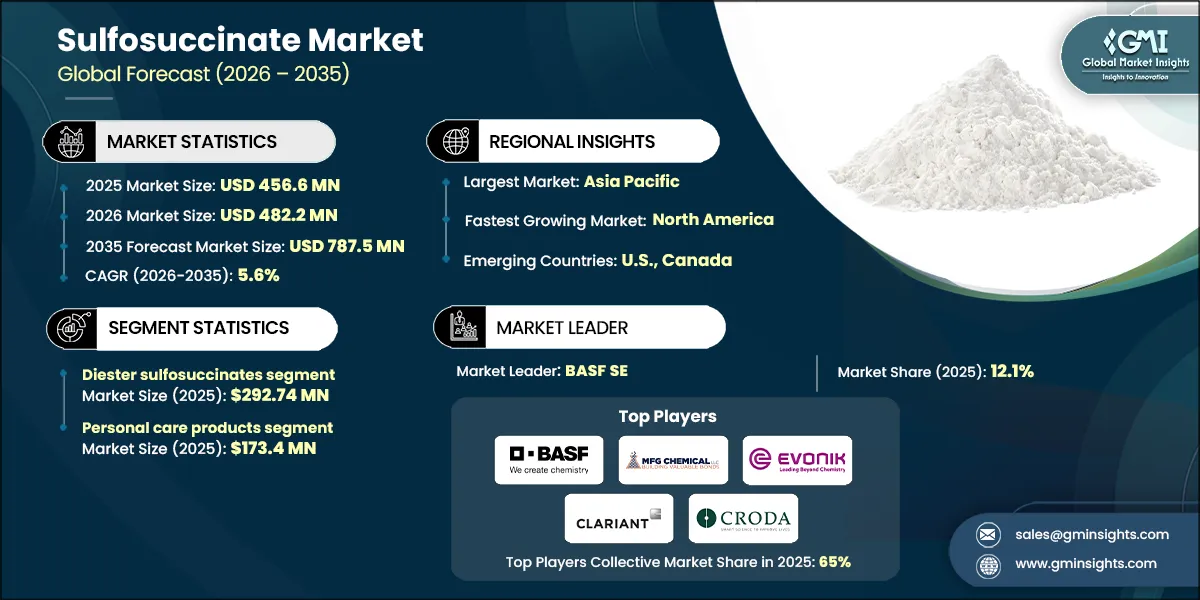
The global sulfosuccinate market was valued at USD 456.6 million in 2025 and is set to expand from USD 482.2 million in 2026 to USD 787.5 million by 2035, advancing at a 5.6% CAGR from 2026 to 2035 according to latest report published by Global Market Insights Inc.
To get key market trends
- Momentum is rooted in the shift to milder, readily biodegradable surfactants across personal care, household, and industrial systems. Gentle cleansing trend and it’s environmental compliance paired with reliable performance in tough conditions is driving growth in the market. Programs like EPA Safer Choice and Europe’s REACH framework continue to shape portfolio decisions and favor sulfosuccinate adoption in certified or highly scrutinized applications.
- Rising personal care and cosmetics demand brands are reformulating to milder systems for baby care, facial cleansers, shampoos, and sensitive-skin SKUs, with spending tailwinds visible in fast-growing APAC economies and regulatory guardrails in the EU supporting sulfate-alternative adoption.
- Growth in industrial cleaning, clean-in-place, pharma/healthcare, food processing, and I&I cleaning standards continue to raise the bar, sulfosuccinates deliver wetting, penetration, and low-residue profiles that map to CDC/FDA guidance for compliant operations.
Sulfosuccinate Market Report Attributes
| Key Takeaway | Details |
|---|---|
| Market Size & Growth | |
| Base Year | 2025 |
| Market Size in 2025 | USD 456.6 Million |
| Market Size in 2026 | USD 482.2 Million |
| Forecast Period 2026-2035 CAGR | 5.6% |
| Market Size in 2035 | USD 787.5 Million |
| Key Market Trends | |
| Drivers | Impact |
| Personal care premiumization and sulfate-alternative reformulations expand mild surfactant use | Drives increased demand for gentle, eco-friendly surfactants like sulfosuccinates. |
| I&I cleaning standards require wetting/low-residue profiles aligned with CDC/FDA guidance | Boosts need for high-performance, low-residue emulsifiers suitable for industrial cleaning. |
| EOR deployment sustains demand for high-performing emulsifiers | Maintains steady demand for effective sulfosuccinate-based emulsifiers in oil recovery. |
| Pitfalls & Challenges | Impact |
| Compliance and dossier burdens under REACH/TSCA increase cost-to-serve | Raises operational costs and complicates market entry for sulfosuccinate products. |
| Opportunities: | Impact |
| Bio-based inputs and ISCC-type programs improve brand acceptance and regulatory fit | Enhances market appeal and regulatory compliance of bio-based sulfosuccinate formulations. |
| Market Leaders (2025) | |
| Market Leader |
12.1 % market share |
| Top 5 Players |
Collective market share is 65 % in 2025 |
| Competitive Edge |
|
| Regional Insights | |
| Emerging countries | U.S., Canada |
| Future outlook |
|
What are the growth opportunities in this market?
Sulfosuccinate Market Trends
- Sustainability and green-chemistry alignment Safer Choice criteria and EU biodegradability rules are pushing surfactant selection toward readily biodegradable and low-toxicity options; sulfosuccinates check both boxes and are increasingly specified in certified green formulations for personal care and I&I cleaning. The numbers tell us policy is acting as a market shaper, not just a label exercise brand owners want audited environmental attributes that survive regulatory scrutiny.
- Premiumization and functional specialization Manufacturers are investing in R&D to tune structure property relationships, from cold-water solubility to foam stability and microemulsion behavior, with a growing focus on bio-based feedstocks and greener processes. Industry data indicates rising R&D intensity in surfactant chemistry, enabling faster customization for pharma delivery, textile auxiliaries, ag-adjuvants, and specialty cleaners. This matters because differentiation is shifting from “mild and green” to “mild, green, and tailored,” supporting higher value capture.
- Industrial adoption oilfield and high-spec hygiene EOR remains a durable niche where sulfosuccinate emulsification improves displacement efficiency in mature fields; the IEA continues to project investment in such technologies as conventional production matures. On the hygiene side, CDC and FDA frameworks set clear expectations for facility cleaning and food-contact surfaces, reinforcing demand for low-residue, material-compatible systems where sulfosuccinates perform well.
Sulfosuccinate Market Analysis

Learn more about the key segments shaping this market
Based on product type the market is segmented as diester sulfosuccinates, monoester sulfosuccinates, and others.
- Diester sulfosuccinates lead on emulsification and wetting, with DOSS/AOT an industry benchmark across personal care and industrial formulations. Oilfield EOR leverages diesters’ microemulsion stability to lift displacement in aging reservoirs, an area the IEA still views as investment-relevant. Innovation spans low-foam variants for automated cleaning, cold-water solubility improvements, and pharmaceutical-grade purity for drug-delivery work.
Monoester sulfosuccinates deliver greater hydrophilicity and foaming, positioning them as secondary surfactants in shampoos, face/body washes, liquid laundry, and dish liquids. Clean-beauty reformulation and frequent-use household products both benefit from their mildness and compatibility, while bio-based monoesters address procurement and sustainability goals.
Learn more about the key segments shaping this market
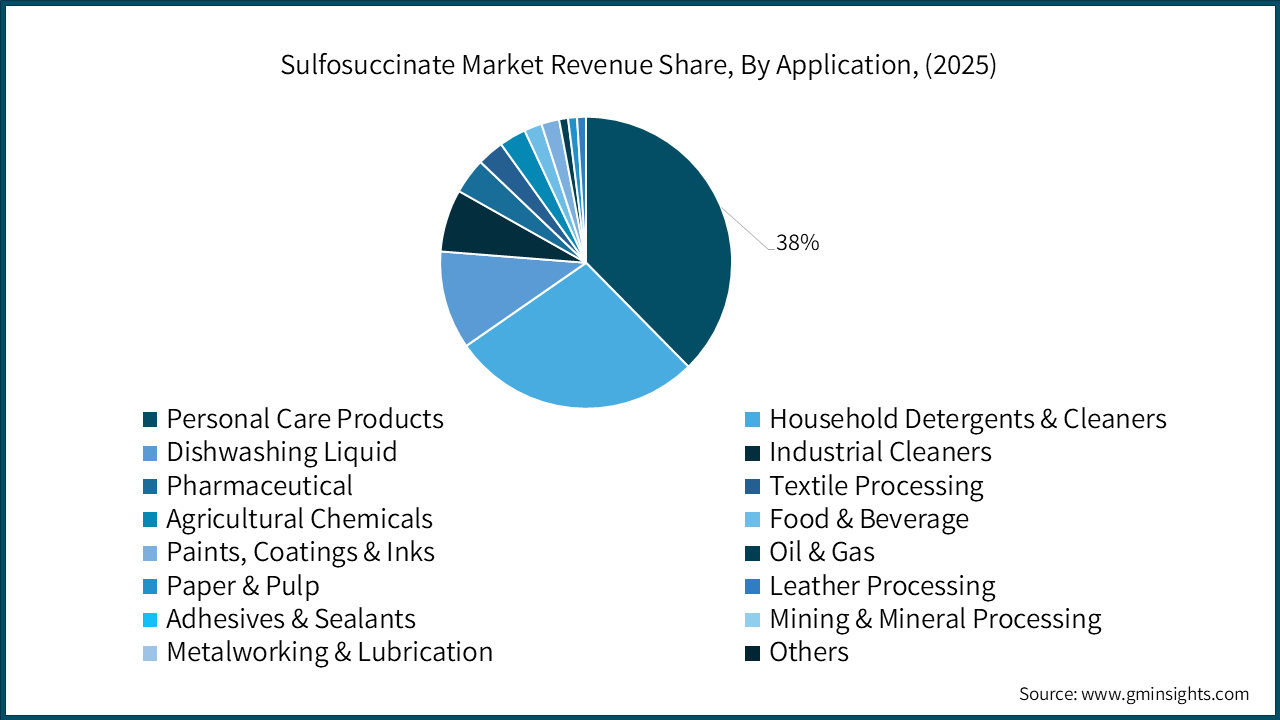
Based on application the sulfosuccinate market is segmented as personal care products, household detergents & cleaners, dishwashing liquid, industrial cleaners, pharmaceutical, textile processing, agricultural chemicals, food & beverage, paints, coatings & inks, oil & gas, paper & pulp, leather processing, adhesives & sealants, mining & mineral processing, metalworking & lubrication, others.
- Personal care products are the largest use case, as dermatology-friendly cleansing, infant care, and sensitive-skin products lean into sulfosuccinates’ mildness. Household detergents & cleaners use sulfosuccinates as secondary surfactants/foam boosters in laundry and hard-surface cleaners. Dishwashing liquids value foam profile and hand-mildness. Industrial cleaners benefit from wetting/low-residue features compatible with CDC/FDA expectations for health care and food processing. Other applications span pharma, textiles, ag-chem, food & beverage, coatings/inks, oil & gas, paper, leather, adhesives, mining, and metalworking.
Looking for region specific data?
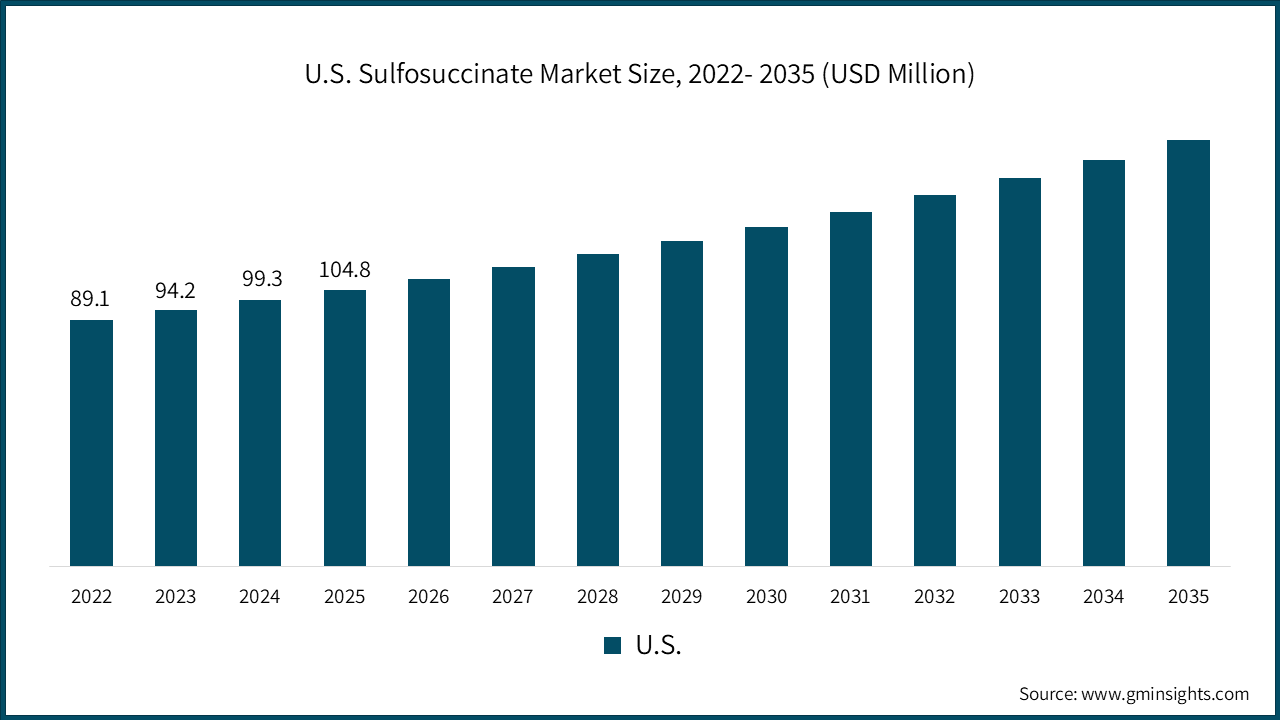
The U.S. Sulfosuccinate market valued at USD 104.8 million in 2025 and estimated to grow to almost USD 180.8 million by 2035. North America holds around 28% of the Sulfosuccinate market share in 2025. North America is the fastest-growing region, with Safer Choice adoption, reformulation activity, and high-spec I&I cleaning supporting steady volume and premium-value gains.
- U.S. EPA Safer Choice criteria continues to prop up reformulation activity across major brands in response to regulatory encouragement to safer, less toxic formulations. This well-established I & I cleaning sector would want high performance non-irritating surfactants such as sulfosuccinates in a typical preference value. Increased demand from premium personal care and specialty cleaning categories then adds to the need, which is heightened further by their reliance on mild biodegradable ingredients.
Asia Pacific sulfosuccinate market is both the largest consumer and a key manufacturing base, with China, India, Japan, and South Korea anchoring demand.
- Growth reflects rising incomes, urbanization, and a strong personal care footprint. Rising disposable incomes and fast-paced urbanization lead to an increased requirement of shampoos, cleansers, skincare, and home-care developed from mild surfactants. Among them, the most promising electronics, textiles, and industrial chemicals are sulfosuccinates for wetting, emulsification, and dispersing functions. They have been benefitting as these hold cost-competitive production ecosystems, thus allow rapid scaling functions and a focus on exports. Then also, heightened interests in biodegradable and low- irritation formulations go along with the tightening environmental policies in these key markets. Collectively, these developments strengthen the whole being that makes Asia-Pacific the global growth point of sulfosuccinate demand.
Europe sulfosuccinate marketmarket is mature and highly regulated; compliance with EU Cosmetics, Detergents, and REACH standards shapes product specs and documentation, favoring suppliers with robust stewardship and bio-based options.
- Compliance requirements favor those suppliers who can provide high-purity, traceable, and so-called environmentally friendly surfactants. The surfactants are mild, biodegradable sulfosuccinates to take care of the demand from the place where the high demand comes from premium personal care, dermatologically certified cleaners, and eco-certified household cleaners. The trend toward sulfate-free formulations continues to accelerate within the region, as consumers and retailers alike highly prioritize gentleness and sustainability.
The sulfosuccinate market has remained relatively small yet trending upwards in Latin America due to increasing incomes and a growing middle-class demographic in urban areas, while premium personal care and home-care products have also been broadening among the population.
- Rising consumer awareness on mild and dermatologist-friendly formulations has driven local and multinational brands to consider including sulfosuccinates within their shampoos, facial cleansers, or household detergents. Supply chains are seen to become more formalized and modernized, which causes the production and distribution of surfactants within the region to become more efficient, hence increasing their availability in the high-value chemistry line. With the modernization and establishment of contemporary retail and e-commerce, the demand for internationalized formulations such as sulfate-free ones becomes increasingly pervasive.
The sulfosuccinate market of Middle East and Africa sulfosuccinate market is on the up as rising income levels, city populations, and modern personal care and home-care products pas effect.
- Expansion of organized retail channels and increased penetration of global personal care brands drive demand for mild, high-performance surfactants. Increasingly, organized channels of retail are driving demand for high-performance mild surfactants globally. Industrial and institutional cleaning facilities also in the region go for safer, low-irritation surfactants in line with international standards of quality. As the very strong improvement develops for supply chain efficiency with both manufacturers and distributors, so widen the availability of specialty surfactants, such as sulfosuccinates, for broader markets of distribution. Growing interests, together with the pace at which products will come to environmentally responsible formulations, develop at the moment also their own category of shape product development choices.
Sulfosuccinate Market Share
Market concentration is high, with the top five players BASF SE, MFG Chemicals, Evonik AG, Clariant AG, and Croda International collectively covering nearly 65% share in 2025. BASF leads at 12.1% on the strength of its surfactant breadth, global footprint, technical service, and sustainability programs. Dow leverages upstream integration and industrial reach; Huntsman emphasizes specialty formulations and application support; Stepan shows strong North American presence with expanding bio-based surfactants; Evonik, Clariant, Croda, KAO, and Henkel add differentiated positions in personal care and home care. The competitive playbook is consistent capacity in APAC, greener routes, and customer co-development for regulated/specialty applications.
BASF SEBASF SE is a global leader in surfactants, and Sulfosuccinate's markets are still well served with Texapon and Disponil. Sustainability initiatives are at the heart of the company's investments into bio-feedstocks and energy-efficient manufacturing processes as it faces soaring consumer demand for green products. Thanks to innovation and a transcontinental network for distribution, BASF becomes the supplier choice for customers who demand quality, sustainable surfactants.
MFG Chemical Inc.MFG Chemicals is quite flexible about its ability to customize solutions, especially for the niche market needs that characterize the Sulfosuccinate market space. MFG can quickly adapt to changing customer needs because of its responsive service model, presenting itself as a reliable partner in specialized formulations. MFG caters to a variety of clientele due to the nature of its custom manufacturing procedures and a stringent focus on quality, ranging from personal care to industrial cleaning as well as oilfield formulations.
Evonik Industries AGEvonik Industries AG-commercializing innovations and in their market tagline using the phrase innovation and sustainability in both cases which they claimed is in their work in the sulfosuccinate market, is primarily focused on care solutions in personal and home care products. Environmentally conscious production techniques fried coupled with sustainable product development will satisfy increasing consumer demand for natural and environmentally friendly ingredients and further position the corporation ahead in sustainable surfactant solutions.
Clariant AGClariant strategically focuses on care chemicals and sustainability, thus providing a sound platform for the Sulfosuccinate market. Clariant aims to develop performant, environmentally conscious surfactants meeting the highest international standards because of the fact that their production is of a global scale. Sustainability forms a core principle of the company in achieving the objective of innovative and responsible solutions to global customers.
Croda InternationalCroda International also concentrates on premium personal care ingredients and has further strengthened its footprint in the natural-origin segment of Sulfosuccinate. Offering high-value, sustainable surfactants from natural raw materials, it appeals to consumers who are much more interested in green and mild products. With Croda's emphasis on innovation and high-quality specialty grades, the company garners respect as a provider of premium sustainable surfactant solutions.
Sulfosuccinate Market Companies
Major players operating in the Sulfosuccinate industry are:
- The Dow Chemical Company
- Huntsman Corporation
- MFG Chemical
- Stepan Company
- Cytec Industries
- Air Products and Chemicals
- Evonik Industries AG
- Clariant AG
- Dupont
- Croda International
- KAO Corporation
- Henkel AG
Sulfosuccinate Industry News
- In March 2025, Evonik AG launched Evonik TEGO Foamex 8420, this product is a high performance defoamer specifically formulated for waterborne inks which often contains foam- foam-stabilizing sulfosuccinates.
- In December 2023, Evonik AG collaborated with clean beauty brand in Europe to launch their sulfate free skincare series that incorporates their biotech formulated disodium laureth sulfosuccinate blend, targeted at consumers with sensitive skin.
The sSulfosuccinate market research report includes in-depth coverage of the industry, with estimates & forecast in terms of revenue (USD Million) and volume (Kilo Tons) from 2022 to 2035, for the following segments:
Market, By Product Type
- Diester sulfosuccinates
- Dioctyl sodium sulfosuccinate
- Sodium diisotridecyl sulfosuccinate
- Dilauryl sodium sulfosuccinate
- Ditridecyl sodium sulfosuccinate
- Others
- Monoester sulfosuccinates
- Ammonium lauryl sulfosuccinate
- Disodium lauryl sulfosuccinate
- Ethoxylated monoalkyl sulfosuccinates
- Cocomonoethanolamide sulfosuccinate
- Others
Market, By Form
- Liquid formulations
- Paste formulations
- Powder formulations
Market, By Application
- Dishwashing liquid
- Household detergents & cleaners
- Laundry detergents
- Hard surface cleaners
- Fabric & textile care
- Others
- Industrial cleaners
- Metal cleaning & degreasing
- Institutional & industrial (I&I) cleaning
- Automotive cleaners
- Others
- Personal care products
- Shampoos
- Body care & lotions
- Cosmetics
- Hair care products
- Others
- Pharmaceutical
- Oral laxatives
- Tablet formulation
- Others
- Food & beverage
- Food emulsifier
- Beverage processing
- Others
- Agricultural chemicals
- Agrochemical emulsifiers
- Adjuvants
- Others
- Textile processing
- Dyeing & leveling
- Textile sizing
- Textile auxiliaries
- Leather processing
- Leather finishing
- Leather dyeing
- Paper & pulp
- Paints, coatings & inks
- Oil & gas
- Adhesives & sealants
- Mining & mineral processing
- Metalworking & lubrication
- Others (antifog, wallpaper removers, germicidal preparations)
The above information is provided for the following regions and countries:
- North America
- U.S.
- Canada
- Europe
- UK
- Germany
- France
- Italy
- Spain
- Rest of Europe
- Asia Pacific
- China
- India
- Japan
- South Korea
- Australia
- Rest of Asia Pacific
- Latin America
- Brazil
- Mexico
- Argentina
- Rest of Latin America
- Middle East & Africa
- UAE
- Saudi Arabia
- South Africa
- Rest of Middle East & Africa
Frequently Asked Question(FAQ) :
Which region leads the sulfosuccinate market?
The U.S. sulfosuccinate industry was valued at USD 104.8 million in 2025 and is projected to approach USD 180.8 million by 2035. Growth is supported by Safer Choice reformulations, premium personal care demand, and high-spec industrial and institutional cleaning needs.
What are the key trends shaping the sulfosuccinate industry?
Key trends include sustainability-driven reformulations, bio-based feedstock development, and greater customization for performance attributes like foam stability and microemulsion behavior. Regulatory frameworks such as REACH and Safer Choice continue to shape portfolio strategies and promote greener surfactant choices.
Which product segment dominates the sulfosuccinate industry?
Diester sulfosuccinates dominate the industry owing to strong emulsification and wetting performance, along with their role in EOR and high-spec cleaning applications. Their versatility across personal care, oilfield, and industrial systems reinforces segment leadership.
What is the growth outlook for the personal care application segment?
The personal care segment is expected to maintain strong growth as brands reformulate toward mild, dermatology-friendly, and biodegradable ingredients. Premium skincare, baby care, and sensitive-skin lines continue to elevate sulfosuccinate adoption in the market.
Who are the key players in the sulfosuccinate market?
Major players include BASF SE, MFG Chemicals, Evonik AG, Clariant AG, Croda International, The Dow Chemical Company, Huntsman Corporation, Stepan Company, KAO Corporation, and Henkel AG. These companies emphasize innovation, sustainable chemistry, and application-specific performance to strengthen their industry positions.
Which application segment held the largest share in 2025?
Personal care products represented the largest application segment in 2025. Rising awareness around gentle cleansing and sustainability positioned sulfosuccinates as preferred surfactants in shampoos, cleansers, and related cosmetic formulations.
What is the sulfosuccinate market size in 2025?
The sulfosuccinate market was valued at USD 456.6 million in 2025. Demand is supported by premiumization in personal care and the shift toward milder, readily biodegradable surfactants across multiple industries.
What is the current sulfosuccinate market size in 2026?
The market size reached USD 482.2 million in 2026, reflecting steady expansion. Growth is linked to sulfate-alternative reformulation trends and rising demand for gentle surfactant systems.
What is the projected value of the sulfosuccinate market by 2035?
The market is expected to reach USD 787.5 million by 2035, growing at a CAGR of 5.6%. Expansion is driven by eco-friendly formulation requirements, regulatory alignment, and broader use in personal care, industrial cleaning, and specialty applications.
Sulfosuccinate Market Scope
Related Reports