Summary
Table of Content

Storage Water Heater Market
Get a free sample of this report
Form submitted successfully!
Error submitting form. Please try again.
Thank you!
Your inquiry has been received. Our team will reach out to you with the required details via email. To ensure that you don't miss their response, kindly remember to check your spam folder as well!
Request Sectional Data
Thank you!
Your inquiry has been received. Our team will reach out to you with the required details via email. To ensure that you don't miss their response, kindly remember to check your spam folder as well!
Form submitted successfully!
Error submitting form. Please try again.
Storage Water Heater Market Size
The storage water heater market size was valued at USD 22.2 billion in 2025. The market is anticipated to grow from USD 23.4 billion in 2026 to USD 40.6 billion in 2035, at a CAGR of 6.3% from 2026 to 2035.
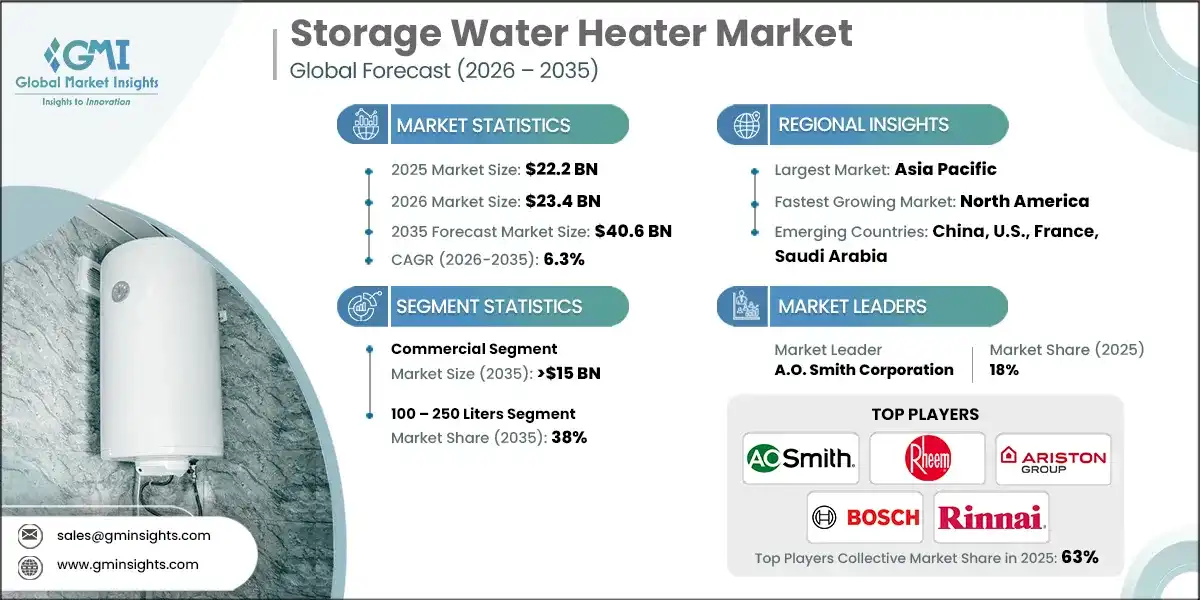
To get key market trends
- Technological advancements including enhanced insulation materials, intelligent control systems, and improved heat exchanger designs will improve the efficiency and usability of large-capacity storage water heaters, thereby driving their enhanced adoption. Increased compliance with domestic and international energy efficiency standards, along with investments in high-capacity, energy-efficient water heaters, is further supporting market growth.
- Growing emphasis on sustainability and reducing carbon footprints in commercial settings. Businesses are increasingly opting for energy-efficient and environmentally friendly water heating solutions to align with their sustainability goals, which will complement the industry landscape.
- Government and utility company incentives, rebates, and tax credits for installing energy-efficient water heaters are motivating commercial entities to upgrade their systems, which will complement the product demand. Additionally, water heaters integrated with smart grids to optimize energy usage and reduced costs will boost the industry statistics.
- Ongoing integration of water heaters with renewable energy sources such as solar thermal systems and geothermal heat pumps. will help businesses further reduce their energy costs and reliance on fossil fuels. Moreover, incentives offered by governments and utility providers, such as rebates and tax credits for energy-efficient water heating installations, are positively influencing the uptake of large storage water heaters.
Storage Water Heater Market Report Attributes
| Key Takeaway | Details |
|---|---|
| Market Size & Growth | |
| Base Year | 2025 |
| Market Size in 2025 | USD 22.2 Billion |
| Market Size in 2026 | USD 23.4 Billion |
| Forecast Period 2026 - 2035 CAGR | 6.3% |
| Market Size in 2035 | USD 40.6 Billion |
| Key Market Trends | |
| Drivers | Impact |
| Government mandates pertaining to energy efficiency | Regulatory frameworks such as minimum energy performance standards (MEPS), energy labeling programs, and carbon reduction policies are encouraging the replacement of outdated, inefficient water heaters with modern, high-efficiency storage units. These mandates not only help reduce energy consumption and greenhouse gas emissions but also create a favorable environment for innovation and investment in advanced insulation, smart controls, and high-performance heating technologies, thereby supporting sustained market growth. |
| Increasing demand for water heating systems | The increasing demand for water heating systems is a major driver of the storage water heater market, fueled by population growth, urbanization, and rising standards of living worldwide. Expanding residential construction, along with growing installation of hot water systems in hotels, hospitals, educational institutions, and industrial facilities, is boosting the need for reliable and high-capacity water heating solutions. |
| Rapid urbanization and government mandates pertaining to GHG emissions | The governments are enforcing stricter emissions regulations and energy efficiency standards to curb carbon footprints, encouraging the adoption of modern, energy-efficient storage water heaters. These policies are accelerating the replacement of older, inefficient units with advanced systems that offer lower emissions, improved performance, and compliance with sustainability goals, thereby supporting market growth. |
| Pitfalls & Challenges | Impact |
| High installation costs | Large-capacity storage water heaters, in particular, often require reinforced infrastructure and professional installation, increasing overall project costs for residential and commercial users. These high initial investments can deter price-sensitive consumers and slow adoption, especially in developing regions or in applications where lower-cost, tankless alternatives are available, thereby limiting market penetration despite the long-term efficiency and reliability benefits. |
| Opportunities: | Impact |
| Growing demand for energy efficient and smart water heating solutions | With rising energy costs and efficiency regulations become more stringent, consumers and commercial users are increasingly seeking advanced storage water heaters with better insulation, intelligent temperature controls, and connectivity features. Smart and high-efficiency models enable lower operating costs, improved user convenience, and compliance with energy standards, creating strong growth potential for manufacturers investing in innovation, digitalization, and premium product offerings. |
| Growing demand for renewable and hybrid storage water heaters | Governments across regions are promoting low-carbon water heating technologies through incentives, subsidies, and clean energy mandates, encouraging the replacement of conventional electric or gas heaters. This transition presents significant opportunities for market players to develop large-capacity, renewable-integrated storage water heaters for residential, commercial, and institutional applications, especially in regions with high solar potential and growing sustainability commitments. |
| Market Leaders (2025) | |
| Market Leaders |
18% market share |
| Top Players |
|
| Competitive Edge |
|
| Regional Insights | |
| Largest Market | Asia Pacific |
| Fastest Growing Market | North America |
| Emerging Countries | China, U.S., France, Saudi Arabia |
| Future outlook |
|
What are the growth opportunities in this market?
Storage Water Heater Market Trends
- The market is expanding in emerging economies due to urbanization, increasing commercial construction, and rising energy demand. Increasingly stringent energy efficiency standards and regulations will continue to drive the adoption of more efficient water heater systems. Moreover, high-efficiency models, including those with condensing technology and heat pump integration, are increasingly popular to reduce energy consumption and lower utility bills, contributing to the business scenario.
- The global market for storage water heaters is witnessing steady adoption, driven by rising demand for reliable hot water across residential, commercial, and industrial sectors. Rapid urbanization, population growth, and improvements in living standards particularly in emerging economies are increasing the installation of centralized hot water systems in households, hotels, hospitals, educational institutions, and industrial facilities. Storage water heaters remain preferred in regions with high and simultaneous hot water demand due to their ability to deliver consistent water temperatures and serve multiple outlets effectively.
- Ongoing shift toward energy-efficient and high-capacity systems along with introduction of storage water heaters by manufacturers with advanced insulation materials, improved heat exchangers, and higher energy efficiency ratings to reduce heat loss and operating costs will complement the business growth. Compliance with stricter energy efficiency standards and labeling programs in regions such as North America, Europe, and parts of Asia-Pacific is accelerating the replacement of older, inefficient units with modern, energy-saving models, thereby supporting market growth.
- The integration of smart and connected technologies is another emerging trend in the global storage water heater market. Smart thermostats, remote monitoring, usage analytics, and demand-response capabilities are enhancing user convenience while enabling better energy management. These features are particularly attractive in developed markets, where consumers and commercial users seek greater control over energy consumption and compatibility with smart home and building management systems.
- The market is witnessing growing adoption of renewable and hybrid storage water heating solutions, including solar-assisted and heat pump-based storage water heaters. These systems help reduce dependence on conventional electricity or fossil fuels and align with global decarbonization goals. Government incentives, subsidies, and favorable regulations promoting renewable-based water heating solutions are encouraging adoption, especially in Europe, China, India, and parts of Latin America.
- Regionally, Asia-Pacific remains the fastest-growing market, driven by expanding residential construction, rising middle-class populations, and increasing access to electricity and gas infrastructure. Meanwhile, North America and Europe are experiencing stable growth, supported by replacement demand, efficiency upgrades, and sustainability initiatives. Overall, the global adoption of storage water heaters is being shaped by a combination of efficiency improvements, digitalization, renewable integration, and supportive policy frameworks, positioning the market for sustained long-term growth.
Storage Water Heater Market Analysis
Learn more about the key segments shaping this market
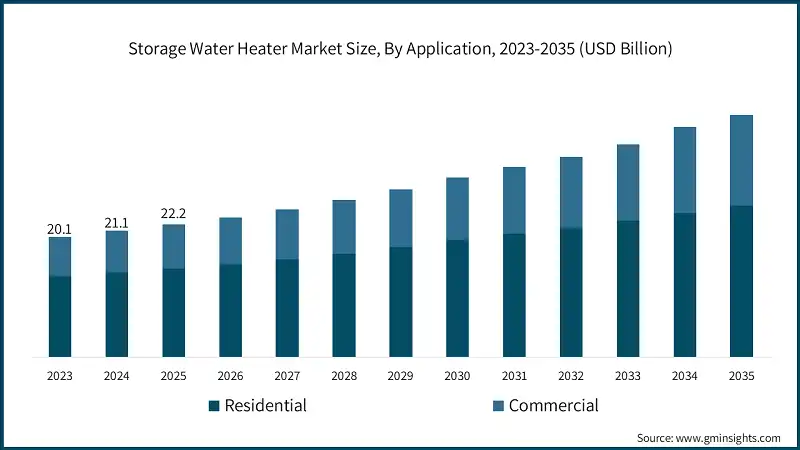
- Based on application, the market is segmented into residential and commercial. The commercial application is set to reach USD 15 billion by 2035.
- Increasingly stringent energy efficiency regulations are accelerating the shift toward high-efficiency storage water heaters. Lower energy consumption translates into reduced operating costs, making advanced models more appealing despite higher initial investments. Technological advancements including enhanced insulation materials and smart control features will improve the system performance and user convenience, strengthening the market attractiveness. Additionally, commercial facilities are upgrading or replacing aging, inefficient water heaters during renovation cycles or at the end of equipment lifespans, supporting market growth.
- For instance, in November 2025, Rinnai launched the Demand Duo R-Series, designed for commercial applications. It combines tankless performance with storage capability, designed for hotels, restaurants, and similar sectors.
- The adoption of residential storage water heaters is steadily increasing and will grow to CAGR more than 5.5% by 2035, driven by rising household energy demand, improving living standards, and the need for reliable hot water across daily domestic applications. Homeowners are increasingly shifting toward energy-efficient models that comply with tightening efficiency standards, as these systems help reduce electricity or gas consumption and lower long-term utility bills. Technological advancements such as improved tank insulation, smart thermostats, and integration with home energy management systems are enhancing performance and user convenience, further supporting adoption.
Learn more about the key segments shaping this market
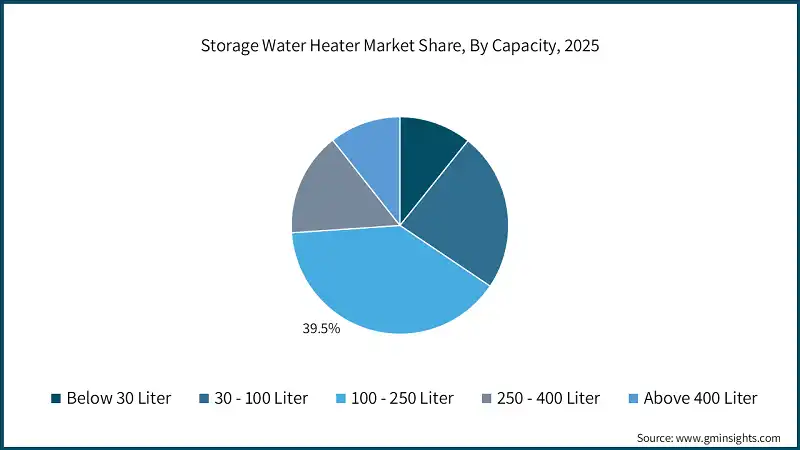
- Based on capacity, the storage water heater market is segmented into < 30 liters, 30-100 liters, 100 – 250 liters, 250-400 liters and >400 liters. The > 400 liters segment is set to grow more than 6.5% CAGR by 2035.
- Sectors such as hospitality, healthcare, and education have a high demand for large volumes of hot water. These industries are leading adopters of large-capacity storage water heaters owing to their need to supply hot water consistently. Furthermore, continuous introduction of smart & modern products delivering minimized dry firing, smart control, corrosion resistance, and efficient energy use will enhance the adoption of electric water heaters. Additionally, ongoing introduction of energy efficient devices delivering convenient solutions across end users will benefit the industry scenario.
- The < 30 liters will reach USD 4 billion by 2035 particularly in small households, apartments, and regions with space constraints. These systems are commonly used for point-of-use applications such as kitchens and bathrooms, where limited hot water demand and quick heating are priorities. Growth is supported by urbanization, rising penetration of compact housing, and affordability compared to larger systems. Additionally, increasing electrification in emerging economies and demand for basic water heating solutions in low- to mid-income households continue to drive adoption.
- 30-100 liters capacity segment is set to grow over 6.5% CAGR by 2035, driven by its suitability for small- to mid-sized households. These systems provide a balance between capacity, energy efficiency, and cost, making them ideal for daily residential use. Adoption is fueled by increasing replacement of older water heaters with energy-efficient models, compliance with efficiency regulations, and growing consumer preference for reliable hot water across multiple outlets. Government incentives and expanding residential construction activity further strengthen demand for this segment.
- 100-250 liters market will amount to more than 38% market share in 2035, especially in larger households, multi-bathroom residences, and small commercial settings such as clinics and guesthouses. Growth in this segment is driven by rising hot water consumption due to higher living standards and lifestyle changes, particularly in developed markets. Improved insulation technologies and smart temperature controls have helped reduce energy losses, making larger-capacity systems more cost-effective and attractive. The segment also benefits from renovation activities and demand for centralized hot water systems.
- 250-400 liters market is primarily adopted in high-demand residential applications, including luxury homes, villas, and apartment complexes with centralized water heating systems. Adoption is supported by rising premium housing developments and increasing preference for uninterrupted hot water supply. Although higher upfront and installation costs remain a challenge, advancements in high-efficiency designs and integration with renewable energy sources, such as solar thermal systems and heat pumps, are improving the value proposition. This segment is gaining traction in regions with strong infrastructure development and higher disposable incomes.
Looking for region specific data?
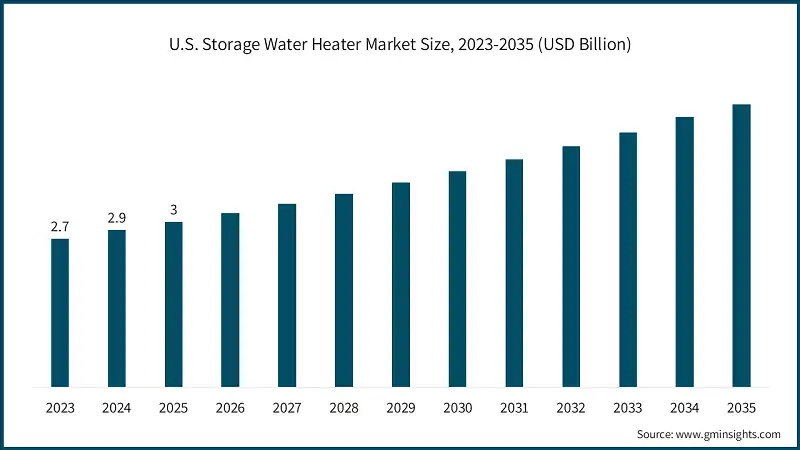
- The U.S. storage water heater market was valued at USD 2.7 billion, USD 2.9 billion, and USD 3.0 billion in 2023, 2024, and 2025, respectively. As of 2025, North America holds a market share of 19.1% which is anticipated to improve further by 2035.
- The U.S. storage water heater market is significantly enhanced by integrating energy storage solutions and attracting substantial financial investments. The rising demand for reliable renewable energy drives the adoption of solar-plus-storage projects. For instance, in July 2025, A.O. Smith introduced the Cyclone FLEX high-efficiency commercial gas water heater. It maximizes the combustion efficiency and system reliability by identifying the gas supply qualities and automatically adjusting parameters for optimal combustion control.
- Europe storage water heater market is set to reach more than USD 8 billion by 2035. Many European countries have an aging building base, creating strong demand for retrofitting and modernization of existing water heating systems. Both residential and commercial users are increasingly replacing outdated, inefficient units with advanced, energy-efficient models.
- This transition is supported by government-backed incentives, subsidies, and rebates across the region that encourages the adoption of efficient water heating technologies. Additionally, ongoing urban redevelopment and smart city initiatives are incorporating high-efficiency, digitally enabled water heating solutions, strengthening the overall market outlook.
- Asia Pacific storage water heater market will grow more than USD 13 billion by 2035, driven by rapid urbanization, rising middle-class incomes, and improving living standards across countries such as China, India, Indonesia, and Vietnam. Growing residential construction activity, particularly in urban apartments and housing complexes, is fueling demand for reliable and affordable water heating solutions.
- Government initiatives promoting electrification, energy efficiency, and reduced emissions are encouraging the replacement of traditional heating methods with modern storage water heaters. Additionally, the expanding hospitality, healthcare, and commercial sectors are contributing to higher adoption of medium- and large-capacity units, while manufacturers are focusing on compact designs, faster heating, and energy-efficient models to cater to space constraints and cost-sensitive consumers in the region.
- In Eurasia, the adoption of storage water heaters is driven by growing urbanization, rising disposable incomes, and increasing demand for reliable hot water in residential and commercial buildings. Aging infrastructure in countries like Russia and Kazakhstan has created significant replacement opportunities, while energy efficiency regulations are encouraging consumers to upgrade to modern, high-performance units. Additionally, the expansion of multi-family housing and commercial complexes is supporting demand for medium- and large-capacity water heaters, and manufacturers are focusing on energy-efficient, durable, and easy-to-install models to cater to these markets.
- CIS market will grow to CAGR 7% by 2035 owing to rising awareness of energy efficiency and government policies promoting modern appliances are encouraging the replacement of old, inefficient water heaters. Harsh climatic conditions in parts of the region further drive the need for high-capacity and reliable systems. The market growth is supported by increasing availability of both locally manufactured and imported units, alongside gradual penetration of smart and energy-efficient models.
- MEA contributed to 12.5% market share in 2025 and is anticipated to grow in the forecasted timeline. Countries including Saudi Arabia, UAE, South Africa, and Egypt are experiencing demand for both residential and commercial water heating systems, supported by government initiatives, subsidies, and incentives for efficient appliances. Additionally, modernization of existing infrastructure and large-scale housing developments are creating opportunities for medium- and high-capacity storage water heaters, while manufacturers are introducing solar-assisted and hybrid models to meet sustainability and energy-efficiency goals.
- Latin America is anticipated to grow more than 6.5% CAGR by 2035 on account of expanding urbanization, rising household incomes, and increasing commercial infrastructure in countries such as Brazil, Mexico, Chile, and Colombia. Replacement of aging water heating systems, coupled with the push for energy efficiency and reduced electricity consumption, is encouraging uptake of modern storage water heaters.
Storage Water Heater Market Share
- The top five companies operating in the storage water heater industry include A.O. Smith, Rheem Manufacturing Company, Ariston Group, Bosch Thermotechnology and Rinnai Corporation. The competition is driven by energy efficiency compliance, smart features, product reliability, and strong after-sales networks.
- The storage water heater market is intensely competitive, fueled by technological innovation, adherence to regulatory standards, and evolving consumer demands. Leading companies are prioritizing product development, energy-efficient solutions, and market expansion to maintain a strong competitive position. Additionally, the growth of distribution networks to improve market accessibility, along with strategic pricing approaches aimed at capturing market share particularly in emerging regions which will shape the industry landscape.
- Major manufacturers compete by offering energy-efficient, high-capacity, and smart-enabled water heaters that comply with increasingly stringent national and international energy regulations. Innovation in insulation, heat exchanger design, and integration with renewable or hybrid systems provides a technological edge, while companies leverage brand reputation, distribution networks, and after-sales service to strengthen market presence.
Storage Water Heater Market Companies
Key industry players operating in the storage water heater industry are:
- A.O. Smith
- Ariston Holding N.V.
- Bosch Thermotechnology
- Bradford White Corporation, USA
- Essency
- Ferroli S.p.A
- Groupe Atlantic
- Havells India Ltd.
- Hubbell Heaters
- Haier Inc.
- Jaquar India
- Linuo Ritter International Co.
- Nihon Itomic Co.
- Rheem Manufacturing Company
- Rinnai America Corporation
- State Industries.
- Saudi Ceramics Company
- Viessmann
- Vaillant
- Whirlpool Corporation
- A. O. Smith Corporation is a U.S.?based global leader in water technology, specializing in the manufacture and distribution of residential and commercial storage water heaters, boilers, and water treatment products. In 2025, the company is projected to generate revenue of USD?3.8?billion. The company received the 2025 Silver Edison Award for Sustainable Consumer Product Innovation for its Adapt gas tankless water heaters featuring built?in scale prevention technology, highlighting its commitment to energy efficiency and advanced product design.
- Ariston Holding N.V. is a globally recognized manufacturer of water heating and thermal comfort solutions. The company operates in more than 40 countries across five continents with 29 production sites and 28 R&D centers, offering a broad portfolio that includes storage water heaters, heat pump water heaters, hybrid systems, solar thermal solutions. The company’s strategic expansion initiatives include a joint venture with Lennox International to launch water heating solutions in North America, aimed at strengthening its distribution and presence in one of the world’s largest HVAC markets.
- Bosch Thermotechnology is a leading global provider of energy?efficient heating, hot water, and climate comfort solutions, including storage water heaters, heat pumps, hybrid systems, boilers, and connected home technologies. The company accounted for USD 4.7 billion in 2024, reflecting its strong position in residential and commercial heating markets. The continued evolution of its product lineup in 2025 toward sustainable and smart solutions, including expanded offerings in heat pump and hybrid water heating technologies, reinforced by its rebranding to Bosch Home Comfort Group.
Storage Water Heater Industry News
- In December 2025, A.O. Smith was selected for the prestigious Top 75 Building Products list by Building Design + Construction. The company’s Emerge-i Commercial heat pump water heater received the accolade for its innovative features and superior functionality, thereby supporting the company’s commitment to provide high-quality, innovative products to the customers.
- In November 2025, Ariston introduced the Rubis electric storage water heater, featuring a new smart hot water management system tailored to Middle East and North Africa customer needs, with improved comfort functions and energy efficiency.
- In October 2025, Voltas entered the water heater segment with a new line of storage water heaters in various capacities ranging from 10 L, 15 L, and 25 L, expanding beyond its traditional air?conditioning portfolio to meet diverse hot water needs in the Indian market.
- In December 2022, Havells India Ltd. introduced Otto and Orizzonte, its new range of storage water heaters in India. Otto comes in 10, 15 & 25 liters with an exclusive circular design, LED light indicators, and a temperature adjustment knob for modified heating. The introduction of the new products strengthened the company’s portfolio and market presence.
This storage water heater market research report includes an in-depth coverage of the industry with estimates & forecast in terms of volume and revenue in “USD Billion & ‘000 Units” from 2023 to 2035, for the following segments:
Market, By Capacity
- < 30 liters
- 30 – 100 liters
- 100 – 250 liters
- 250 – 400 liters
- >400 liters
Market, By Application
- Residential
- Commercial
- College/University
- Offices
- Government/Military
- Others
Market, By Energy Source
- Electric
- Gas
The above information has been provided for the following countries:
- North America
- U.S.
- Canada
- Europe
- UK
- France
- Germany
- Italy
- Austria
- Spain
- Netherlands
- Denmark
- Finland
- Sweden
- Norway
- Eurasia
- Russia
- Belarus
- Kazakhstan
- Kyrgyzstan
- Armenia
- CIS
- Azerbaijan
- Moldova
- Tajikistan
- Turkmenistan
- Uzbekistan
- Asia Pacific
- China
- Australia
- India
- Japan
- South Korea
- Indonesia
- Malaysia
- Singapore
- Thailand
- New Zealand
- Philippines
- Vietnam
- Middle East & Africa
- Saudi Arabia
- UAE
- Qatar
- Kuwait
- Oman
- Turkey
- South Africa
- Nigeria
- Egypt
- Israel
- Iraq
- Latin America
- Brazil
- Argentina
- Chile
- Mexico
Frequently Asked Question(FAQ) :
Who are the key players in the storage water heater market?
Key players include A.O. Smith Corporation, Rheem Manufacturing Company, Ariston Group, Bosch Thermotechnology, Rinnai Corporation, Bradford White Corporation, Essency, Ferroli, Groupe Atlantic, Havells India, Hubbell Heaters, Haier, Jaquar India, Linuo Ritter International, Nihon Itomic, State Industries, Saudi Ceramics Company, Viessmann, Vaillant, and Whirlpool Corporation.
Which region leads the storage water heater market?
North America held 19.1% market share in 2025. Integration of energy storage solutions and strong financial investments, reinforcing its regional market dominance.
What are the key trends in the storage water heater market?
Key trends include integration with smart and connected technologies, renewable and hybrid solutions including solar-assisted systems, compliance with stricter energy standards, and digitalization for energy management.
What market share did the >400 liters capacity segment target by 2035?
The >400 liters segment is set to grow at more than 6.5% CAGR by 2035, driven by high demand from hospitality, healthcare, and education sectors requiring large hot water volumes.
What is the current storage water heater market size in 2026?
The market size is projected to reach USD 23.4 billion in 2026.
How much revenue will the commercial application segment generate by 2035?
The commercial application segment is set to reach USD 15 billion by 2035, driven by stringent energy efficiency regulations and technological advancements.
What is the market size of the storage water heater in 2025?
The market size was USD 22.2 billion in 2025, with a CAGR of 6.3% expected through 2035 driven by technological advancements enhancing efficiency and usability of large-capacity systems.
What is the projected value of the storage water heater market by 2035?
The storage water heater market is expected to reach USD 40.6 billion by 2035, propelled by energy efficiency mandates, smart technologies, and renewable integration.
Storage Water Heater Market Scope
Related Reports