Summary
Table of Content

Storage Tank Market
Get a free sample of this report
Form submitted successfully!
Error submitting form. Please try again.
Thank you!
Your inquiry has been received. Our team will reach out to you with the required details via email. To ensure that you don't miss their response, kindly remember to check your spam folder as well!
Request Sectional Data
Thank you!
Your inquiry has been received. Our team will reach out to you with the required details via email. To ensure that you don't miss their response, kindly remember to check your spam folder as well!
Form submitted successfully!
Error submitting form. Please try again.
Storage Tank Market Size
The storage tank market was estimated at USD 28.5 billion in 2025. The market is expected to grow from USD 29.6 billion in 2026 to USD 44.8 billion in 2035, at a CAGR of 5.3%, according to latest report published by Global Market Insights Inc.
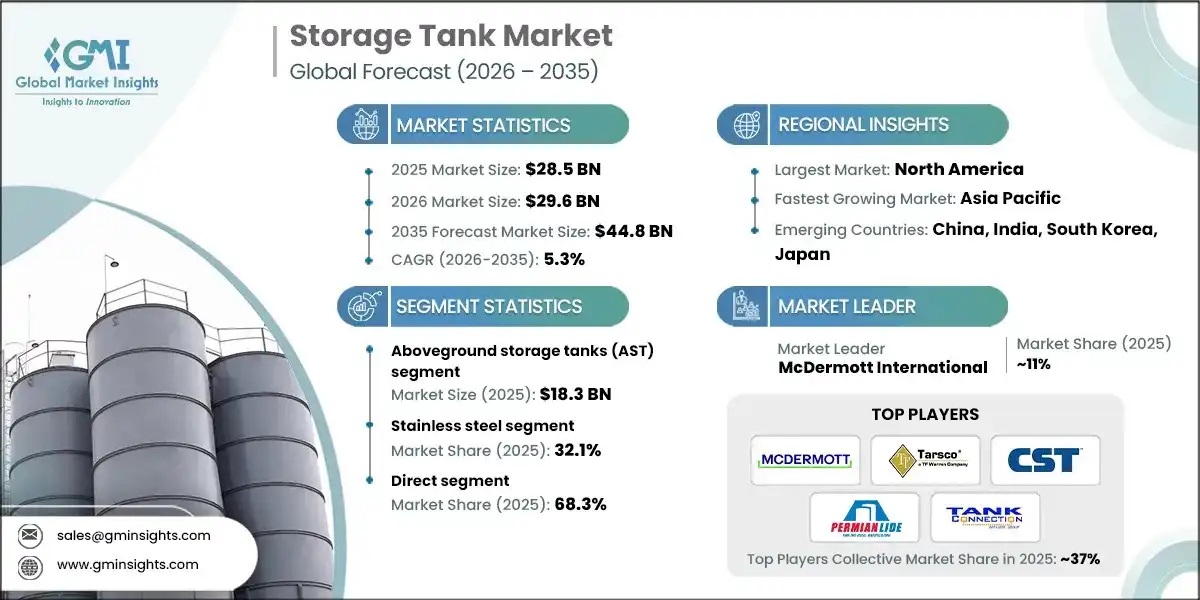
To get key market trends
- Expansion of oil and gas and petrochemical infrastructure projects is driving growth in the storage tank market. In July?2025, it is reported that India is planning to build three new strategic petroleum reserve facilities in Bikaner, Mangalore, and Bina with capacities of 5.2–5.3?million?tons, 1.75?million?tons, and a further facility of yet?to?be?set capacity, respectively. Rising exploration, production, and refining activities require large-capacity tanks for safe storage of crude oil, refined products, and chemicals. Industrial facilities are investing in tanks made from stainless steel, fiberglass, and carbon steel to ensure durability and corrosion resistance. Storage solutions are essential for managing inventory, maintaining supply continuity, and supporting operational efficiency. Increasing energy demand and new refinery setups are contributing to recurring orders for both aboveground and underground tanks. Construction of petrochemical complexes is creating demand for specialized tanks designed for hazardous or volatile substances. Growing emphasis on reliable storage infrastructure is influencing procurement decisions across the industry.
- Growth of wastewater treatment and recycling facilities is driving demand in the storage tank market. Treatment plants require large-capacity tanks to store and process water, sludge, and chemical reagents efficiently. Municipal and industrial facilities are investing in corrosion-resistant tanks made from stainless steel, concrete, and polyethylene for long-term durability. Proper storage solutions help maintain consistent treatment processes and meet environmental discharge standards. Expansion of recycling initiatives is increasing the need for tanks to collect, segregate, and store reclaimed water safely. Governments and private operators are emphasizing infrastructure upgrades to support sustainable water management. In 2024, the EPA’s most recent wastewater infrastructure demands assessment identified approximately?17,500 publicly owned wastewater treatment works operating in the U.S. serving around 270?million people, indicating a large and expanding wastewater treatment system requiring significant infrastructure capacity. Advanced tanks with monitoring and containment features are being adopted to reduce leakage and operational risks. Rising awareness of water conservation and regulatory compliance is encouraging facility owners to modernize storage systems.
- The stainless steel segment in the storage tank market is valued for its strength, corrosion resistance, and long service life. These tanks are widely used in food and beverage, chemical, pharmaceutical, and water storage applications due to their ability to maintain product purity and withstand harsh environments. Smooth surfaces prevent contamination and allow easy cleaning, supporting hygienic storage. Increasing demand for durable and low-maintenance storage solutions is driving adoption. The combination of structural integrity, resistance to chemical reactions, and versatility in design makes stainless steel storage tanks a preferred choice across multiple industries globally.
Storage Tank Market Report Attributes
| Key Takeaway | Details |
|---|---|
| Market Size & Growth | |
| Base Year | 2025 |
| Market Size in 2025 | USD 28.5 Billion |
| Market Size in 2026 | USD 29.6 Billion |
| Forecast Period 2026-2035 CAGR | 5.3% |
| Market Size in 2035 | USD 44.8 Billion |
| Key Market Trends | |
| Drivers | Impact |
| Expansion of oil and gas and petrochemical infrastructure projects | Industrial storage requirements boost demand for high-capacity and corrosion-resistant tanks. |
| Growth of wastewater treatment and recycling facilities | Environmental infrastructure development increases usage of specialized containment tanks. |
| Rising demand for water storage due to urbanization and population growth | Increased municipal and residential water needs drive large-scale installation of storage tanks. |
| Pitfalls & Challenges | Impact |
| High capital cost of large-capacity and customized storage tanks | Budget constraints delay project execution and reduce short-term demand. |
| Budget constraints delay project execution and reduce short-term demand. | Maintenance burdens increase lifecycle costs for end users. |
| Opportunities: | Impact |
| Rising demand for modular and prefabricated storage tank solutions | Faster installation methods improve project efficiency and adoption rates |
| Growing use of advanced coatings and composite materials | Enhanced durability extends tank life and supports premium product positioning. |
| Market Leaders (2025) | |
| Market Leaders |
Market share of ~11% |
| Top Players |
|
| Competitive Edge |
|
| Regional Insights | |
| Largest Market | North America |
| Fastest growing market | Asia Pacific |
| Emerging countries | China, India, South Korea, Japan |
| Future outlook |
|
What are the growth opportunities in this market?
Storage Tank Market Trends
- The growth of oil and gas projects is increasing demand for large-capacity storage tanks. Refineries, terminals, and distribution facilities require reliable tanks for crude oil, refined products, and chemicals. Companies are seeking corrosion-resistant materials and advanced coatings to extend tank life. Manufacturers are innovating modular and prefabricated designs for faster installation and maintenance. Rising exploration and production activities are creating continuous demand across upstream, midstream, and downstream sectors.
- Wastewater treatment plants are adopting storage tanks to manage water, sludge, and chemical reagents efficiently. Municipal and industrial facilities require corrosion-resistant tanks for long-term durability and safe storage. Expansion of recycling initiatives increases the need for tanks to store reclaimed water securely. Manufacturers are developing polyethylene, stainless steel, and concrete tanks suitable for diverse processes. Facility managers prioritize reliable tanks that minimize maintenance and operational risks.
- Chemical and petrochemical facilities rely on storage tanks for safe handling of hazardous liquids and gases. Tanks must comply with stringent safety and environmental regulations. Buyers are prioritizing materials that resist chemical corrosion and ensure long-term operational reliability. Manufacturers are producing tanks with enhanced safety features and monitoring systems. Continuous expansion of chemical production in emerging markets is increasing storage needs.
- Modular and prefabricated tanks are gaining popularity due to easier installation and reduced construction timelines. These designs allow flexible configurations for different storage capacities and applications. Buyers value tanks that simplify maintenance while minimizing downtime. Manufacturers are offering standardized units that can be quickly delivered and installed on-site. Modular designs support expansion projects without major structural modifications.
- Environmental and operational concerns are driving adoption of sustainable and corrosion-resistant storage tanks. Materials like stainless steel, fiberglass, and coated concrete enhance longevity and reduce maintenance requirements. Facility managers are seeking tanks that minimize chemical leaching and environmental impact. Manufacturers are innovating coatings and lining technologies to improve tank durability and performance. Increasing regulations for safe storage and waste management influence material selection.
Storage Tank Market Analysis
Learn more about the key segments shaping this market
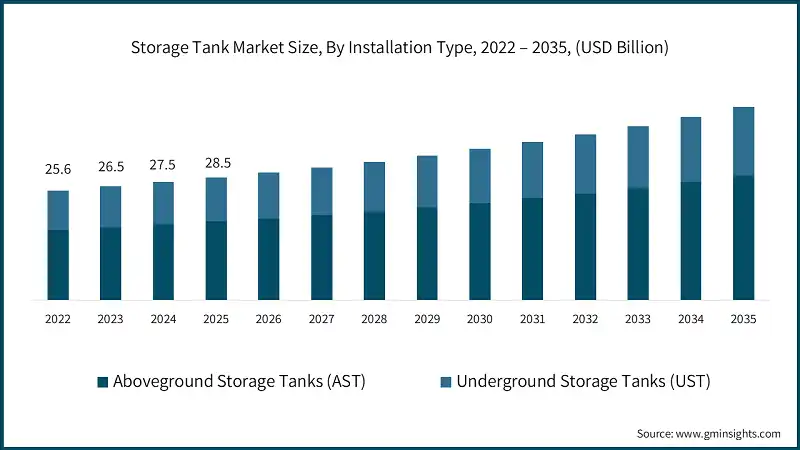
Based on installation type, the market is categorized into aboveground storage tanks (AST), underground storage tanks (UST). The aboveground storage tanks (AST) segment accounted for revenue of around USD 18.3 billion in 2025 and is anticipated to grow at a CAGR of 5.4% from 2026 to 2035.
- The aboveground storage tank (AST) segment holds a prominent position in the storage tank market due to ease of installation, inspection, and maintenance. These tanks are suitable for storing liquids such as water, chemicals, and petroleum products in industrial, municipal, and commercial facilities. Construction materials like stainless steel, concrete, and polyethylene ensure durability and resistance to corrosion and environmental factors.
- Additionally, ASTs allow flexible capacity expansion and quick accessibility for monitoring and repairs. Growing demand from oil and gas, chemical, and wastewater treatment sectors is driving adoption. The combination of operational efficiency, safety, and adaptability makes aboveground storage tanks a widely preferred choice in global storage applications.
Based on material, the market consists of stainless steel, polyethylene, fiberglass, concrete and others. The stainless steel emerged as leader and held 32.1% of the total market share in 2025 and is anticipated to grow at a CAGR of 4.9% from 2026 to 2035.
- The stainless steel segment holds a significant share in the storage tank market due to its durability, corrosion resistance, and long-term reliability. These tanks are widely used across oil and gas, chemical, water treatment, and food and beverage industries, where product purity and structural integrity are critical. Smooth surfaces enable easy cleaning and minimize contamination risks, supporting hygienic storage.
- High strength and resistance to extreme temperatures make stainless steel tanks suitable for diverse environments. Growing industrialization, infrastructure development, and demand for low-maintenance storage solutions are driving adoption, reinforcing stainless steel as a preferred material in the global market.
Learn more about the key segments shaping this market
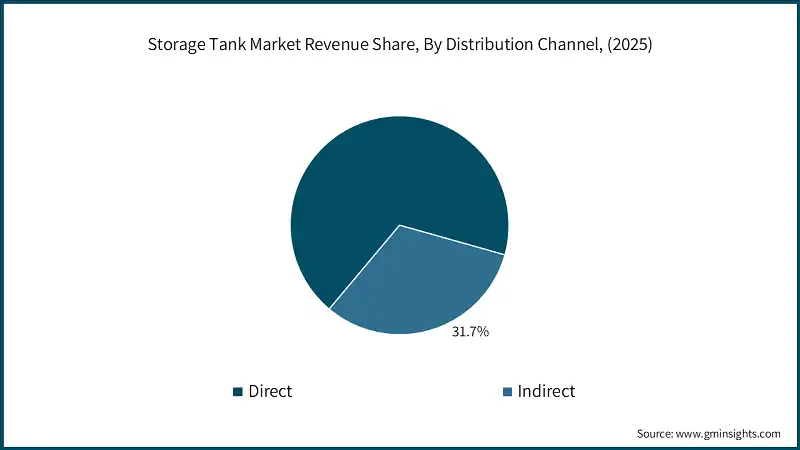
Based on distribution channel, storage tank market consists of direct and indirect. The direct emerged as leader and held 68.3% of the total market share in 2025 and is anticipated to grow at a CAGR of 5.4% from 2026 to 2035.
- The direct distribution channel holds a strong position in the global market due to its ability to provide customized solutions and direct support to industrial and commercial clients. Purchasing directly from manufacturers ensures tailored designs, timely delivery, and technical assistance during installation and maintenance. This approach allows buyers to specify material, capacity, and structural requirements according to operational needs.
- Growing demand from oil and gas, chemical, water treatment, and food processing industries is driving adoption. The combination of personalized service, reliability, and seamless communication makes the direct distribution channel a preferred choice for procuring storage tanks globally.
Looking for region specific data?
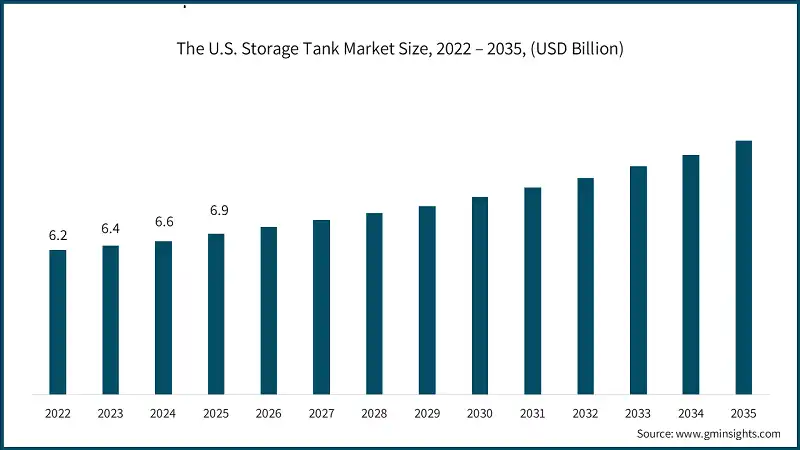
The U.S. dominates an overall North America storage tank market and was valued at USD 6.9 billion in 2025 and is estimated to grow at a CAGR of 5.3% from 2026 to 2035.
- The U.S. market is driven by expansion in the oil and gas, petrochemical, and water treatment industries. Large-scale infrastructure and refinery projects require aboveground storage tanks for petroleum products and chemicals. Municipal and industrial wastewater treatment facilities increasingly adopt corrosion-resistant tanks for water, sludge, and chemical storage. Rising demand for food-grade and industrial liquid storage supports growth in stainless steel, polyethylene, and fiberglass tanks.
- Strict safety and environmental regulations influence tank design, materials, and maintenance practices. Technological advancements in tank monitoring, leak detection, and modular construction enhance operational efficiency. Steady investment in energy, chemical, and municipal projects continues to sustain demand across the U.S.
In the Europe storage tank market, Germany held 27% market share in 2025 and is anticipated to grow at a CAGR of 5.7% from 2026 to 2035.
- The Europe market is influenced by stringent environmental and safety regulations governing chemical, petroleum, and wastewater storage. Countries such as Germany, France, and the Netherlands emphasize corrosion-resistant and double-walled tanks to prevent leaks and environmental contamination. Industrial expansion in sectors like chemicals, food processing, and water treatment drives demand for durable stainless steel and fiberglass tanks. Retrofit and modernization of aging storage infrastructure in urban and industrial areas support replacement and upgrade projects.
- Adoption of modular and prefabricated tank systems enhances installation efficiency and compliance with EU standards. Growing focus on sustainable storage solutions and energy-efficient designs contributes to steady market growth across European industrial and municipal applications.
In the Asia Pacific storage tank market, China held 30.5% share in 2025 and is expected promising growth from 2026 to 2035.
- The Asia Pacific market is expanding due to rapid industrialization and urban infrastructure development. China, India, and Southeast Asian countries lead demand for large-capacity tanks in oil, gas, and chemical industries. Municipal water supply and wastewater treatment projects increasingly require corrosion-resistant and high-durability tanks. Growing food and beverage processing industries also drive demand for hygienic storage solutions.
- Government initiatives to improve water management and environmental compliance support adoption of advanced tank technologies. Prefabricated and modular tanks are gaining traction due to ease of installation and scalability. Increasing industrial investment in emerging economies sustains steady market growth across the Asia Pacific region.
In the Middle East and Africa storage tank market, Saudi Arabia held 35.7% share in 2025 and promising growth from 2026 to 2035.
- The Middle East and Africa market is driven by large-scale oil, gas, and petrochemical infrastructure projects in Gulf countries such as Saudi Arabia and the UAE. High ambient temperatures and harsh climatic conditions increase demand for corrosion-resistant and heat-tolerant storage solutions. Industrial and municipal water storage needs are rising due to rapid urbanization and infrastructure development in emerging African economies.
- Prefabricated and modular tank systems are preferred for ease of transport and installation in remote or challenging locations. Investments in food and beverage processing, as well as mining and chemical industries, further support demand. Government regulations on safety and environmental compliance are shaping material selection and tank design across the region.
Storage Tank Market Share
- In 2025, the prominent manufacturers in storage tank industry are McDermott International, Tarsco, CST Industries, PermianLide, and Tank Connection collectively held the market share of ~37%.
- McDermott is a major global supplier of engineered storage tank solutions for oil & gas, chemicals and industrial applications. The company emphasizes turnkey project capabilities, large?scale fabrication and integration with infrastructure works. It invests in engineering excellence, compliance and global delivery excellence to serve energy and industrial clients across multiple regions.
- Tarsco, part of TF Warren Group, specializes in welded carbon steel tanks, turnkey installation and field services for energy and industrial markets. The company leverages a strong manufacturing footprint and project execution expertise to win large storage tank contracts, particularly in oil & gas and chemical storage. Its breadth supports both retrofit and new build demand.
Storage Tank Market Companies
Major players operating in the storage tank industry include:
- Caldwell Tanks
- CST Industries
- Fox Tank Company
- Highland Tank & Manufacturing Company
- McDermott International
- Motherwell Bridge Industries
- PermianLide
- Pfaudler Group
- Snyder Industries
- Superior Tank Co.
- Synalloy Corporation
- Tank Connection
- Tarsco
- Worthington Industries
- ZCL Composites
CST Industries produces bolted and coated steel tanks for water, wastewater, industrial and energy sectors. The company’s extensive installed base and manufacturing scale support global project execution. CST invests in corrosion protection technologies and modular tank systems to meet diverse storage needs with regulatory compliance and long?term performance.
PermianLide delivers engineered storage tanks and containment solutions tailored for midstream oil & gas and industrial applications. The firm emphasizes technical engineering, quality fabrication and industry compliance. PermianLide’s strategic focus on cost?effective, durable tank systems and project support services underpins its competitive position in North American and export markets.
Tank Connection is known for custom?engineered tank solutions, especially bolted storage tanks used in oil & gas, food and water sectors. The company’s strength lies in design flexibility, compliance with industry standards and global service reach. Continuous investment in engineering and scalable manufacturing enables Tank Connection to serve diversified storage projects.
Storage Tank Machine Industry News
- In June?2025, ZCL Composites introduced a new line of double?wall, corrosion?resistant fiberglass storage tanks. These tanks are designed for hazardous liquids and industrial applications, broadening product offerings for chemical and energy infrastructure projects.
- In March?2025, Vopak announced plans to expand its joint?venture terminal in Thailand to support U.S. ethane imports, including construction of approximately 160,000?m³ of new tank storage capacity at Map Ta Phut. This project is backed by a long?term contract with PTT Global Chemical and reinforces regional petrochemical logistics infrastructure.
- In March?2025, CST Industries announced the acquisition of Snyder Industries to expand its fiberglass above?ground storage tank portfolio and delivery capabilities. This strategic move strengthens CST’s position in chemical and industrial storage markets by broadening available tank types and project scopes.
- In October?2024, Tank Connection secured a major contract to supply a bolted tank farm for grain and liquid storage across multiple North American sites. This development highlights expansion of industrial storage infrastructure beyond traditional oil & gas applications.
The storage tank market research report includes in-depth coverage of the industry, with estimates & forecast in terms of revenue (USD Billion) and volume (Thousand Units) from 2022 to 2035, for the following segments:
Market, By Product Type
- Hazardous Storage Tanks
- Non-Hazardous Storage Tanks
Market, By Installation Type
- Aboveground Storage Tanks (AST)
- Underground Storage Tanks (UST)
Market, By Material
- Stainless Steel
- Polyethylene
- Fiberglass
- Concrete
- Others
Market, By End Use Industry
- Oil & Gas Industry
- Chemical Industry
- Water and Wastewater Treatment
- Food and Beverage Industry
- Pharmaceutical Industry
- Others
Market, By Distribution Channel
- Direct
- Indirect
The above information is provided for the following regions and countries:
- North America
- U.S.
- Canada
- Europe
- Germany
- UK
- France
- Italy
- Spain
- Asia Pacific
- China
- Japan
- India
- South Korea
- Australia
- Latin America
- Brazil
- Mexico
- Argentina
- MEA
- Saudi Arabia
- UAE
- South Africa
Frequently Asked Question(FAQ) :
Who are the key players in the storage tank market?
Key players include McDermott International, Tarsco, CST Industries, PermianLide, Tank Connection, Caldwell Tanks, Fox Tank Company, Highland Tank & Manufacturing Company, Motherwell Bridge Industries, Pfaudler Group, Snyder Industries, Superior Tank Co., Synalloy Corporation, Worthington Industries, and ZCL Composites.
What are the upcoming trends in the storage tank market?
Key trends include adoption of modular and prefabricated tank systems for faster installation, advanced coatings and composite materials for enhanced durability, smart monitoring systems with leak detection, and sustainable eco-friendly storage solutions.
Which region leads the storage tank market?
North America leads the market with the U.S. with USD 6.9 billion in 2025 and is projected to register at a 5.3% CAGR through 2035. Expansion in oil & gas, petrochemical, and water treatment industries fuel the region's dominance.
What is the market size of the storage tank in 2025?
The market size was USD 28.5 billion in 2025, with a CAGR of 5.3% expected through 2035 driven by expanding oil & gas and petrochemical infrastructure projects and growth of wastewater treatment facilities.
What is the projected value of the storage tank market by 2035?
The storage tank market is expected to reach USD 44.8 billion by 2035, propelled by rising demand for water storage due to urbanization, modular tank solutions, and advanced coatings and composite materials.
What is the current storage tank market size in 2026?
The market size is projected to reach USD 29.6 billion in 2026.
How much revenue did the aboveground storage tanks (AST) segment generate in 2025?
Aboveground storage tanks (AST) generated around USD 18.3 billion in 2025, driven by ease of installation, inspection, and maintenance across industrial and municipal applications.
What is the growth outlook for the direct distribution channel from 2026 to 2035?
The direct distribution channel held 68.3% market share in 2025 and is projected to grow at a CAGR of 5.4% through 2035, driven by customized solutions and direct technical support.
What was the market share of the stainless steel material segment in 2025?
Stainless steel held 32.1% of the total market share in 2025 and is anticipated to grow at a CAGR of 4.9% from 2026 to 2035.
Storage Tank Market Scope
Related Reports