Summary
Table of Content

Protein A Resins Market
Get a free sample of this report
Form submitted successfully!
Error submitting form. Please try again.
Thank you!
Your inquiry has been received. Our team will reach out to you with the required details via email. To ensure that you don't miss their response, kindly remember to check your spam folder as well!
Request Sectional Data
Thank you!
Your inquiry has been received. Our team will reach out to you with the required details via email. To ensure that you don't miss their response, kindly remember to check your spam folder as well!
Form submitted successfully!
Error submitting form. Please try again.
Protein A Resins Market Size
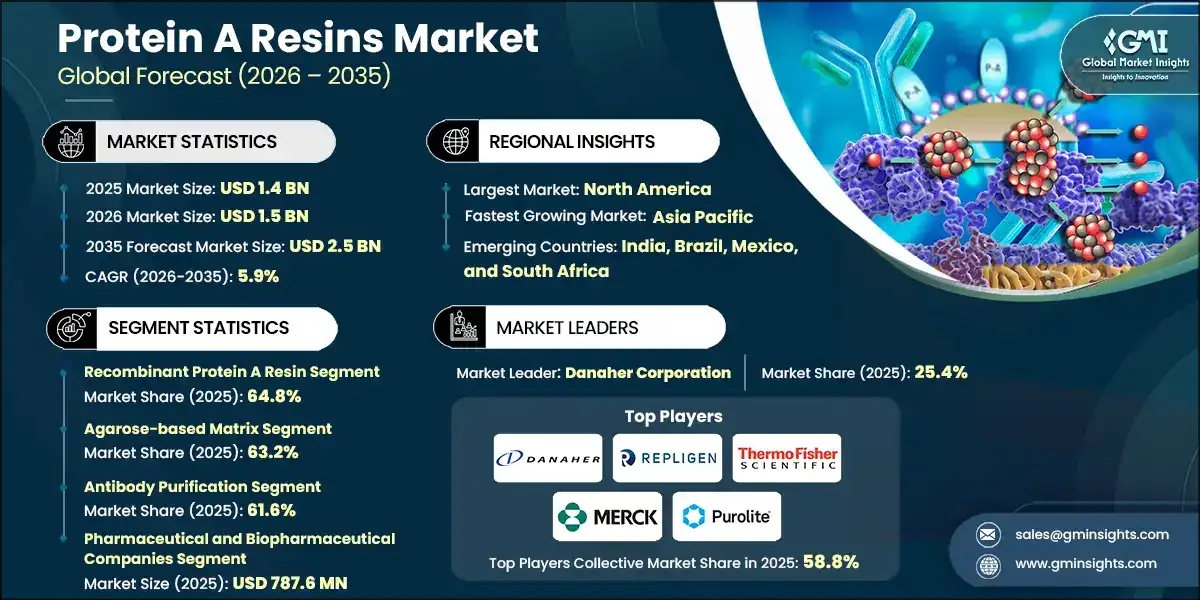
The global Protein A resins market was valued at USD 1.4 billion in 2025. The market is expected to grow from USD 1.5 billion in 2026 to USD 2.5 billion in 2035, growing at a CAGR of 5.9%, according to the latest report published by Global Market Insights Inc. Protein A resin is a high-affinity chromatography medium. It’s used for the one-step purification of monoclonal antibody products (mAb) and immunoglobulins. Major players in the protein A resins industry include Danaher Corporation, Repligen Corporation, Thermo Fisher Scientific, Merck, and Purolite.
To get key market trends
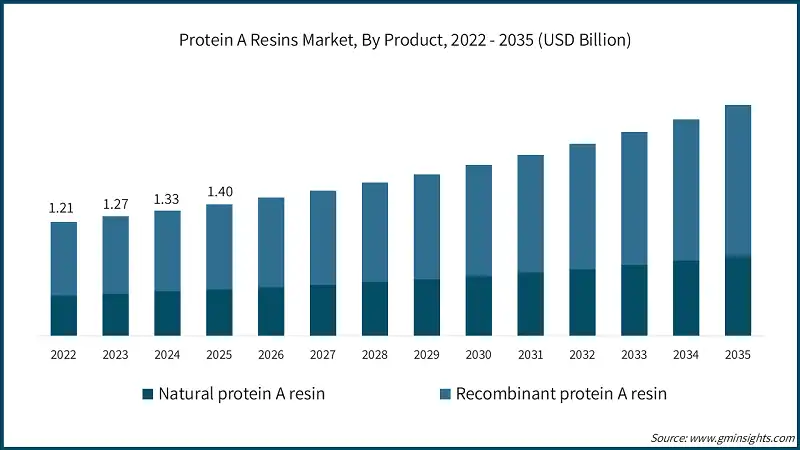
The global market increased from USD 1.2 billion in 2022 to USD 1.3 billion in 2024. The increasing prevalence of chronic diseases, such as diabetes, cardiovascular diseases, cancer, chronic kidney diseases (CKD) are significant factors driving the market growth. For instance, in 2021, as per the data from the WHO, non-communicable disease was responsible for 43 million deaths worldwide among this cardiovascular disease was responsible for at least 19 million deaths followed by cancer with 10 million, chronic respiratory diseases with 4 million.
Thus, this alarming statistic highlights the growing need for biopharmaceuticals. Protein A resins play a critical role in the purification process of these biopharmaceuticals and biologics during manufacturing, ensuring high purity and efficacy. As pharmaceutical companies scale up production to meet growing therapeutic needs, the reliance on efficient protein A resins intensifies, fostering the market growth.
Additionally, the global protein A resins market is experiencing significant growth due to the growing elderly population worldwide. For instance, according to data provided by the United Nations, it is projected that the global population aged 65 years and older will reach around 1.5 billion by 2050, representing 16% of the world’s population. Moreover, according to data from the Population Reference Bureau, individuals in the U.S. aged 65 and older are projected to reach 82 million by 2050, up from 58 million in 2022.
The population of this demographic is more likely to have chronic disease conditions, these conditions often require biologic therapies, including monoclonal antibodies, and vaccines, which is estimated to reach USD 145.8 billion by 2034. These therapies depend on protein A resins for efficient purification during manufacturing. Therefore, the aging demographic not only amplifies the demand for advanced pharmaceuticals but also reinforces the critical role of protein A resins in meeting these healthcare needs, ensuring sustained market growth in the coming decades.
Protein A Resins Market Report Attributes
| Key Takeaway | Details |
|---|---|
| Market Size & Growth | |
| Base Year | 2025 |
| Market Size in 2025 | USD 1.4 Billion |
| Market Size in 2026 | USD 1.5 Billion |
| Forecast Period 2026 - 2035 CAGR | 5.9% |
| Market Size in 2035 | USD 2.5 Billion |
| Key Market Trends | |
| Drivers | Impact |
| Rising demand for vaccine and therapeutic antibodies | Drives strong resin consumption for monoclonal antibody capture and large-scale biopharmaceutical production. |
| Increasing prevalence of chronic diseases | Expands biologic pipelines for oncology and autoimmune conditions, increasing purification needs. |
| Growing drug discovery and research and development activity | Creates demand for laboratory-scale and bulk resins as more early-stage programs and method development occur. |
| Technology advancements in protein A resins | Improves productivity and cost efficiency through innovations such as alkaline-stable ligands and high-capacity resins. |
| Pitfalls & Challenges | Impact |
| Rise in alternative methods for the purification of monoclonal antibodies | Reduces reliance on Protein A as synthetic ligands and mixed-mode resins replace it in certain workflows |
| High cost of the matrix resins | Limits adoption because upfront and lifecycle costs remain significant, especially for clinical-phase programs |
| Opportunities: | Impact |
| Regional expansion in emerging markets | Boosts demand as Asia-Pacific countries rapidly scale biomanufacturing capacity and adopt dual-sourcing strategies |
| Sustainability and cost-effectiveness | Encourages adoption of eco-friendly materials, longer resin lifecycles, and robust cleaning-in-place solutions |
| Market Leaders (2025) | |
| Market Leaders |
25.4% market share |
| Top Players |
|
| Competitive Edge |
|
| Regional Insights | |
| Largest Market | North America |
| Fastest Growing Market | Asia Pacific |
| Emerging Countries | India, Brazil, Mexico, and South Africa |
| Future outlook |
|
What are the growth opportunities in this market?
Protein A Resins Market Trends
- The growth of the market is strongly supported by increased investment in life science research, expansion of biotechnological and pharmaceutical manufacturing, and heightened regulatory emphasis on quality control.
- For instance, as per the April 2025 report issued by the U.S. commission, the government will make around USD 15 billion investment in the field of biotechnology to boost the country's biotechnology sector.
- Similarly, the National Institutes of Health (NIH), invested nearly USD 48 billion in 2023 to advance medical research pertaining to reduce illness and disability. Moreover, the FDA's Orphan Products Grants Program allocated USD 17.2 million to support seven clinical trials in fiscal year 2024, including a Phase 3 trial for a rare skin disease.
- Thus, such investments propel the research and development activities across various subdomains of the pharmaceutical and biotechnological sectors, such as vaccine development and personalized medicine research, which in turn stimulate the demand for monoclonal antibodies, biologics, and vaccines, which require efficient purification processes using protein A resins.
- Therefore, the surge in research and development and manufacturing activities directly stimulates the need for high-performance protein A resins, propelling the market growth across the globe.
Protein A Resins Market Analysis
Learn more about the key segments shaping this market
Based on product, the global protein A resins market is segmented into natural protein A resin and recombinant protein A resin. The recombinant protein A resin segment dominated the market with the largest revenue share of 64.8% in 2025.
- Recombinant resins provide higher binding capacity, improved stability, and consistent quality, making them the preferred choice for large-scale production of monoclonal antibodies and other biologics.
- Additionally, advancements in recombinant technology have enabled manufacturers to develop resins with enhanced chemical resistance and longer operational life, which helps reduce overall production costs.
- These advantages, combined with the growing demand for therapeutic antibodies and personalized medicines, have driven the dominance of recombinant protein A resins in the market.
Based on matrix type, the global protein A resins market is segmented into agarose-based matrix, glass or silica gel-based matrix, and organic polymer-based matrix. The agarose-based matrix segment dominated the market, with a share of 63.2% in 2025, primarily due to its superior performance characteristics and widespread use in biopharmaceutical purification processes.
- Agarose-based matrices offer high mechanical strength, excellent flow properties, and compatibility with large-scale chromatography systems, making them ideal for industrial applications.
- For example, Thermo Fisher Scientific’s MabCaptureC Affinity Matrix is an agarose-based, high-binding-capacity protein A chromatography resin featuring a recombinant protein A ligand produced in yeast. This engineered ligand binds at the CH2-CH3 interface of the Fc region of IgGs and exhibits cross-binding to the VH3 domain, ensuring efficient monoclonal antibody purification.
- The ligand is immobilized on highly cross-linked, uniform-sized agarose beads with an average particle size of 75 μm, delivering superior performance compared to traditional protein A resins.
- These technical advantages, combined with the growing demand for high-purity biologics, have reinforced the dominance of agarose-based matrices in the protein A resin market.
Based on application, the global protein A resins market is segmented into immunoprecipitation and antibody purification. The antibody purification segment dominated the application segment within the market, with a share of 61.6% in 2025.
- The increasing prevalence of chronic diseases, such as autoimmune disorders and cancer, continues to be a major driver of growth in the protein A resins market. For instance, according to data from the WHO, an estimated 20 million new cancer cases were reported globally in 2022, resulting in approximately 9.7 million deaths. Moreover, WHO data indicates that about 1 in 5 individuals will develop cancer during their lifetime, with around 1 in 9 men and 1 in 12 women succumbing to the disease.
- These alarming figures highlight the growing burden of cancer and underscore the critical need for advanced therapeutics, such as monoclonal antibodies. Biopharmaceutical companies are investing heavily in the production of therapeutic antibodies, which require robust purification systems to ensure product quality and safety, fostering the segment's growth.
- Additionally, advancements in recombinant protein A technology and the expansion of biologics manufacturing have further strengthened the use of protein A resins in antibody purification, making it the dominant application segment in the market.
Learn more about the key segments shaping this market
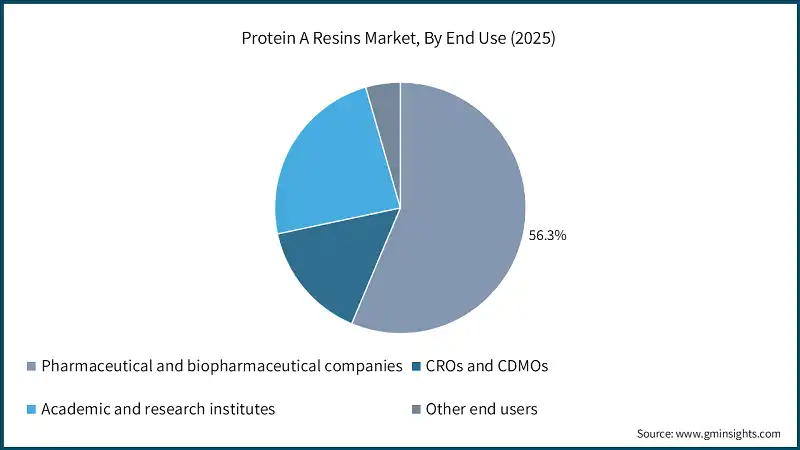
Based on end use, the global protein A resins market is segmented into pharmaceutical and biopharmaceutical companies, contract research organization (CROs) and contract development and manufacturing organization (CDMOs), academic and research institutes, and other end users. The pharmaceutical and biopharmaceutical companies segment dominated the market with the largest revenue of USD 787.6 million in 2025, primarily due to their widespread involvement in the development and large-scale production of biologics, including monoclonal antibodies.
- These companies require high-performance protein A resins for efficient purification processes to ensure product quality, safety, and regulatory compliance. The growing prevalence of chronic diseases, coupled with the rising demand for targeted therapies and personalized medicines, has driven significant investments in biologics manufacturing by these firms.
- Additionally, the expansion of production facilities and increased research and development activities to develop innovative antibody-based drugs further reinforce their reliance on protein A resins, making pharmaceutical and biopharmaceutical companies the leading end users in this market.
Looking for region specific data?
North America Protein A Resins Market
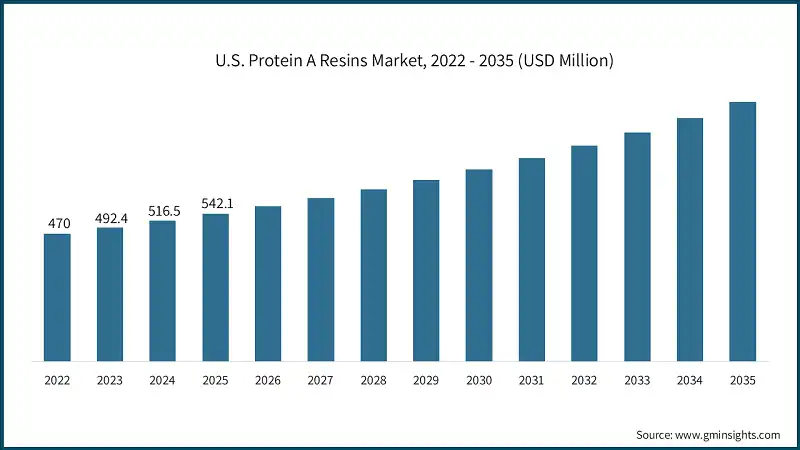
The North America dominated the market with a market share of 42.5% in 2025. The U.S. market is projected to grow significantly, from USD 542.1 million in 2025 to USD 952.4 million by 2035.
- The increasing prevalence of cancer is the key driver for the growth of the market in the U.S.
- For instance, as per the data from the American Cancer Society in 2025, around 2,041,910 new cases of cancer were to be diagnosed, and 618,120 cases of cancer related deaths are projected to occur in the U.S.
- Thus, this rising burden of the cancer is propelling the market in the U.S. as many pharmaceutical and biotechnology companies and research institutes are undertaking various research to develop advanced therapeutics such as the monoclonal antibodies to combat the disease in the country.
- This, in turn, is increasing the reliance of pharmaceutical companies on protein A resin for the purification of antibodies, fostering market growth in the region.
Europe Protein A Resins Market
Europe market accounted for USD 362.7 million in 2025 and is anticipated to show lucrative growth over the forecast period.
- The rising prevalence of chronic diseases in the region coupled with the increasing government initiatives to enhance drug discovery and research and development is anticipated to spur the growth of the market.
- Moreover, the presence of key market players in the region reinforces Europe’s strength in the market. These companies are actively participating in innovation through the development of innovative solutions, thereby aiding market growth.
The protein A resins market in Germany is expected to experience significant and promising growth from 2026 to 2035.
- Germany is the center for innovation and scientific research, with strong investments in academic institution and private research and development labs.
- For instance, according to data published by the Federal Ministry of Research, Technology, and Space, Germany has over 1,000 publicly funded research organizations and research and development centers run by industrial companies.
- Therefore, the increasing number of medical research facilities and medical research and development activities upsurges the need for advanced protein A resin for proper purification of the therapeutically active antibodies and biologics, thereby propelling the growth of the market in the country.
Asia Pacific Protein A Resins Market
The Asia Pacific market is anticipated to grow at the CAGR of 6.3% during the analysis timeframe.
- The market in the Asia Pacific region is expanding rapidly due to the growing burden of chronic diseases, rising health awareness, and continuous advancements and investment in pharmaceutical and biopharmaceutical sector.
- Advancements in healthcare infrastructure, including the construction of new academic and research laboratories, geographical expansion of pharmaceutical and biopharmaceutical companies, are propelling the demand for advanced protein A resin to ensure the regulatory compliance of antibodies and biologics produced by the companies, thereby propelling the market growth in the region.
- Additionally, rapid growth in government policies aimed at improving medical research and development activities, such as vaccine and biologics development, is further contributing to the growth of the market in the region.
China protein A resins market is anticipated to witness lucrative growth between 2026 - 2035.
- The country has a rapidly increasing aging population that necessitates frequent healthcare intervention.
- For instance, as per the estimates from the World Health Organization in 2019, approximately 254 million people of the age group 65 and above were residing in the country. This number is projected to rise significantly, with 402 million people expected to be over the age of 60 by 2040.
- The population of this demographic is more likely to have chronic disease conditions, which often require frequent medical intervention, in turn stimulating the need for medication and vaccines that are associated with the treatment of these elderly individuals, which depend on protein A resins for efficient purification during manufacturing, thereby propelling the market growth in the country.
Latin America Protein A Resins Market
The Brazil market is expected to experience significant and promising growth from 2026 to 2035.
- Brazil's commitment to enhancing its research capabilities, supported by both public and private funding, has led to the establishment of more sophisticated laboratories that require technologically advanced and efficient protein A resin for purification of the biologics.
- This growth is further fuelled by the trend towards precision medicine, and biopharmaceuticals, both of which significantly increase the demand for high-performance protein A resin solutions in Brazil.
Middle East and Africa Protein A Resins Market
The Saudi Arabia market is expected to experience significant and promising growth from 2026 to 2035.
- Saudi Arabia’s Vision 2030 initiative emphasizes the development of advanced healthcare systems and the localization of pharmaceutical and biopharmaceutical production, creating strong demand for high-quality purification technologies such as protein A resin.
- Moreover, increased government and private sector funding for research and development, coupled with the establishment of modern laboratories and biomanufacturing facilities, further accelerates market expansion.
Protein A Resins Market Share
The global market is characterized by a dynamic mix of international and regional players delivering advanced purification solutions to meet the growing demand for efficient antibody processing in biopharmaceutical manufacturing. Top 5 companies such as Danaher Corporation, Repligen Corporation, Thermo Fisher Scientific, Merck, and Purolite collectively account for approximately 58.8% of the market share, highlighting their strong dominance in this sector.
The market remains highly competitive, with major corporations and emerging suppliers investing heavily in next-generation technologies such as high-capacity alkaline-stable resins, continuous chromatography systems, and membrane-based protein A solutions. Strategic collaborations with biopharmaceutical companies, CDMOs, and research institutions are critical for accelerating adoption of innovative purification platforms and expanding global distribution networks. These initiatives enable companies to address the rising demand for cost-effective, scalable, and sustainable protein A resins in large-scale monoclonal antibody production.
Protein A Resins Market Companies
Some of the eminent market participants operating in the global protein A resins industry include:
- Agarose Beads Technologies
- Agilent Technologies
- Bio-Rad Laboratories
- Danaher Corporation
- GenScript
- Merck
- Purolite
- Repligen Corporation
- Takara Bio
- Thermo Fisher Scientific
- Tosoh Bioscience
- Agarose Bead Technologies
Agarose Bead Technologies (ABT) is a European manufacturer of high-quality agarose resins for biopharmaceutical purification. Operating ISO 9001:2015 certified cGMP facilities, ABT delivers custom and standard chromatography resins for process development and commercial-scale applications, supporting global bioprocessing needs.
Bio-Rad provides a range of protein A media tailored for diverse monoclonal antibody purification needs. UNOsphere SUPrA Resin is optimized for process-scale workflows, while Affi-Gel and Affi-Prep protein A resins deliver highly purified IgG.
Ecolab produces resin beads through its Purolite product line, serving highly regulated industries for precise separation, removal, or recovery of specific elements and compounds. The Purolite portfolio includes over 1,000 active commercial products that provide essential solutions across multiple sectors.
Protein A Resins Industry News:
- In September 2025, Cytiva, part of Danaher Corporation, expanded its industry-leading resin portfolio with the launch of two new products, MabSelect SuRe 70 and MabSelect PrismA X. These resins were introduced to address market needs for cost efficiency and high performance in low-demand production environments, strengthening Cytiva’s product offering.
The global protein A resins market research report includes an in-depth coverage of the industry with estimates and forecast in terms of revenue in USD Million from 2022 - 2035 for the following segments:
By Product
- Natural protein A resin
- Recombinant protein A resin
By Matrix Type
- Agarose-based matrix
- Glass or silica gel-based matrix
- Organic polymer-based matrix
By Application
- Immunoprecipitation
- Antibody purification
By End Use
- Pharmaceutical and biopharmaceutical companies
- CROs and CDMOs
- Academic and research institutes
- Other end use
The above information is provided for the following regions and countries:
- North America
- U.S.
- Canada
- Europe
- Germany
- UK
- France
- Italy
- Spain
- Netherlands
- Asia Pacific
- Japan
- China
- India
- Australia
- South Korea
- Latin America
- Brazil
- Mexico
- Argentina
- Middle East and Africa
- South Africa
- Saudi Arabia
- UAE
Frequently Asked Question(FAQ) :
How much revenue did the pharmaceutical and biopharmaceutical companies segment generate in 2025?
The pharmaceutical and biopharmaceutical companies segment generated USD 787.6 million in 2025, leading the market due to their significant role in biologics development and large-scale production.
Who are the key players in the global protein A resins market?
Key players include Agarose Beads Technologies, Agilent Technologies, Bio-Rad Laboratories, Danaher Corporation, GenScript, Merck, Purolite, Repligen Corporation, and Takara Bio.
What are the key trends in the global protein A resins industry?
Key trends include increased government and private investments in biotechnology, advancements in monoclonal antibody production, and the adoption of high-performance chromatography mediums for biopharmaceutical purification.
Which region dominated the global protein A resins market in 2025?
North America led the market with a 42.5% share in 2025. The U.S. market is projected to grow from USD 542.1 million in 2025 to USD 952.4 million by 2035, driven by strong biopharmaceutical infrastructure and investments.
What was the revenue share of the recombinant protein A resin segment in 2025?
The recombinant protein A resin segment dominated the market with a revenue share of 64.8% in 2025.
What was the market share of the agarose-based matrix segment in 2025?
The agarose-based matrix segment held a 63.2% market share in 2025, attributed to its superior performance characteristics and widespread use in biopharmaceutical purification.
What is the projected value of the global protein A resins market by 2035?
The market is expected to reach USD 2.5 billion by 2035, fueled by advancements in biopharmaceutical purification processes and heightened regulatory emphasis on quality control.
What was the market size of the protein A resins market in 2025?
The market size was valued at USD 1.4 billion in 2025, with a CAGR of 5.9% projected through 2035, driven by increased investment in life sciences research and the expansion of biotechnological and pharmaceutical manufacturing.
Protein A Resins Market Scope
Related Reports