
Industrial Vehicle Market Size & Share 2026-2035
Market Size By Vehicle (Forklifts, Tow Tractors, Container Handlers, Aisle Trucks, Automated Guided Vehicles (AGVs), Others), By Propulsion (Internal Combustion Engine (ICE), Electric, Hybrid Vehicles, Hydrogen Fuel Cell Vehicles), By Level of Automation (Manual / Operator-Driven, Semi-Autonomous, Fully Autonomous), By End User (Manufacturing, Logistics & Warehousing, Construction, Mining, Agriculture, Ports & Shipping, Others), Growth Forecast. The market forecasts are provided in terms of value (USD Mn) & volume (Units).
Report ID: GMI5806
|
Published Date: May 2026
|
Report Format: PDF
Download Free PDF
Authors:
Preeti Wadhwani, Aishvarya Ambekar


Industrial Vehicle Market Size
The global industrial vehicle market was estimated at USD 45.6 billion in 2025. The market is expected to grow from USD 48.4 billion in 2026 to USD 85.8 billion in 2035, at a CAGR of 6.6% according to latest report published by Global Market Insights Inc.
Industrial Vehicle Market Key Takeaways
Market Size & Growth
Regional Dominance
Key Market Drivers
Challenges
Opportunity
Key Players
The industrial vehicle industry volume was valued at 2.3 Million Units in 2025. The market is expected to grow from 2.4 Million Units in 2026 to 3.8 Million Units in 2035 at a CAGR of 5.3%, according to latest report published by Global Market Insights Inc.
The growth in global warehousing and logistics operations has increased the global demand for industrial trucks. This is being driven by manufacturers, ports, and distribution centers that require industrial trucks to fulfil their requirements. According to the International Trade Administration, the total eCommerce sales globally was over $5.8 trillion in 2023, which has resulted in a demand for material handling and warehouse equipment on a worldwide basis.
Fast growth of manufacturing companies and automated manufacturing/industrial processes will also support growth of the industrial truck industry. The United Nations Industrial Development Organization states that global manufacturing output in 2024 grew by 2.3%. This has led to additional industrial truck implementations to increase productivity & reduce dependence on manual labor. Additionally, these trucks will help facilitate production flow through the use of automation.
Continued capital investment into warehouse infrastructure, along with the continued development of smart logistics facilities, is also contributing to the growth of industrial truck demands. As per the World Bank, many developing countries are continuing to modernize their logistics systems through logistics infrastructure modernization projects and are working towards improving their logistics performance in both domestic & global activities. As such, the trend towards automated guided vehicles and electric fork trucks is expected to continue, particularly in high throughput industrial operations.
Industrial Vehicle Market Trends
The warehouse and logistics industry is going through tremendous changes as a result of technology that automates industrial vehicles, thus enabling companies to be more effective and efficient while saving costs and being more eco-friendly.
According to the International Federation of Robotics, there are more than 540,000 robots globally installed for the production of goods (as of 2023). These currently include automated guide vehicles (AGVs) and autonomous mobile robots (AMRs).
Electric industrial vehicles are experiencing increased adoption throughout all areas of industry, driven mainly by sustainability goals, as well as lower operating costs. The International Energy Agency (IEA) has estimated that worldwide battery demand for electric industrial vehicles will increase by about 35%. Electric forklift and battery manufacturers have expanded their products to meet rising demand for no-emission vehicles from companies.
Also, telemetry and fleet management systems are becoming more significant systems to employ in combination with industrial vehicle usage. Fleet productivity has significantly increased, while downtime has been reduced through the use of real-time monitoring of fleet vehicles, using preventive maintenance and monitoring vehicle usage. To maximize productivity and efficiency regarding the movement of goods in warehouse environments, companies are introducing vehicle-to-vehicle communication systems.
Industrial Vehicle Market Analysis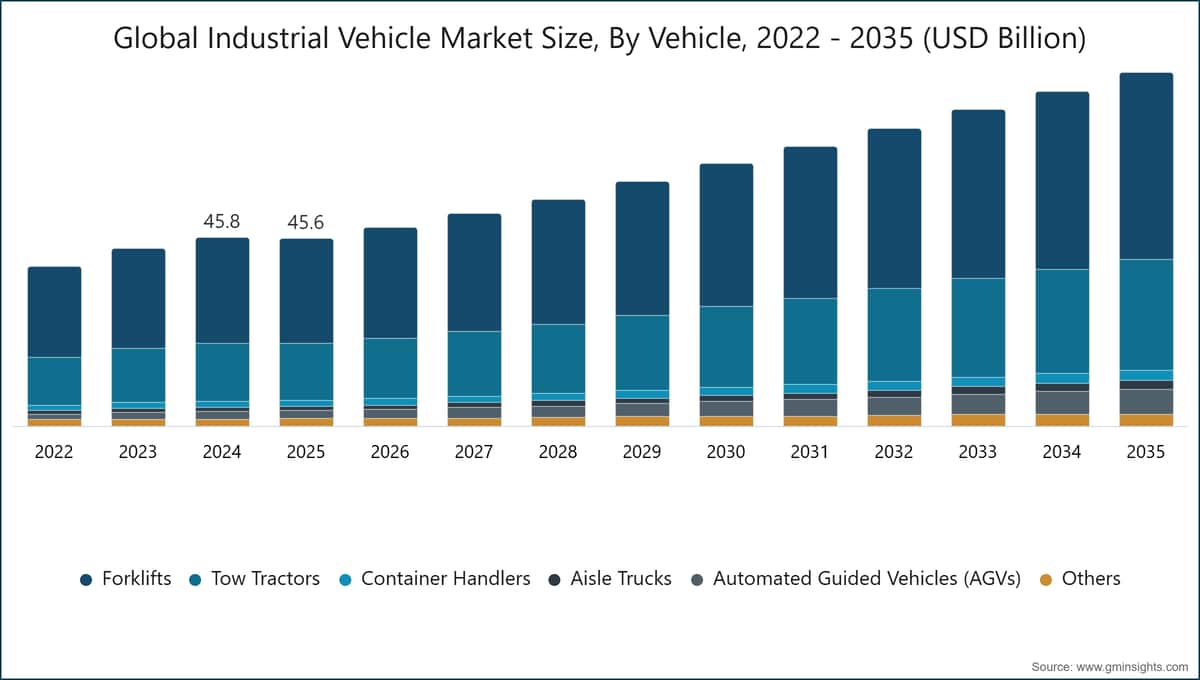
Based on vehicle, the industrial vehicle market is segmented into forklifts, tow tractors, container handlers, aisle trucks, automated guided vehicles (AGVs), and others. The forklifts segment dominates the market with 55% share in 2025, and the segment is expected to grow at a CAGR of 6% from 2026 to 2035.
Based on propulsion, the industrial vehicle market is divided into internal combustion engine (ICE), electric, hybrid vehicles, and hydrogen fuel cell vehicles. The electric segment dominates with 71.4% market share in 2025 and is growing at a CAGR of 7.7% from 2026 to 2035.
Based on level of automation, the industrial vehicle market is segmented into manual / operator-driven, semi-autonomous, and fully autonomous. The manual / operator-driven segment dominates with 82% market share in 2025.
Based on end user, the industrial vehicle market is divided into be manufacturing, logistics and warehousing, construction, mining, agriculture, ports and shipping, and others. Logistics and warehousing dominate with 32% market share in 2025.
China dominates the Asia Pacific industrial vehicle market accounting for 65% and generating USD 14.7 billion in 2025.
U.S. dominates North America industrial vehicle market growing with a CAGR of 4.4% from 2026 to 2035.
Germany dominates the Europe industrial vehicle market, showcasing strong growth potential, with a CAGR of 4.8% from 2026 to 2035.
Brazil leads the Latin American industrial vehicle market, exhibiting remarkable growth of 8.2% during the forecast period of 2026 to 2035.
UAE witnessed substantial growth in the Middle East and Africa industrial vehicle market in 2025.
Industrial Vehicle Market Share
Industrial Vehicle Market Companies
Major players operating in the Industrial vehicle industry are:
15.5% Market Share
Collective Market Share is 45.4%
Industrial Vehicle Industry News
In May 2026, Toyota Industries announced plans to expand manufacturing capabilities through a proposed USD 2 billion investment project in Texas aimed at strengthening production capacity and operational competitiveness.
In April 2026, Hyster Yale announced a strategic business realignment initiative focused on accelerating electrification technologies, battery solutions, and hydrogen fuel cell industrial equipment development across global material handling operations.
In April 2026, Hyster launched a pedestrian detection event dashboard designed to improve workplace safety through real time monitoring of pedestrian proximity around industrial lift truck operations.
In April 2026, Yale Lift Truck Technologies introduced an automated lift truck with vertical pallet positioning capability designed to automate elevated pallet transportation and warehouse material handling operations.
In March 2026, KION Group showcased autonomous industrial trucks and physical artificial intelligence warehouse technologies at GTC 2026 to improve automated trailer loading and warehouse operational efficiency.
Click here to Buy Section of this Report
Market, By Vehicle
Forklifts
Tow Tractors
Market, By Propulsion
Internal Combustion Engine (ICE)
Diesel
Market, By Level of Automation
Manual / Operator-Driven
Semi-Autonomous
Market, By End User
The above information is provided for the following regions and countries:
Research methodology, data sources & validation process
This report draws on a structured research process built around direct industry conversations, proprietary modelling, and rigorous cross-validation and not just desk research.
Our 6-step research process
1. Research design & analyst oversight
At GMI, our research methodology is built on a foundation of human expertise, rigorous validation, and complete transparency. Every insight, trend analysis, and forecast in our reports is developed by experienced analysts who understand the nuances of your market.
Our approach integrates extensive primary research through direct engagement with industry participants and experts, complemented by comprehensive secondary research from verified global sources. We apply quantified impact analysis to deliver dependable forecasts, while maintaining complete traceability from original data sources to final insights.
2. Primary research
Primary research forms the backbone of our methodology, contributing nearly 80% to overall insights. It involves direct engagement with industry participants to ensure accuracy and depth in analysis. Our structured interview program covers regional and global markets, with inputs from C-suite executives, directors, and subject matter experts. These interactions provide strategic, operational, and technical perspectives, enabling well-rounded insights and reliable market forecasts.
3. Data mining & market analysis
Data mining is a key part of our research process, contributing nearly 20% to the overall methodology. It involves analysing market structure, identifying industry trends, and assessing macroeconomic factors through revenue share analysis of major players. Relevant data is collected from both paid and unpaid sources to build a reliable database. This information is then integrated to support primary research and market sizing, with validation from key stakeholders such as distributors, manufacturers, and associations.
4. Market sizing
Our market sizing is built on a bottom-up approach, starting with company revenue data gathered directly through primary interviews, alongside production volume figures from manufacturers and installation or deployment statistics. These inputs are then pieced together across regional markets to arrive at a global estimate that stays grounded in actual industry activity.
5. Forecast model & key assumptions
Every forecast includes explicit documentation of:
✓ Key growth drivers and their assumed impact
✓ Restraining factors and mitigation scenarios
✓ Regulatory assumptions and policy change risk
✓ Technology adoption curve parameter
✓ Macroeconomic assumptions (GDP growth, inflation, currency)
✓ Competitive dynamics and market entry/exit expectations
6. Validation & quality assurance
The final stages involve human validation, where domain experts manually review filtered data to identify nuances and contextual errors that automated systems might miss. This expert review adds a critical layer of quality assurance, ensuring data aligns with research objectives and domain-specific standards.
Our triple-layer validation process ensures maximum data reliability:
✓ Statistical Validation
✓ Expert Validation
✓ Market Reality Check
Trust & credibility
Verified data sources
Trade publications
Security & defense sector journals and trade press
Industry databases
Proprietary and third-party market databases
Regulatory filings
Government procurement records and policy documents
Academic research
University studies and specialist institution reports
Company reports
Annual reports, investor presentations, and filings
Expert interviews
C-suite, procurement leads, and technical specialists
GMI archive
13,000+ published studies across 30+ industry verticals
Trade data
Import/export volumes, HS codes, and customs records
Parameters studied & evaluated
Every data point in this report is validated through primary interviews, true bottom-up modelling, and rigorous cross-checks. Read about our research process →