Summary
Table of Content

Industrial Gearbox Market
Get a free sample of this report
Form submitted successfully!
Error submitting form. Please try again.
Thank you!
Your inquiry has been received. Our team will reach out to you with the required details via email. To ensure that you don't miss their response, kindly remember to check your spam folder as well!
Request Sectional Data
Thank you!
Your inquiry has been received. Our team will reach out to you with the required details via email. To ensure that you don't miss their response, kindly remember to check your spam folder as well!
Form submitted successfully!
Error submitting form. Please try again.
Industrial Gearbox Market Size
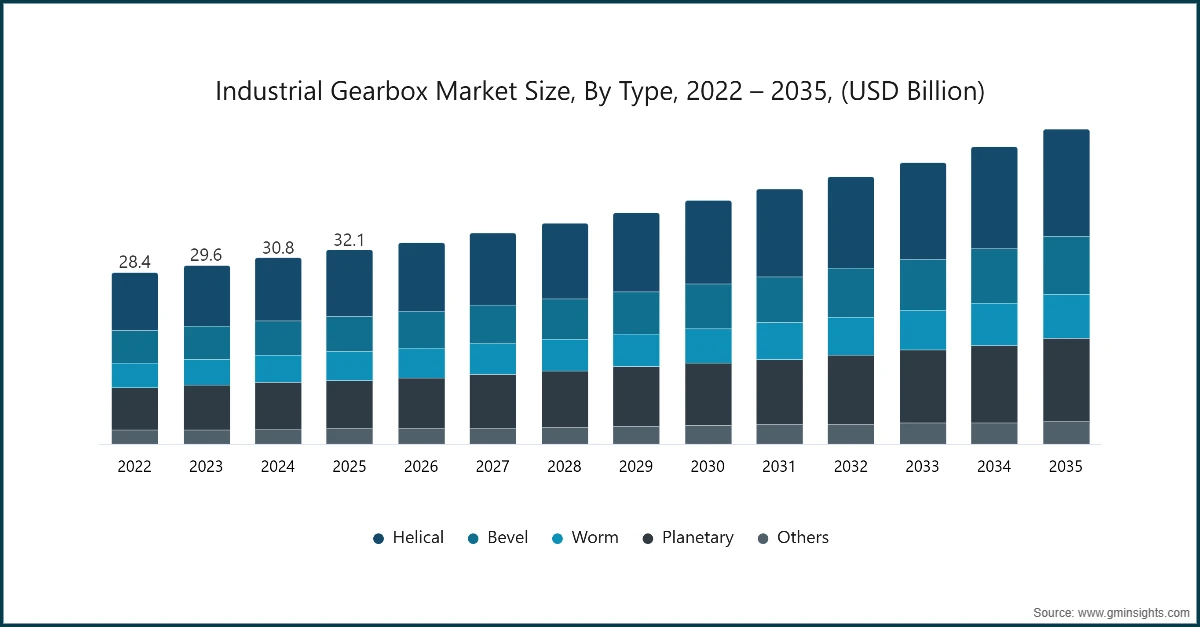
The industrial gearbox market was estimated at USD 32.1 billion in 2025. The market is expected to grow from USD 33.4 billion in 2026 to USD 52.1 billion in 2035, at a CAGR of 5.1%, according to latest report published by Global Market Insights Inc.

To get key market trends
- The continued rise in industrial automation and Industry 4.0 technology has led to the growth of the industrial gearbox market. The manufacturing sector has increased its deployment of automated machinery to achieve precise torque transfer and controlled mechanical movement. Automated production lines rely on industrial gearboxes to maintain the same speed and load consistently. As Industry 4.0 continues to gain traction, it has placed an emphasis on connected equipment, which will operate continuously at increasingly high-performance levels. As a result, industrial gearboxes have become even more important in supporting the continuous operation of digitally enabled factories. As the intensity of automation increases, so does the demand for gearbox components that can withstand the additional mechanical stress. Gearboxes that are designed specifically for industrial automation also provide the necessary durability, precision and reliable torque transmission. In addition, to meet the growing needs of smart manufacturing operations, they must also be compatible with equipment used for remote monitoring and predictive maintenance. The adoption of robotics in manufacturing operations increases the overall requirement for low-cost and accurate motion control applications. In turn, the increased operational efficiency gained from using more effectively automated systems has resulted in increased installation rates of industrial gearboxes.
- The growth of the industrial gearbox industry is the effect of a rise in renewable energy expansion. Increasingly detailed mechanical systems for the conversion of speed/torque requirements for renewable energy, such as solar and hydropower, as well as wind turbine systems depend heavily on gearboxes for effective rotor speed control within wind energy systems. Solar tracking systems use gearboxes for optimum positioning of the solar panel surface through the tracking of the sun, enabling continuous energy collection. Hydropower facilities have high load, stable, and reliable gearbox solutions. Renewable energy facilities, using mechanical systems, continue to have fluctuating loads thus requiring increased durability in gears for the effective operation of renewable energy projects. Industrial gearboxes provide the ability to transmit power between two points over harsh and variable weather conditions. Acceleration by Government entities in the "Green Energy" Industry both increases the rate of development of renewable generation assets globally and increases the number of customers procuring industrial gearbox systems due to the increased demand for renewable energy systems.
- Due to their superior efficiency, helical gearboxes hold a sizeable share in the industrial gearbox market. The angled tooth design facilitates greater power transmission efficiency and reduced operating noise. In addition, the high load-carrying capacity of helical gearboxes allows them to be used in a variety of heavy-duty industrial applications. Improved torque distribution also enhances the durability of helical gearboxes during continuous operation. Manufacturing facilities are inclined to utilize helical gearboxes to achieve high reliability and lower vibration. Further, the lower maintenance requirements of helical gearboxes, as compared to other types of gearboxes, provide for greater operational uptime and lower overall lifecycle costs. The compatibility of helical gearboxes with automated systems, in addition to their reliability, leads to their increasing adoption in modern industrial infrastructures. The strong growth of the manufacturing, mining, and energy sectors will provide a continued driving force for the segment growth .
Industrial Gearbox Market Report Attributes
| Key Takeaway | Details |
|---|---|
| Market Size & Growth | |
| Base Year | 2025 |
| Market Size in 2025 | USD 32.1 Million |
| Market Size in 2026 | USD 33.4 Billion |
| Forecast Period 2026-2035 CAGR | 5.1% |
| Market Size in 2035 | USD 52.1 Billion |
| Key Market Trends | |
| Drivers | Impact |
| Rising industrial automation | Industrial automation is a major growth catalyst, with gearboxes essential for CNC machines, robots, conveyor systems, and assembly lines. Increasing adoption across sectors continues to drive overall market expansion |
| Advancements in gearbox technology | Continuous improvements in gearbox design—such as higher torque density, compact formats, and smarter servo-integrated gearboxes—boost their use in modern manufacturing environments. |
| Growing demand for heavy-duty machinery & infrastructure | Global expansion in construction, public works, and material-handling equipment is amplifying gearbox demand, driven by the need for reliable torque transmission in cranes, hoists, and heavy machinery |
| Pitfalls & Challenges | Impact |
| High maintenance requirements | Industrial gearboxes require continuous upkeep to avoid failures, and gear wear remains a persistent challenge affecting operational efficiency and lifecycle costs. |
| Supply chain disruptions & geopolitical factors | Recent shifts in global trade, tariffs, and geopolitical tensions have disrupted sourcing and manufacturing, affecting gearbox availability and increasing procurement complexity |
| Opportunities: | Impact |
| Expansion of infrastructure & construction projects | As global infrastructure development accelerates, demand increases for gearboxes used in construction machinery like lifts, cranes, and hoists—creating strong growth avenues. |
| Rising adoption of smart & industry 4.0 technologies | Integration of IoT, AI‑driven analytics, and predictive maintenance opens opportunities for next‑generation “smart” gearboxes with higher efficiency, longer lifespan, and reduced downtime. |
| Market Leaders (2025) | |
| Market Leader |
Market share of ~ 4% |
| Top Players |
The collective market share in 2025 is ~26% |
| Competitive Edge |
|
| Regional Insights | |
| Largest Market | Asia Pacific |
| Fastest growing market | Asia Pacific |
| Emerging countries | China, Brazil, India |
| Future outlook |
|
What are the growth opportunities in this market?
Industrial Gearbox Market Trends
To improve the mechanical performance of industrial facilities, many companies are using high-efficiency gearboxes. Because of this, manufacturers have noted that these gearboxes decrease energy usage compared with traditional designs as reported for the most recent set of installations. Increased efficiency has a direct impact on the overall operating costs of production plants, and the resulting decrease in costs allows for an increase in equipment uptime. Because of the greater focus on performance from these manufacturers, many different types of industries are making large investments into new technologies that involve gearboxes.
- As more industrial gearbox systems incorporate the use of sensors to monitor the vibration, temperature, and quality of lubrication in real-time, predictive maintenance can occur prior to failures leading to extensive downtime and cost. Engineers and operators are now using real-time data collected from gearboxes to determine when to perform preventative maintenance and have eliminated the need to perform this maintenance at a predetermined time interval. This data-driven approach provides longer equipment lifetimes and provides the optimal use of resources.
- The preference for manufacturers and end-users is to use modular gearbox designs as they provide manufacturers with a better flexible solution for their application requirements. A modular design enables faster installation and will reduce lead times on specially designed industrial configurations. By providing the ability to customize each modular gearbox’s output torque and speed to meet the exact needs of the machinery being used, it increases the adaptability of these gearboxes across manufacturing, mining and material handling applications.
- Compact gearbox designs are becoming more accepted as engineers continue their trend of reducing system weight by utilizing smaller gearboxes that provide better spatial efficiency in limited capacity equipment. The mass of the gearbox also reduces the structural support needed for handling and transporting goods. These trends mirror the drive toward portable and adaptable equipment design in today's industrial sector.
- With the growth of the industrial sector, suppliers of industrial gears are now expanding their service offerings to clients after the sale of the equipment. In addition to initial sales, industrial suppliers have increased their offerings to include refurbishment, performance tuning, and consulting regarding the entire lifecycle of complex installations. Clients will see a reduction in overall costs due to lower downtime of equipment and more consistent service from design-build contractors. This change will enhance the long-term relationships among all supply chains in the industrial sector.
Industrial Gearbox Market Analysis
 Learn more about the key segments shaping this market
Learn more about the key segments shaping this market
Based on type, the market is categorized into helical, bevel, worm, planetary, and others. The helical segment accounted for revenue of around USD 11 billion in 2025 and is anticipated to grow at a CAGR of 4.6% from 2026 to 2035.
- Helical gearboxes dominate the industrial gearbox market due to efficient power transmission capabilities. Angled gear teeth ensure smoother operation and significantly lower noise during continuous industrial use. High load handling supports deployment across heavy machinery and processing equipment. Improved torque distribution enhances operational stability under demanding working conditions.
- Industries prefer helical gearboxes due to reduced vibration and extended service life. Lower maintenance frequency minimizes downtime and operational costs for end users. Compatibility with automated production systems increases adoption across modern manufacturing facilities. Consistent performance reliability strengthens dominance across multiple industrial sectors.
Based on power, industrial gearbox market consists of small, medium and large. The small emerged as leader and held 57.91% of the total market share in 2025 and is anticipated to grow at a CAGR of 4.3% from 2026 to 2035.
- Small power industrial gearboxes up to 500 kW lead the market share due to widespread applicability. These gearboxes support operations across manufacturing, food processing, and packaging industries. Compact design allows easy integration into space-constrained industrial machinery and equipment. Moderate power output meets requirements of continuous and intermittent duty applications efficiently.
- Lower initial investment attracts small and medium-scale industrial operators globally. Energy efficiency improves operational cost control across daily production cycles. Simplified installation and maintenance reduce downtime risks for end users. Growing automation adoption strengthens demand for small power gearbox solutions across industries.
Learn more about the key segments shaping this market
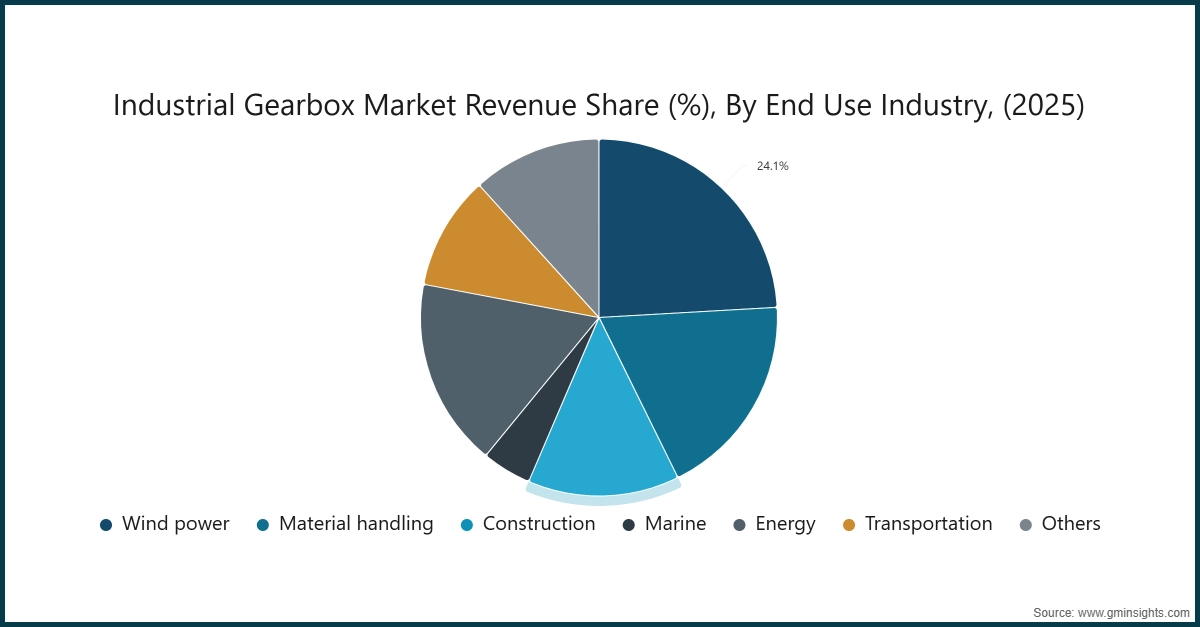
Based on end-use industry, the market consists of wind power, material handling, construction, marine, energy, transportation, and others. The wind power segment is expected to grow at a CAGR of 5.1% between 2026 and 2035.
- Wind power leads the industrial gearbox market due to expanding renewable energy capacity installations. Turbine gearboxes require high reliability to manage variable wind loads effectively. Long operational hours increase demand for durable and high torque transmission systems. Government incentives accelerate wind farm development across onshore and offshore projects. Large turbine sizes require precision-engineered gearboxes supporting efficient energy conversion.
- Maintenance reduction remains critical for remote wind installations, increasing preference for advanced gearbox designs. Rising focus on clean energy strengthens sustained demand from the wind power sector.
Europe Industrial Gearbox Market
 Looking for region specific data?
Looking for region specific data?
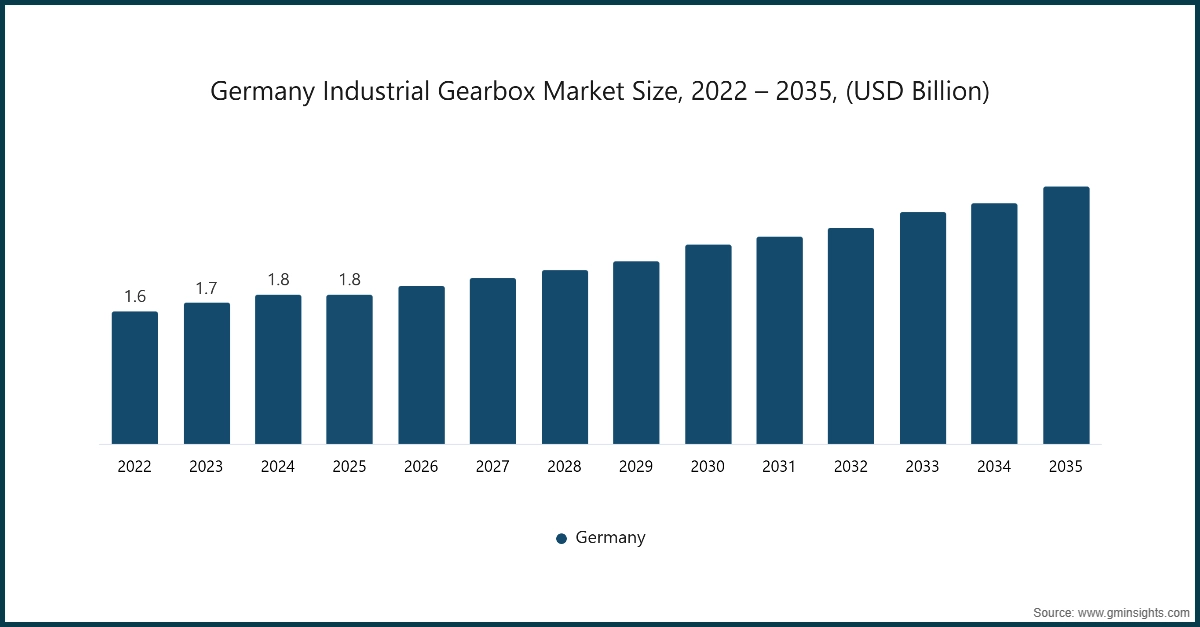
Germany dominates an overall Europe industrial gearbox market and valued at USD 1.84 billion in 2025 and is estimated to grow at a CAGR of 4.9% from 2026 to 2035.
- Due to the strong manufacturing base, the Europe market is stable. The increased implementation of automated processes across many industries has resulted in increased demand for precision gearbox systems. In addition, energy efficiency regulations result in the replacement of obsolete mechanical transmission equipment. Heavy-duty gearbox solutions are in constant demand from automotive and metal processing industries. Continuous investment in advanced drive technologies due to modernization initiatives support this ongoing demand for gearboxes.
- The high emphasis on operational reliability has led to an increased preference for durable and low-maintenance gearboxes. The presence of established manufacturers in Europe provides a solid foundation for the supply of products to the region. Therefore, the continuous export of manufactured goods to Western and Central Europe from the region will continue to provide long-term demand for industrial gearboxes.
North America Industrial Gearbox Market
In the North America market, the U.S. held 78.79% market share in 2025 and is anticipated to grow at a CAGR of 4.0% from 2026 to 2035.
The North America industrial gearbox industry benefits from strong demand across manufacturing industries. High automation adoption increases usage of precision gearbox systems in production lines. Aging industrial equipment encourages replacement with advanced and energy-efficient gearbox solutions. Shale oil and gas activities support demand for heavy-duty gearboxes in drilling operations. Food processing industries require hygienic and reliable gearbox systems for continuous operations.
- Presence of established OEMs improves product availability and technical support services. High capital investment capacity enables adoption of customized and high-performance gearbox models. Strict safety standards influence consistent upgrades across industrial facilities. Regional focus on operational efficiency sustains long-term gearbox demand.
Asia Pacific Industrial Gearbox Market
In the Asia Pacific market, China is expected to experience significant and promising growth at a CAGR of 5.5% from 2026 to 2035.
The Asia Pacific industrial gearbox industry shows strong growth due to rapid industrial expansion. Rising manufacturing activities in China and India increase demand for industrial power transmission systems. Infrastructure development projects require large-scale gearbox installations for construction machinery. Cost-competitive manufacturing supports high-volume production of standard gearbox models.
- Expansion of renewable energy projects increases demand for wind turbine gearbox systems. Growing cement and mining industries drive usage of rugged and high-load gearboxes. Local suppliers improve regional availability through competitive pricing strategies. Industrial diversification supports sustained demand across multiple end-use sectors.
Middle East and Africa Industrial Gearbox Market
In the Middle East and Africa imarket, Saudi Arabia held a significant market share in 2025 promising growth from 2026 to 2035.
The Middle East and Africa industrial gearbox industry develops steadily through infrastructure investments. Oil and gas sector reliance drives demand for robust gearbox solutions. Large-scale desalination and water treatment plants require continuous-duty gearbox systems. Mining activities across African countries support demand for heavy-load industrial gearboxes.
- Government-backed industrialization initiatives increase adoption of modern mechanical equipment. Limited local manufacturing increases dependence on imported gearbox solutions. Harsh operating environments require gearboxes designed for durability and thermal resistance. Gradual industrial modernization supports long-term market expansion across the region.
Industrial Gearbox Market Share
- In 2025, the prominent manufacturers in industrial gearbox industty are Siemens, Bonfiglioli Riduttori, SEW-EURODRIVE, Regal Rexnord Corporation, and Nidec Motor Corporation collectively held the market share of ~62%.
- Siemens is a leading global industrial technology firm known for integrating advanced automation, drive systems, and industrial gearboxes. The company’s gearbox offerings benefit from its strong expertise in digitalization, IoT-enabled monitoring, and energy-efficient solutions. Siemens focuses on smart manufacturing, predictive maintenance, and scalable modular systems that support diverse sectors including manufacturing, energy, and infrastructure, reinforcing its competitive position worldwide.
- Bonfiglioli Riduttori is an Italian gearbox specialist known for its comprehensive portfolio of planetary, helical, and bevel gear solutions. The company emphasizes energy efficiency, compact design, and adaptability for automation and mobile machinery. Bonfiglioli invests in product innovation and sustainable manufacturing, supported by strong global distribution. Its focus on renewable energy applications and automation systems helps drive market penetration and long-term growth.
Industrial Gearbox Market Companies
Major players operating in the industrial gearbox industry include:
- ABB Ltd.
- Bonfiglioli Riduttori
- Dana Incorporated
- DB Santasalo
- Elecon Engineering Company
- Getriebebau NORD
- Liebherr Group
- Nabtesco Corporation
- Nidec Motor Corporation
- Regal Rexnord Corporation
- Rossi
- SEW-EURODRIVE
- Siemens
- Sumitomo Heavy Industries, Ltd.
- ZF Friedrichshafen
SEW-EURODRIVE is a major German manufacturer of industrial gearboxes, geared motors, and automation drives. The company focuses on modular designs and customizable solutions that support material handling, automotive, and logistics sectors. SEW integrates digital technologies such as condition monitoring and predictive maintenance. Its global manufacturing footprint and responsive service network enhance reliability and strengthen customer relationships across key regions.
Regal Rexnord Corporation is a U.S.-based industrial solutions provider with strong positions in power transmission and gearbox products. It emphasizes robust, heavy-duty designs suitable for manufacturing, mining, and material handling. Regal Rexnord leverages broad distribution networks and customer-focused service offerings to maintain competitiveness. The company also invests in application-driven engineering to improve durability and operational performance.
Nidec Motor Corporation is a global manufacturer of motors and integrated drive systems with growing presence in industrial gearboxes. The company emphasizes precision engineering, compact gear solutions, and integration with electric motors for automation and robotics applications. Nidec’s investments in R&D and scalable manufacturing support performance improvements and cost efficiency. Its diverse end-use reach strengthens regional presence and long-term market growth.
Industrial Gearbox Industry News
- In October 2025, ZF Wind Power delivered the world’s first next-generation offshore 9.5 MW wind turbine gearbox and continues to expand its high-performance gearbox platforms. The company has installed the largest offshore turbine gearboxes and continues investment in advanced gearbox designs for wind power applications across global markets.
- In October 2025, SEW-EURODRIVE reported showcasing its latest industrial gear unit solutions, including digital and condition-monitoring features, at the SPS 2025 automation trade event. The company highlighted modular gear units and IoT-enabled maintenance solutions tailored for smart factory environments.
- In July 2025, Siemens AG completed the acquisition of ebm-papst’s industrial drive technology business. This acquisition adds intelligent, integrated mechatronic systems, including advanced drive and motor technologies to Siemens’ portfolio, enhancing its industrial automation and motion control offerings. The acquired business will be marketed under the Simotics E brand and support flexible manufacturing and digitalized factory solutions.
- In February 2025, SEW-EURODRIVE introduced a new generation of integrated precision planetary gearmotors combining its PxG planetary gearbox units with servomotors. This new gearmotor series offers space-saving, high-dynamic performance for automation applications in manufacturing and material handling systems.
The industrial gearbox market research report includes in-depth coverage of the industry, with estimates & forecast in terms of revenue (USD Billion) and volume (Thousand Units) from 2022 to 2035, for the following segments:
Market, By Type
- Helical
- Bevel
- Worm
- Planetary
- Others
Market, By Power
- Small (up to 500 kW)
- Medium (500 kW to 10 MW)
- Large (above 10 MW)
Market, By End Use Industry
- Wind power
- Material handling
- Construction
- Marine
- Energy
- Transportation
- Others
Market, By Power
- Direct
- Indirect
The above information is provided for the following regions and countries:
- North America
- U.S.
- Canada
- Europe
- Germany
- UK
- France
- Italy
- Spain
- Asia Pacific
- China
- Japan
- India
- South Korea
- Australia
- Latin America
- Brazil
- Mexico
- Argentina
- MEA
- Saudi Arabia
- UAE
- South Africa
Frequently Asked Question(FAQ) :
Who are the key players in the industrial gearbox market?
Key players include Siemens, Bonfiglioli Riduttori, SEW-EURODRIVE, Regal Rexnord Corporation, Nidec Motor Corporation, ABB Ltd., Dana Incorporated, DB Santasalo, Elecon Engineering Company, Getriebebau NORD, Liebherr Group, Nabtesco Corporation, Rossi, Sumitomo Heavy Industries, Ltd., and ZF Friedrichshafen.
Which region leads the industrial gearbox market?
In the North America industrial gearbox market, the U.S. held 78.79% share in 2025 and is anticipated to grow at a CAGR of 4% from 2026 to 2035.
What are the upcoming trends in the industrial gearbox market?
Key trends include adoption of high-efficiency gearboxes with predictive maintenance capabilities, increasing use of modular and compact designs, expansion of after-sales services, and integration of IoT sensors for real-time monitoring and performance optimization.
What was the market share of the small power segment in 2025?
The small power segment (up to 500 kW) held 57.91% market share in 2025 and is anticipated to grow at a CAGR of 4.3% from 2026 to 2035.
What is the growth outlook for the wind power segment from 2026 to 2035?
The wind power segment is expected to grow at a CAGR of 5.1% between 2026 and 2035, driven by expanding renewable energy capacity installations and government incentives for wind farm development.
How much revenue did the helical gearbox segment generate in 2025?
The helical segment generated USD 11 billion in 2025 and is anticipated to grow at a CAGR of 4.6% from 2026 to 2035.
What is the current industrial gearbox market size in 2026?
The market size is projected to reach USD 33.4 billion in 2026.
What is the market size of the industrial gearbox in 2025?
The market size was USD 32.1 billion in 2025, with a CAGR of 5.1% expected through 2035 driven by rising industrial automation and expansion of renewable energy projects.
What is the projected value of the industrial gearbox market by 2035?
The industrial gearbox market is expected to reach USD 52.1 billion by 2035, propelled by adoption of smart manufacturing technologies, infrastructure development, and integration of Industry 4.0 solutions.
Industrial Gearbox Market Scope
Related Reports