Summary
Table of Content

Food Robotics Market
Get a free sample of this report
Form submitted successfully!
Error submitting form. Please try again.
Thank you!
Your inquiry has been received. Our team will reach out to you with the required details via email. To ensure that you don't miss their response, kindly remember to check your spam folder as well!
Request Sectional Data
Thank you!
Your inquiry has been received. Our team will reach out to you with the required details via email. To ensure that you don't miss their response, kindly remember to check your spam folder as well!
Form submitted successfully!
Error submitting form. Please try again.
Food Robotics Market Size
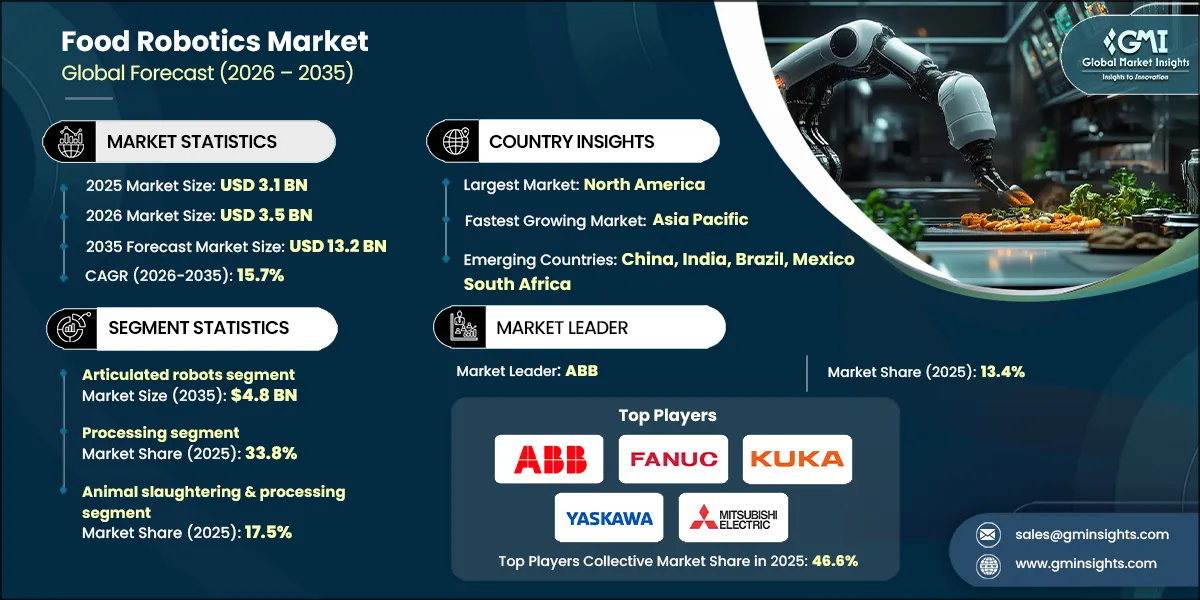
The global food robotics market was valued at USD 3.1 billion in 2025 and volume 431 units. The market is expected to grow from USD 3.5 billion in 2026 to USD 13.2 billion in 2035 and volume 2,106 units, at a CAGR of 15.7% and a value CAGR 17.2% during the forecast period according to the latest report published by Global Market Insights Inc.
To get key market trends
The market for food robots is expected to grow due to the following factors: the high demand for accurate and light-handed handling of perishable products coupled with acute labor shortages, that have created a need for more automation in the food industry. In August 2023, Wootzano launched its Avarai Robot in the United States. Using an innovative, patented technology called “Wootzkin” electronic skin to handle and pack fragile items like grapes, the Avarai robot will help reduce bruising during product transportation. Further, AI-powered robots such as the Avarai are used in many areas of California's Central Valley, as it can reduce labor needs by as much as 60%, showing how soft robotics are enabling automation in food production tasks that have historically relied on manual labor, thus addressing food safety concerns and lack of workforce availability.
The rise in consumption of processed and ready-to-eat food items is a significant factor that is fueling the food robotics market, as companies seek scalable solution to cater to the increasing volume of production. Changing lifestyles of people, urbanization, and the need for convenience food items are some of the significant factors that are fueling the market. Companies are developing high-speed food processing, sorting, and packaging solutions that can cater to the needs of the market while ensuring the quality of the food items.
Food Robotics Market Report Attributes
| Key Takeaway | Details |
|---|---|
| Market Size & Growth | |
| Base Year | 2025 |
| Market Size in 2025 | USD 3.1 Billion |
| Market Size in 2026 | USD 3.5 Billion |
| Forecast Period 2026-2035 CAGR | 15.7% |
| Market Size in 2035 | USD 13.2 Billion |
| Key Market Trends | |
| Drivers | Impact |
| Rising automation adoption in food processing and packaging | Accelerates deployment of robotics, boosting market growth and operational efficiency. |
| Regulatory pressure for traceability and quality compliance | Encourages adoption of robotics to meet stringent food safety and reporting standards. |
| Increasing consumption of processed and ready-to-eat foods | Expands demand for automated processing, packaging, and assembly solutions. |
| Expansion of smart factories and Industry 4.0 adoption | Drives integration of intelligent robotics with IoT, data analytics, and connected systems. |
| Acute labor shortages and the need for gentle, high-precision handling of perishable produce | Promotes use of soft robotics and AI-driven automation to reduce reliance on manual labor. |
| Pitfalls & Challenges | Impact |
| High Initial Capital Investment and Implementation Costs | Limits adoption among small and mid-sized food manufacturers due to high initial investment. |
| Technical Complexity and Integration Challenges | Slows deployment and requires skilled personnel for operation and maintenance due to technical complexity. |
| Opportunities: | Impact |
| Expansion in ready-to-eat and processed food segments | Opens new market avenues for robotic assembly, sorting, and packaging solutions in ready-to-eat and processed foods. |
| Growing adoption of ai and machine vision in robotics | Enhances precision, flexibility, and efficiency, creating high-value automation applications through AI and machine vision. |
| Market Leaders (2025) | |
| Market Leader |
Market Share of ABB is 13.4% in 2025 |
| Top Players |
Collective market share in 2025 is 46.6% |
| Competitive Edge |
|
| Regional Insights | |
| Largest Market | North America |
| Fastest growing market | Asia Pacific |
| Emerging countries | China, India, Brazil, Mexico, South Africa |
| Future outlook |
|
What are the growth opportunities in this market?
Food Robotics Market Trends
- Food robots are moving from traditional stationary automated systems to robots that are designed to employ artificial intelligence to interact with changing products in real-time through machine vision and learning technologies, thus enabling them to manage different ingredients without having to be reprogrammed continuously.
- The use of robots in food manufacturing has expanded significantly from performing single-task operations to providing end-to-end assembly of packaged meals.
For example, "Chef+," an AI-driven automated meal assembly system developed by Chef Robotics, was introduced in December 2025 to serve food processors across North America and Europe, demonstrating the industry's push toward solutions that will enable scale and intelligence while allowing manufacturers to adapt recipes, maintain portion control, and update menu offerings quickly. - The increasing demand for food safety is driving the adoption of robotics that aims to limit human interaction. The use of robotic cells that are completely sealed, designs that are compatible with washdown processes, and handling systems that take contamination into consideration is becoming the norm.
- The adoption of food robotics is broadening beyond large multinational processors to mid-sized and regional manufacturers. This is largely due to the reduction in the cost of food robotics systems, which is making it financially viable for food manufacturers of all sizes.
Food Robotics Market Analysis
Learn more about the key segments shaping this market
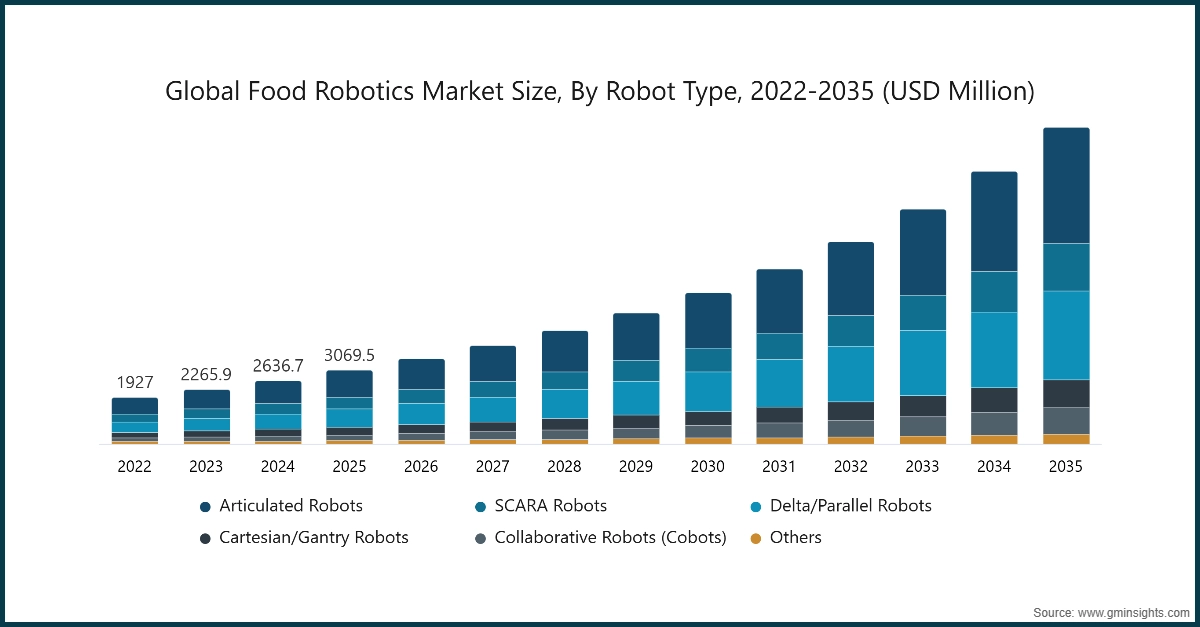
On the basis of robot type, the market is segmented into articulated robots, SCARA robots, delta/parallel robots, cartesian/gantry robots, collaborative robots (Cobots), and others.
- The articulated robots segment is anticipated to reach USD 4.8 billion by 2035. Articulated robots are being widely used in food processing due to their flexibility and ability to move in many directions, making it possible to perform complex tasks such as sorting, packaging, and assembly. They can be easily integrated with AI and vision systems due to their modular design.
- The delta/parallel robots segment was valued at USD 755.8 million in 2025 and is anticipated to grow at a CAGR of 17.2% over the forecast years. Delta/parallel robots are becoming increasingly popular for high-speed pick-and-place operations due to their fast response time and accuracy. They are best for handling sensitive objects such as sweets or fruits while reducing damage in automated food handling.
Learn more about the key segments shaping this market
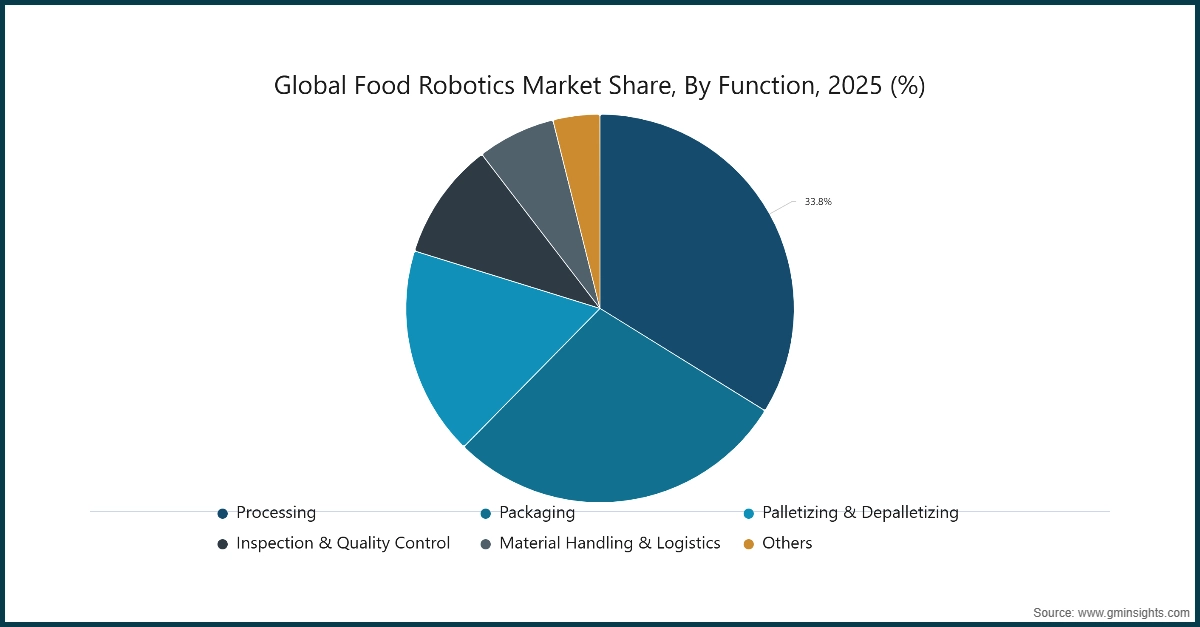
On the basis of function, the food robotics market is divided into processing, packaging, palletizing & depalletizing, inspection & quality control, material handling & logistics, and others.
- The processing segment held a market share of 33.8% in 2025. Automation in processing is also changing with the development of AI-based robotics that can be used for repetitive tasks, as well as hazardous operations, such as cutting, mixing, and portioning. This helps to increase productivity, consistency, and hygiene compliance in various food manufacturing operations.
- The inspection & quality control segment is anticipated to grow at a CAGR of 17.2% during the forecast period 2026 - 2035. The use of robots with machine vision and artificial intelligence is becoming more common in the inspection and quality control areas. Such robots can detect defects, monitor hygiene, and check the accuracy of the packaging.
On the basis of end use application, the food robotics market is divided into animal food manufacturing, grain & oilseed milling, sugar & confectionery, fruit & vegetable preserving, dairy product manufacturing, animal slaughtering & processing, seafood product preparation, bakeries, and others.
- The animal slaughtering & processing segment held a market share of 17.5% in 2025. The process of animal slaughtering and processing is becoming increasingly automated to overcome the shortage of manpower and to improve hygiene. Robots are being employed to carry out cutting, boning, and handling activities.
- The seafood product preparation segment is anticipated to grow at a CAGR of 18.4% during the forecast period 2026 - 2035. Seafood preparation is benefiting from robotics capable of delicate handling, portioning, and packaging of fragile products. AI-enabled systems optimize yield, reduce contamination risk, and enhance efficiency in high-volume seafood processing operations.
Looking for region specific data?
North America Food Robotics Market
The North America market dominated the global market with a market share of 36% in 2025.
- North America is anticipated to maintain its position as the largest market for food robotics due to the presence of well-developed manufacturing infrastructure, high labor costs, and stringent food safety regulations. North America has an advantage because it has been one of the first regions to adopt robotics technology in the meat processing industry, bakery industry, dairy industry, and packaging industry.
- The adoption of robotics technology in North America is also driven by the government’s focus on worker safety. Organizations such as OSHA encourage the use of robots in the food processing industry because it reduces the risk of injury to workers.
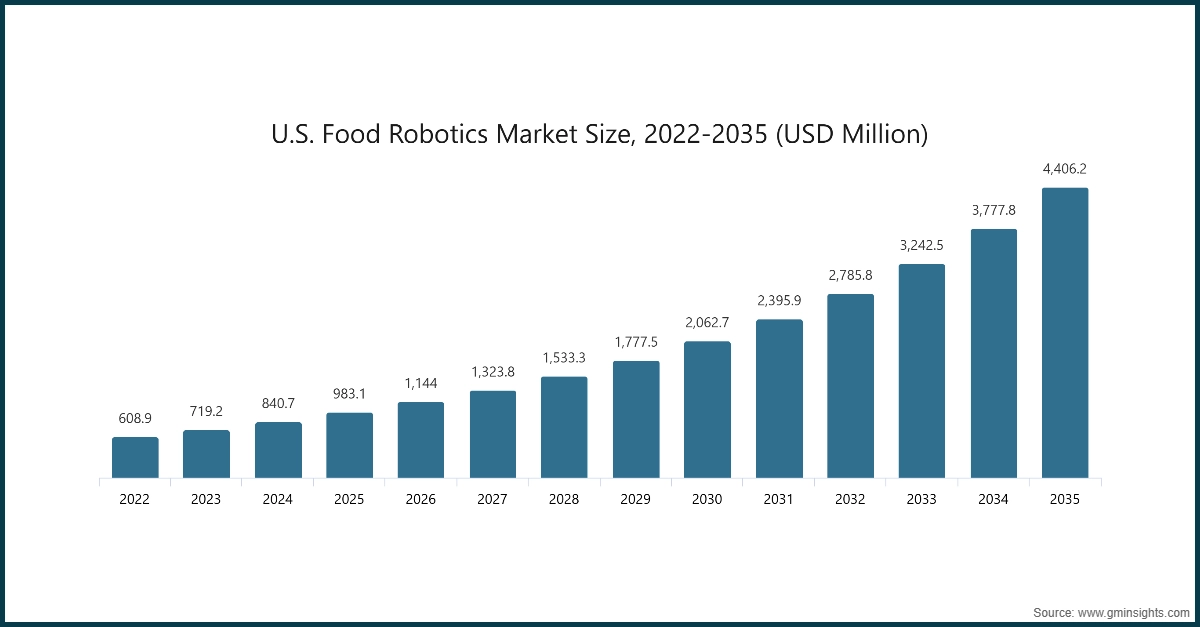
The U.S. food robotics market was valued at USD 608.9 million and USD 719.2 million in 2022 and 2023, respectively. The market size reached USD 983.1 million in 2025, growing from USD 840.7 million in 2024.
- The United States is the largest market in North America due to the high level of food processing infrastructure and the growing level of automation in addressing labor constraints and hygiene issues. In the United States, the food processing industry has more than 285,000 establishments, according to USDA statistics, which generate considerable revenue.
- Federal workplace safety initiatives also catalyze robotics deployment, as the Occupational Safety and Health Administration (OSHA) emphasizes reducing injury rates in the food manufacturing sector relative to other industries.
Europe Food Robotics Market
Europe food robotics market accounted for USD 859.9 million in 2025 and is anticipated to show lucrative growth over the forecast period.
- Europe is an important contributor to the global market for food robotics. This is because the region has witnessed high adoption rates in developed countries and adheres to stringent food safety and hygiene regulations. Robotics solutions extend from primary processing to packaging, and collaborative and high-speed robots are being implemented to achieve quality and efficiency benchmarks. European countries use robotics solutions to stay competitive and achieve sustainable production.
Germany dominates the Europe food robotics market, showcasing strong growth potential.
- Germany is still a significant market for food robotics in Europe, given its high level of automation technology and emphasis on efficiency and quality in food processing and retail operations. In October 2025, Circus SE officially launched its CA-1 autonomous AI robotics system within REWE supermarkets under the new 'Fresh & Smart' brand. The move is the world's first integration of fully autonomous cooking robotics into a grocery retail environment. It is a significant milestone in the country's role in bringing AI-based food robotics from the industrial environment into the consumer space.
Asia Pacific Food Robotics Market
The Asia Pacific market is anticipated to grow at the highest CAGR of 16.7% during the analysis timeframe.
The Asia-Pacific region is at the forefront in terms of deployment volume of food robotics. This is due to the high rate of automation in manufacturing, increased capacity in food production, and increased consumption of processed foods. Food manufacturers in the Asia-Pacific region are increasingly using robotics to enhance production capacity and overcome labor issues in high-volume production.
China food robotics market is estimated to grow with a significant CAGR, in the Asia Pacific market.
- The Chinese path of automation is reflected in its dominant position in industrial robot installations globally, as recent statistics indicate the country has surpassed other major economies in terms of robot density and utilization. Thus the rising level of automation also has the potential to drive the use of robotics in adjacent markets such as food processing, especially for high-speed packaging and handling solutions.
Latin American Food Robotics Market
Brazil is also recognized as an emerging market for food robotics in Latin America, as processors look to improve consistency and competitiveness in the production of meat, beverages, and packaged foods.
Investment in regional infrastructure has the potential to drive the adoption of palletizing, pick-and-place, and hygienic robotics, which is in line with the overall trend towards increased levels of automation within the food industry.
Middle East and Africa Food Robotics Market
In the Middle East & Africa region, South Africa is the leader in terms of food robotics adoption. The main reason is the investment in meat, poultry, and beverage processing plants. The implementation of robotics aims to enhance productivity and quality to meet both domestic and export requirements.
Food Robotics Market Share
The competitive landscape of the market is driven by rapid technological innovation and strategic partnerships among global automation, robotics, and food equipment manufacturers. Leading players such as ABB, FANUC, KUKA, Yaskawa Electric, and Mitsubishi Electric collectively hold an estimated 46.6% share of the global market. These companies are investing heavily in R&D to improve the dexterity of robots, increase processing speeds, and make handling hygienic, besides incorporating AI-based control systems. Collaboration, joint ventures, and capacity additions in various regions are common occurrences as companies look to strengthen distribution channels and meet growing demand in food processing, food packaging, and foodservice industries.
Furthermore, new entrants and niche robotics start-ups are also contributing to the industry's dynamism by developing and providing AI-based handling solutions, flexible automation platforms, and energy-efficient robotic solutions, which can be applied in specific areas. This has ensured that the products in the market continue to be improved in terms of performance, reliability, and user-centricity, thereby contributing to the growth in the global market.
Food Robotics Market Companies
Prominent players operating in the food robotics industry are as mentioned below:
- ABB
- FANUC
- KUKA
- Yaskawa Electric
- Mitsubishi Electric
- Universal Robots
- OMRON
- Stäubli
ABB is a leading player in the market, offering versatile robotic solutions for processing, packaging, and material handling. Its systems are known for high precision, reliability, and integration with AI and vision technologies, enabling efficient automation in food production lines.
FANUC provides high-speed, precise robotics widely adopted in food manufacturing for pick-and-place, packaging, and inspection tasks. The company leverages its global service network and automation expertise to deliver scalable solutions that enhance productivity and ensure hygienic handling.
KUKA specializes in flexible robotic systems for food processing and packaging applications. Its collaborative and articulated robots are designed for delicate handling, high throughput, and integration with Industry 4.0 technologies, helping manufacturers optimize efficiency and maintain consistent product quality.
Food Robotics Market Industry News
- In January 2026, AAA20 Group recently debuted the CP-66-WD, a wash-down collaborative palletizer specifically engineered for the food and protein processing industries. The system was introduced at the International Production & Processing Expo (IPPE) in Atlanta.
- In September 2025, Serve Robotics expanded their AI-powered, sidewalk-delivery robots to Atlanta and Chicago in partnership with Uber Eats, with plans for a 2,000-unit rollout by late 2025.
The food robotics market research report includes in-depth coverage of the industry with estimates and forecast in terms of revenue in USD Million and volume in Thousand Units from 2022 – 2035 for the following segments:
Market, By Robot Type
- Articulated robots
- Scara robots
- Delta/parallel robots
- Cartesian/gantry robots
- Collaborative robots (cobots)
- Others
Market, By Function
- Processing
- Packaging
- Palletizing & depalletizing
- Inspection & quality control
- Material handling & logistics
- Others
Market, By End-use Application
- Animal food manufacturing
- Grain & oilseed milling
- Sugar & confectionery
- Fruit & vegetable preserving
- Dairy product manufacturing
- Animal slaughtering & processing
- Seafood product preparation
- Bakeries & tortilla manufacturing
- Others
The above information is provided for the following regions and countries:
- North America
- U.S.
- Canada
- Europe
- Germany
- UK
- France
- Spain
- Italy
- Netherlands
- Asia Pacific
- China
- India
- Japan
- Australia
- South Korea
- Latin America
- Brazil
- Mexico
- Argentina
- Middle East and Africa
- South Africa
- Saudi Arabia
- UAE
Frequently Asked Question(FAQ) :
What is the projected value of the articulated robots segment by 2035?
The articulated robots segment is anticipated to reach USD 4.8 billion by 2035, owing to their flexibility, multi-directional movement, and compatibility with AI and vision systems.
What was the market share of the processing segment in 2025?
The processing segment held a market share of 33.8% in 2025, driven by the adoption of AI-based robotics for repetitive and hazardous tasks, enhancing productivity and hygiene compliance.
What is the projected size of the food robotics market in 2026?
The market is expected to grow to USD 3.5 billion in 2026.
What was the market size of the food robotics market in 2025?
The market size was valued at USD 3.1 billion in 2025, with a volume of 431 units.
What is the projected value of the food robotics market by 2035?
The market is expected to reach USD 13.2 billion by 2035, with a volume of 2,106 units, growing at a CAGR of 15.7% in volume and 17.2% in value during the forecast period.
Which region dominated the food robotics market in 2025?
North America led the market with a 36% share in 2025, supported by strong industrial infrastructure and technological advancements.
What are the upcoming trends in the global food robotics industry?
Key trends include the shift from stationary automated systems to AI-driven robots capable of real-time interaction, the adoption of end-to-end meal assembly systems like "Chef+," and the integration of modular designs with AI and vision systems for complex tasks.
Who are the key players in the food robotics market?
Major players include ABB, FANUC, KUKA, Yaskawa Electric, Mitsubishi Electric, Universal Robots, and OMRON.
Food Robotics Market Scope
Related Reports