Summary
Table of Content

Fingerprint Access Control System Market
Get a free sample of this report
Form submitted successfully!
Error submitting form. Please try again.
Thank you!
Your inquiry has been received. Our team will reach out to you with the required details via email. To ensure that you don't miss their response, kindly remember to check your spam folder as well!
Request Sectional Data
Thank you!
Your inquiry has been received. Our team will reach out to you with the required details via email. To ensure that you don't miss their response, kindly remember to check your spam folder as well!
Form submitted successfully!
Error submitting form. Please try again.
Fingerprint Access Control System Market Size
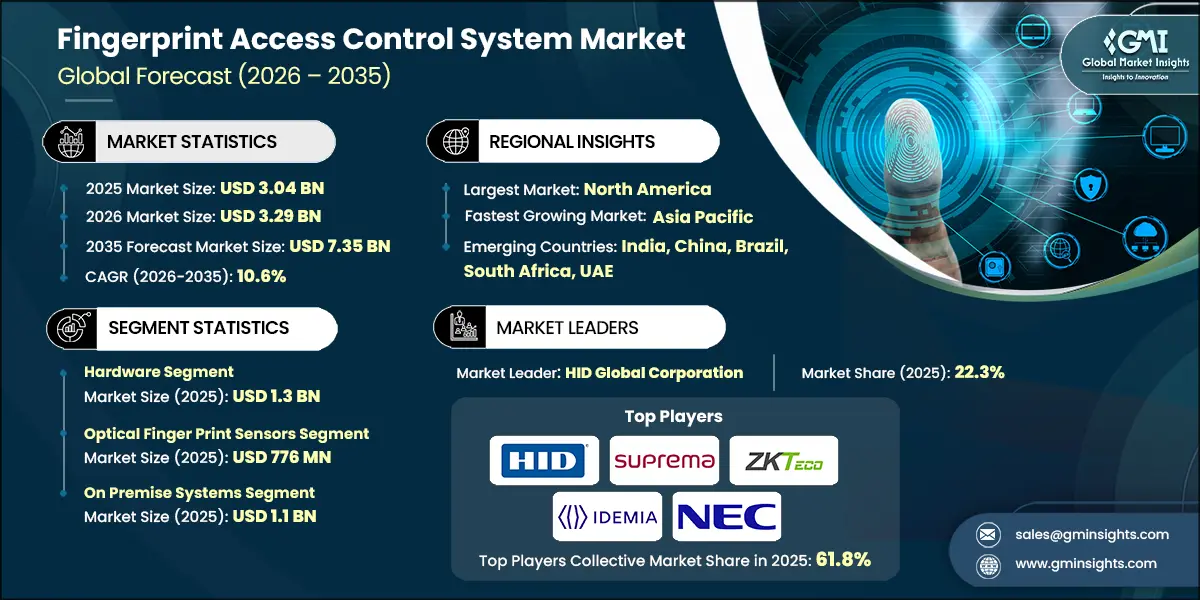
The global fingerprint access control system market was valued at USD 3.04 billion in 2025. The market is expected to grow from USD 3.29 billion in 2026 to USD 5.01 billion in 2031 and USD 7.35 billion in 2035, at a value CAGR of 10.6% during the forecast period, according to the latest report published by Global Market Insights Inc.
To get key market trends
The fingerprint access control system industry is expanding, owing to rising security concerns in residential, commercial, and industrial sectors, increasing adoption of biometric solutions over traditional access systems, government regulations and mandates for secure access in sensitive areas, integration with IoT and smart building technologies, and expansion of commercial infrastructure in emerging markets.
The increased security concerns in the residential, commercial and industrial setting are leading to the use of improved biometric access control systems such as fingerprint systems. The operators and governments are becoming more aware of the fact that the old-fashioned key/ID-badge systems can easily be stolen, duplicated, and shared with the wrong people, which results in the violation of secure zones. As a reaction, biometric authentication has become the focus of the new public security frameworks in an attempt to ensure the security of critical infrastructure, workplace security, and sensitive assets. For instance, in November 2023, the Belgian government passed the implementation of biometric access control at its large ports under the Maritime Security Act in order to prevent unauthorized people accessing port facilities.
Organizations and public authorities are progressively favoring biometric access solutions because they provide more reliable individual authentication than keys, cards, or PINs, reducing unauthorized entry and enhancing accountability. Government digital identity and security initiatives also reinforce this shift, aligning physical access control with secure identity management standards that underpin public and private sector systems. For instance, in May 2025, the European Commission announced the launch of the Shared Biometric Matching Service, enabling interoperable fingerprint and facial recognition across EU border and security systems, reinforcing biometric verification as a trusted method of access and identity validation.
Government regulations and regulatory bodies are also demanding that biometric authentication is used to secure access to sensitive areas and critical infrastructure, a trend that is gaining market demand in fingerprint access control solutions. The laws and security codes that govern public safety usually require more stringent standards of identification of secure facilities, transportation hubs, and points of entry at the borders, which is why the argument in favor of biometric implementations is reinforced. For instance, in November 2025 the U.S. Department of Homeland Security provided a final rule to increase biometric entry/exit requirements at ports of entry and exit, requiring biometric screening of non-U.S. citizens to enhance border security and identity verification.
The fingerprint access control system market comprises biometric security solutions that use unique fingerprint patterns to authenticate individuals. These systems are secure access controls to residential, commercial and industrial areas, preventing unauthorized access and improving security. They combine software platforms and hardware scanners to control, store, and track access data.
Fingerprint Access Control System Market Report Attributes
| Key Takeaway | Details |
|---|---|
| Market Size & Growth | |
| Base Year | 2025 |
| Market Size in 2025 | USD 3.04 Billion |
| Market Size in 2026 | USD 3.29 Billion |
| Forecast Period 2026-2035 CAGR | 10.6% |
| Market Size in 2035 | USD 7.35 Million |
| Key Market Trends | |
| Drivers | Impact |
| Rising security concerns in residential, commercial, and industrial sectors | Accelerates adoption of fingerprint access control systems as organizations and homeowners seek reliable, tamper-proof solutions to prevent unauthorized access and protect sensitive areas. |
| Increasing adoption of biometric solutions over traditional access systems | Promotes a shift from keycards, PINs, and passwords to fingerprint authentication, improving security, reducing credential sharing risks, and enhancing operational efficiency across enterprise and public infrastructures. |
| Government regulations and mandates for secure access in sensitive areas | Encourages mandatory deployment of biometric systems in critical infrastructure, border facilities, and regulated sectors, driving market growth through compliance requirements and standardized security frameworks. |
| Integration with IoT and smart building technologies | Enables connected and automated security management, allowing seamless monitoring, remote access control, and data-driven insights, supporting the adoption |
| Expansion of commercial infrastructure in emerging markets | Fuels market growth as new office complexes, smart residential projects, and industrial facilities adopt fingerprint access solutions, creating demand for scalable and locally adaptable systems. |
| Pitfalls & Challenges | Impact |
| High initial investment and installation costs | Limits adoption in small enterprises and cost-sensitive projects, slowing market penetration despite long-term security and operational benefits. |
| Privacy concerns and data protection regulations | Creates friction in deployment due to GDPR, CCPA, and other data privacy rules, necessitating robust encryption, secure storage, and compliance processes. |
| Opportunities: | Impact |
| Healthcare & Elder Care Security | Increasing adoption of fingerprint access systems in hospitals, clinics, and eldercare facilities enhances patient safety, restricts unauthorized access, and supports staff workflow efficiency. |
| Smart City & Enterprise Integration | Integration of fingerprint access with smart city projects and enterprise digital platforms enables centralized monitoring, predictive security management, and performance-based analytics, boosting long-term adoption and operational insights. |
| Market Leaders (2025) | |
| Market Leader |
22.3% Market Share |
| Top Players |
Collective market share in 2025 is 61.8% |
| Competitive Edge |
|
| Regional Insights | |
| Largest Market | North America |
| Fastest growing market | Asia Pacific |
| Emerging countries | India, China, Brazil, South Africa, UAE |
| Future outlook |
|
What are the growth opportunities in this market?
Fingerprint Access Control System Market Trends
- The fingerprint access control system industry is experiencing a notable shift towards implementation of biometric systems in collaboration with smart technologies, AI and the Internet of Things (IoT). There are now numerous smart devices that have access systems based on fingerprint identification, including smartphones, laptops, and home security systems. This integration also simplifies the process of authentication besides increasing the convenience of the user. Besides, fingerprint recognition implemented in IoT devices strengthens access controls and data protection in interconnected environments.
- For example, in May 2024, IDEMIA Public Security was the first to win the NIST Evaluation of Latent Fingerprint Technologies (ELFT) for the fourth time in a row, with the most accurate and fastest algorithms. Their high-tech fingerprint access control systems, with the help of AI, are also effective in palmprint recognition, which makes law enforcement more effective.
- Moreover, the introduction of innovations such as multimodal biometric systems have been introduced in order to further reduce the false acceptance and rejection rates. Such technological advances not only strengthen security but also make the use of the technology more efficient as it is faster and more stable. These advancements are bound to catalyze the popularization of fingerprint access control systems in various industries due to the unremitting nature of technology.
Fingerprint Access Control System Market Analysis
Learn more about the key segments shaping this market
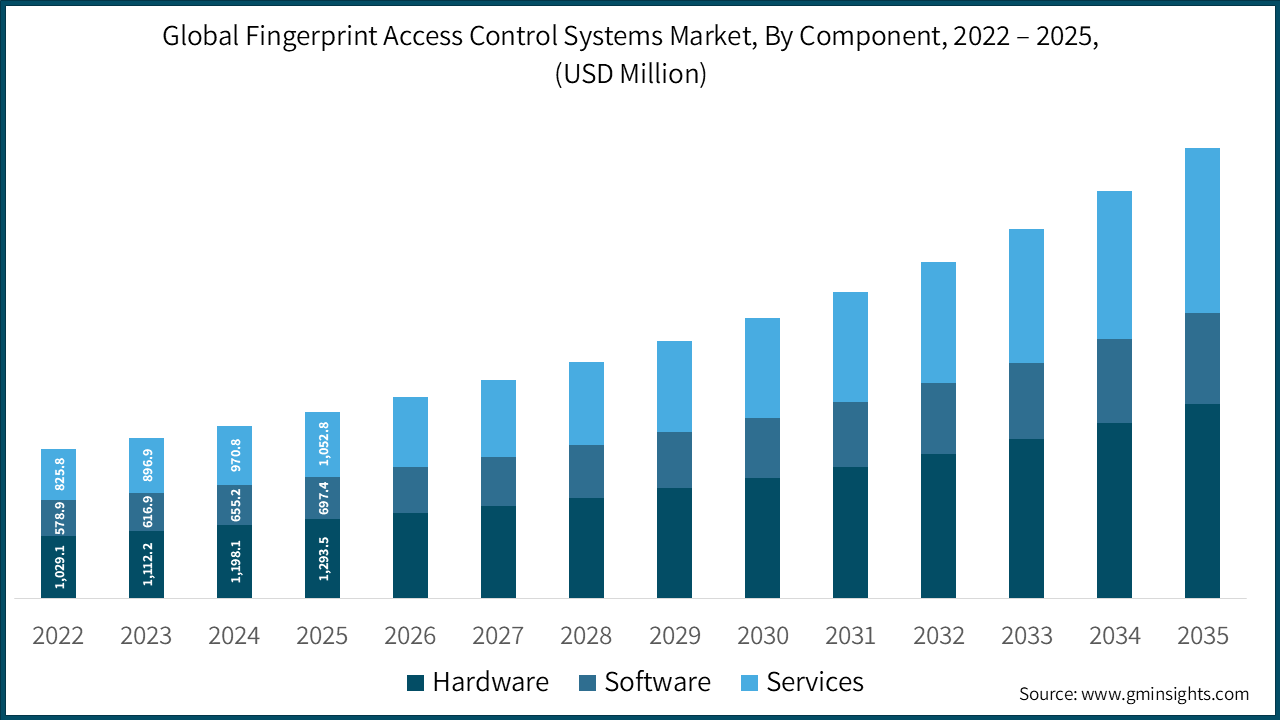
Based on components, the fingerprint access control system market is divided into hardware, software, and services.
- The hardware segment accounted for the largest market and was valued at USD 1.3 billion in 2025. Rising security requirements across commercial buildings, industrial facilities, and government infrastructure are driving large-scale deployment of fingerprint scanners, controllers, and readers to ensure secure, tamper-resistant physical access.
- Government modernization of physical security infrastructure is accelerating hardware adoption for biometric access control across public facilities and critical assets. For instance, in March 2024, the U.S. Department of Homeland Security expanded biometric access requirements for federal buildings.
- Manufacturers should focus on ruggedized, high-accuracy fingerprint hardware compatible with government security standards, enabling long-term contracts in public infrastructure, transportation hubs, and regulated industrial environments.
- The services segment was the fastest growing market during the forecast period, growing at a CAGR of 11.3% during the forecast period. Increasing demand for centralized access management, real-time monitoring, and audit trails is driving adoption of fingerprint access control software across enterprises, enabling efficient credential management and compliance reporting.
- Government digital identity and security interoperability initiatives are driving demand for advanced biometric software platforms. For instance, in October 2023, the European Commission reinforced biometric system interoperability under EU-wide security frameworks.
- Software providers should emphasize scalable, GDPR-compliant platforms with encryption, analytics, and API integration, supporting enterprise-wide deployments across regulated sectors such as government, healthcare, and financial institutions.
Learn more about the key segments shaping this market
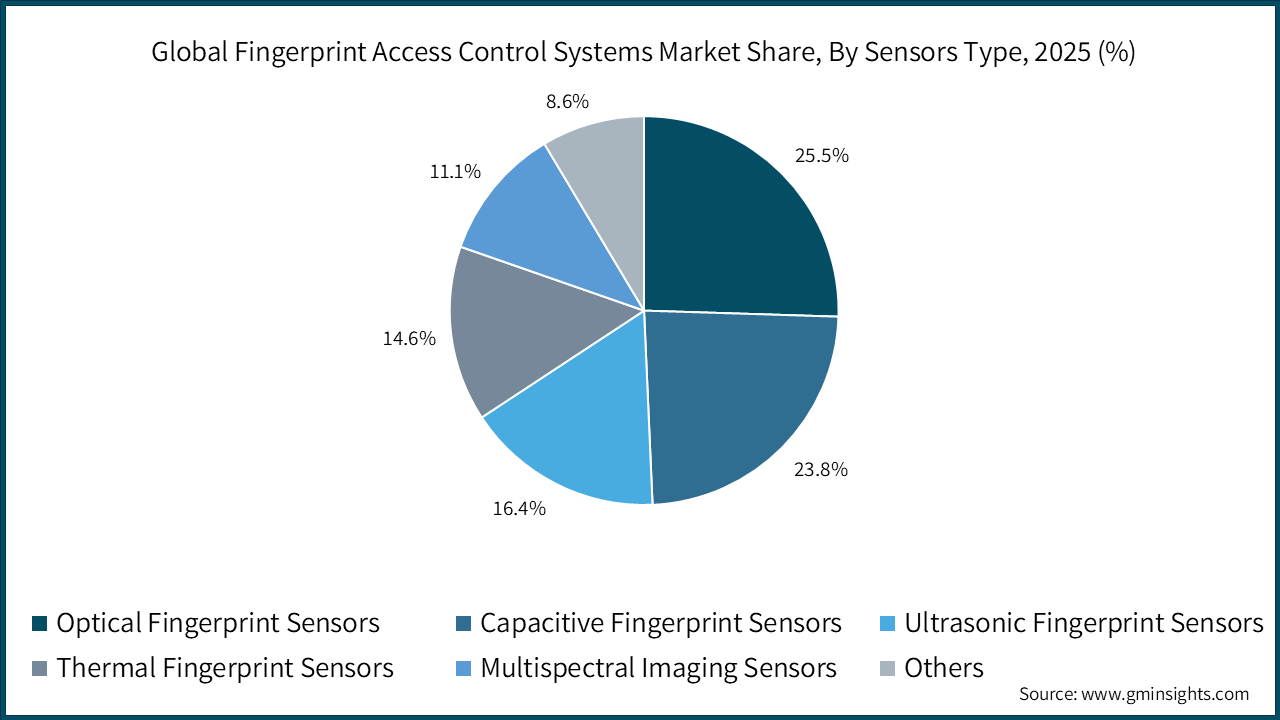
On the basis of sensor type, the fingerprint access control system market is categorized into optical, capacitive, ultrasonic, thermal, multispectral, and other.
- The optical finger print sensors segment accounted for the largest market and was valued at USD 776 million in 2025. Cost-effectiveness, proven reliability, and ease of integration make optical fingerprint sensors widely adopted across commercial offices, residential complexes, and government facilities.
- Public infrastructure projects continue to deploy optical sensors for standardized biometric access. For instance, in January 2024, the Ministry of Housing and Urban Affairs supported biometric access adoption in smart public buildings.
- Manufacturers should optimize optical sensors for affordability and durability, targeting high-volume deployments in offices, residential complexes, and government facilities with standardized security requirements.
- The capacitive fingerprint sensors segment was the fastest growing market during the forecast period, growing at a CAGR of 12.8% during the forecast period. Rising demand for higher accuracy and spoof resistance is accelerating adoption of capacitive sensors in enterprise, BFSI, and high-security access control environments.
- Miniaturization and improved sensor sensitivity enable integration into compact access devices, expanding usage in smart locks, turnstiles, and enterprise access terminals.
- Manufacturers should invest in anti-spoofing enhancements and compact designs to address enterprise security needs and premium access control applications requiring higher authentication reliability.
Based on deployment type, the fingerprint access control system market is on-premise systems, cloud-managed systems, and hybrid systems.
- The on‑premise systems segment accounted for the largest market and was valued at USD 1.1 billion in 2025. Data sovereignty, low latency, and direct control over biometric databases continue to drive preference for on-premise fingerprint access systems in government and regulated industries.
- Public sector security mandates favor locally managed biometric systems. For instance, in February 2024, the Federal Office for Information Security emphasized on-premise security controls for sensitive facilities.
- Vendors should design robust, upgradeable on-premise solutions with strong encryption and compliance features to meet regulatory demands in government, defense, and critical infrastructure environments.
- The cloud based segment was the fastest growing market during the forecast period, growing at a CAGR of 13% during the forecast period. Demand for centralized management, scalability, and remote monitoring is accelerating adoption of cloud-managed fingerprint access systems across multi-site enterprises and commercial facilities.
- Smart building and digital workplace initiatives increasingly favor cloud-based access control for real-time analytics, faster deployment, and lower operational complexity.
Looking for region specific data?
North America Fingerprint Access Control System Market
North America fingerprint access control system industry held a market share of 32.8% in 2025.
- The fingerprint access control market in North America remains the largest globally, driven by strong security investments across commercial, government, healthcare, and enterprise applications, and rapid adoption of cloud‑enabled biometric solutions.
- Widespread deployment in airports, data centers, and smart buildings underpins sustained growth, supported by rigorous compliance frameworks and early technology integration.
- The United States continuously expands biometric use in border management and national security programs, mandating biometric entry/exit processes for non‑citizens effective late 2025, signaling increasing government reliance on fingerprints and facial recognition to enhance identity verification.
- Manufacturers should focus on interoperable, compliant biometric systems tailored to enterprise and government use cases.
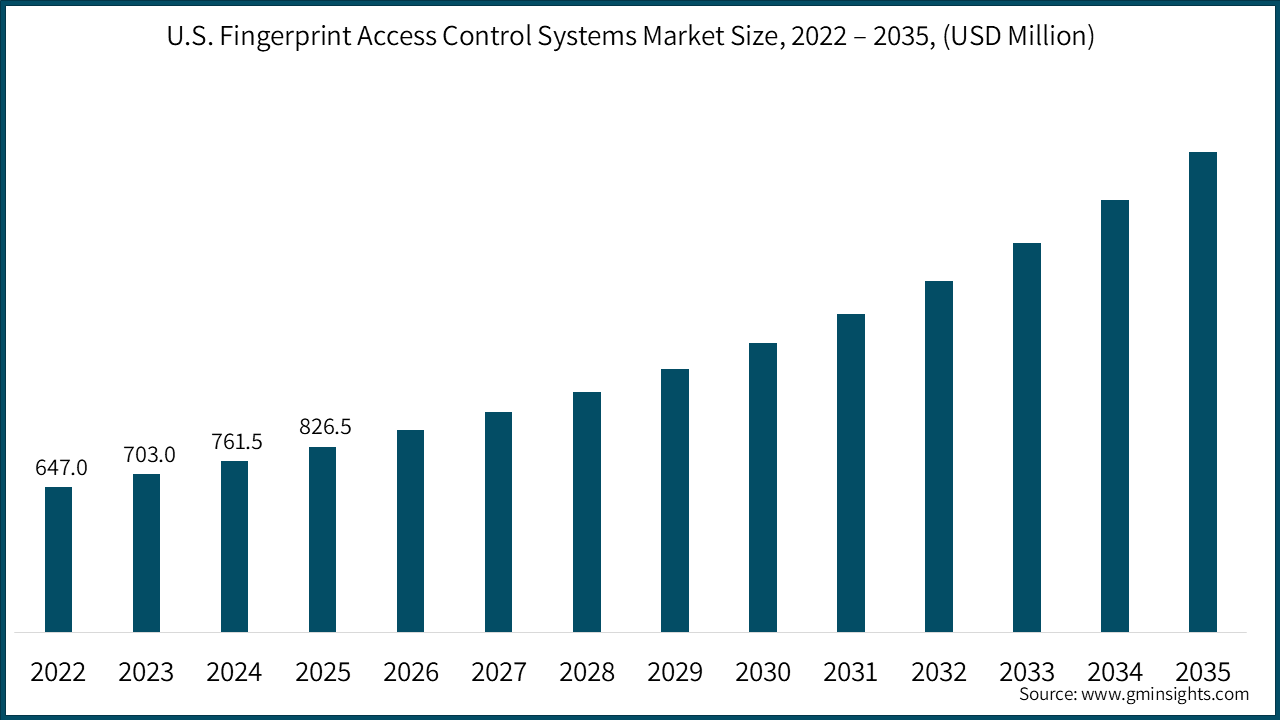
The U.S. fingerprint access control system market was valued at USD 647 million and USD 703 million in 2022 and 2023, respectively. The market size reached USD 826.5 million in 2025, growing from USD 761.5 million in 2024.
- In the United States, fingerprint access control adoption is growing alongside broader biometric enforcement in national security and immigration operations.
- The Department of Homeland Security issued a final rule in November 2025 requiring biometric (including fingerprint) data capture on exit at all ports of departure for non‑U.S. citizens, reinforcing the shift toward comprehensive biometric identity systems.
- This reflects broader federal priorities to modernize security infrastructure and reduce fraud, positioning fingerprints as a cornerstone of secure identity verification across both border control and critical infrastructure sectors.
- Manufacturers must prioritize US DHS standard compliance and partnerships for border and federal agency deployments.
Europe Fingerprint Access Control System Market
Europe fingerprint access control system industry accounted for USD 715.2 million in 2025 and is anticipated to show lucrative growth over the forecast period.
- Europe’s fingerprint access control systems market benefits from regulatory emphasis on secure identity and compliance mandates across sectors including finance, government, and transportation.
- The EU’s Entry/Exit System (EES) began rolling out in October 2025, requiring fingerprint and facial biometric capture at external borders to improve traveller verification and border security across Schengen states.
- This coordinated biometric enforcement accelerates adoption of interoperable fingerprint solutions in physical security frameworks. With tightening data protection laws and cross‑border data exchange initiatives, Europe’s market outlook remains strong for both fingerprint hardware and encryption‑focused access platforms that meet GDPR and shared security requirements.
- Manufacturers need to integrate GDPR‑compliant biometric storage and EES interoperability features.
Germany dominated the Europe fingerprint access control system market, showcasing strong growth potential.
- Germany’s adoption of fingerprint access control is supported by both broader EU biometric initiatives and national security priorities in corporate and public infrastructure.
- The country is implementing the EU’s Entry/Exit System at major airports, integrating automated biometric verification into border management to enhance security and traveler processing.
- German government agencies also explore advanced biometric surveillance and identity document security enhancements, indicating a strategic inclination toward robust authentication technologies.
- Manufacturers should focus on developing solutions optimized for large transit hubs and federal facility compliance.
Asia Pacific Fingerprint Access Control System Market
The Asia Pacific fingerprint access control system industry is the largest and fastest growing market and is anticipated to grow at the CAGR of 12.4% during the analysis timeframe.
- Asia Pacific leads global fingerprint access control adoption, with China, India, Japan, and South Korea installing hundreds of thousands of biometric units across commercial, government, and transportation sectors.
- Rapid urbanization, smart city projects, and growing enterprise infrastructure investments fuel demand for secure access systems. Government‑led digital transformation initiatives and public security modernization efforts further amplify market uptake.
- China’s expansive commercial growth and smart infrastructure programs particularly bolster demand, making Asia Pacific the fastest‑growing regional market for fingerprint‑based security solutions, encompassing both hardware and integrated cloud/IoT platforms.
- Manufacturers must localize product offerings and partner with smart city integrators.
China fingerprint access control system market is estimated to grow with a CAGR of 13.5% during the forecast period.
- China dominates the Asia Pacific fingerprint access control market, deploying extensive biometric systems across commercial, government, and BFSI sectors.
- Strong national initiatives in smart city development and urban infrastructure modernization accelerate large‑scale adoption.
- China’s focus on integrated biometric identity frameworks in transportation hubs and public facilities enhances both security and operational efficiency, while domestic tech supply chains support scalable deployments.
- The widespread rollout of fingerprint systems in enterprise and public venues makes China a core growth engine in the global biometric access control market.
Latin American Fingerprint Access Control System Market
Brazil leads the Latin American fingerprint access control system industry, exhibiting remarkable growth during the analysis period.
- In Brazil, fingerprint access control adoption is growing steadily, particularly within banking, commercial buildings, and public infrastructure, as organizations upgrade security frameworks amidst rising concerns about unauthorized access.
- Local regulatory emphasis on fraud prevention and digital identity programs spurs demand for biometric solutions that can provide reliable authentication while integrating with existing security software.
- Economic expansion in urban centers and government‑backed safety mandates further support market development, positioning Brazil as a key Latin American growth region for fingerprint systems.
- Manufacturers should offer flexible financing and scalable solutions for cost‑sensitive markets.
Middle East and Africa Fingerprint Access Control System Market
South Africa fingerprint access control system industry to experience substantial growth in the Middle East and Africa market in 2025.
- South Africa’s fingerprint access control market is emerging due to increasing investments in infrastructure security and public safety initiatives across government, commercial, and institutional sectors.
- Growing demand for modernized access management solutions reflects broader regional efforts to enhance security frameworks and tackle unauthorized entry challenges.
- While the market’s maturity lags behind developed regions, rising awareness of biometric advantages and integration with smart building trends are fueling incremental adoption.
- South African manufacturers should emphasize on building partnerships with integrators to penetrate institutional and government projects.
Fingerprint Access Control System Market Share
The fingerprint access control system industry is moderately concentrated, with leading manufacturers projected to collectively control a significant portion of global revenue in 2026. Key players such as, HID Global Corporation, Suprema Inc., ZKTeco Co., Ltd., IDEMIA (Morpho), and NEC Corporation held an estimated 61.8% of the total market share. These companies leverage extensive R&D, advanced hardware development, and software integration capabilities to improve scanner accuracy, authentication speed, and system reliability across enterprises, government, and residential applications.
Their strategic collaborations, regional expansions, and acquisitions enable strong positioning in commercial buildings, industrial facilities, government establishments, and smart home solutions. Despite this concentration, smaller and regional suppliers continue to participate, focusing on niche applications, specialized multi-factor authentication solutions, and IoT-integrated access systems, fostering innovation and competitive pressure. Overall, while top corporations dominate a large share, the market remains dynamic due to technological evolution, rising security concerns, and growing adoption across emerging geographies.
Fingerprint Access Control System Market Companies
Prominent players operating in the fingerprint access control system industry are as mentioned below:
- 3M Cogent, Inc.
- Anviz Global Inc.
- Aratek Biometrics
- Aware, Inc.
- BioEnable Technologies Pvt. Ltd.
- Fingerprint Cards AB (Fingerprints)
- HID Global Corporation
- IDEMIA (Morpho)
- Integrated Biometrics
- M2SYS Technology
- Mantra Softech (India) Pvt. Ltd.
- NEC Corporation
- Nitgen Co., Ltd.
- Precise Biometrics AB
- Secugen Corporation
- Suprema Inc.
- Thales Group
- ZKTeco Co., Ltd.
- HID Global Corporation controls 22.3% of the fingerprint access control system market, supported by its strong enterprise and government presence. The company offers highly secure, interoperable fingerprint readers and access platforms with strong compliance credentials. HID Global collaborates with system integrators, government agencies, and smart building solution providers to expand deployments across critical infrastructure, transportation hubs, and commercial facilities.
- Suprema Inc. holds 16.5% of the market, driven by high-performance fingerprint sensors and AI-based biometric algorithms. Its solutions emphasize speed, accuracy, and advanced spoof detection. Suprema collaborates with security solution providers and smart building developers to strengthen adoption in enterprise, government, and high-security commercial environments.
- ZKTeco Co., Ltd. accounts for 10.4% of the market, offering cost-effective fingerprint access control hardware and integrated software platforms. The company focuses on large-scale deployments in commercial, industrial, and emerging markets. ZKTeco partners with local distributors, system integrators, and infrastructure developers to accelerate adoption across price-sensitive regions.
- IDEMIA captures 7.6% of the market, leveraging its expertise in government-grade biometric identity systems. The company’s fingerprint access solutions are widely deployed in border security, public safety, and regulated environments. IDEMIA collaborates with government bodies and national security agencies to support large-scale, high-assurance biometric access implementations.
- NEC Corporation holds 5% of the market, integrating fingerprint biometrics into broader digital identity and public safety ecosystems. NEC’s solutions emphasize system interoperability and large-scale deployment capabilities. The company collaborates with government institutions, transportation authorities, and enterprise clients to expand secure access control adoption globally.
Fingerprint Access Control System Industry News
- In January 2026, NEXT Biometrics partnered with Giantplus Technology to co-develop a prototype for "anywhere-on-display" fingerprint authentication, intended for full-screen integration in mobile and secure access devices.
- In January 2026, Suprema previewed its next-generation AI-powered access control platforms, BioStar X (on-premise) and BioStar Air (cloud-native), at Intersec 2026, with an official launch scheduled for the first half of the year.
- In July 2025, HID Global acquired the Calmell Group to expand its international presence in public transportation and enhance its smart ticketing and access product portfolio.
- In June 2023, Apple introduced significant privacy and security innovations, including major enhancements to Safari Private Browsing, which now includes advanced fingerprinting protections to prevent websites from tracking users. This update underscores Apple's commitment to safeguarding user data through cutting-edge privacy measures.
- In June 2023, HID awarded the 2023 Global Product Leadership Award by Frost & Sullivan for its advanced biometric authentication solutions. Notably, HID excels in fingerprint access control systems, leveraging cutting-edge technology to enhance security and identification across diverse industries.
The fingerprint access control system market research report includes in-depth coverage of the industry with estimates & forecasts in terms of revenue (USD Million) from 2022 to 2035, for the following segments:
Market, By Component
- Hardware
- Readers/scanners
- Fingerprint terminals
- Door locks & controllers
- Software
- Algorithm engine
- Access control management software
- Time & attendance
- Services
- Installation
- Integration
- Maintenance/support
Market, By Sensor Type
- Optical
- Capacitive
- Ultrasonic
- Thermal
- Multispectral
- Other
Market, By Deployment Type
- On-premises systems
- Cloud-managed systems
- Hybrid systems
Market, By Application
- Door access control
- Restricted facility access
- Workforce attendance tracking
- Visitor management
Market, By End-use industry
- Commercial
- Residential
- Industrial/manufacturing
- Government & defense
- Healthcare
- Education
- Hospitality & retail
- Others
The above information is provided for the following regions and countries:
- North America
- U.S.
- Canada
- Europe
- Germany
- UK
- France
- Spain
- Italy
- Netherlands
- Asia Pacific
- China
- India
- Japan
- Australia
- South Korea
- Latin America
- Brazil
- Mexico
- Argentina
- Middle East and Africa
- Saudi Arabia
- South Africa
- UAE
Frequently Asked Question(FAQ) :
What was the valuation of the optical fingerprint sensors segment in 2025?
The optical fingerprint sensors segment was valued at USD 776 million in 2025, led by their cost-effectiveness, reliability, and ease of integration.
What is the expected size of the fingerprint access control system industry in 2026?
The market size is projected to reach USD 3.29 billion in 2026.
How much revenue did the hardware segment generate in 2025?
The hardware segment generated approximately USD 1.3 billion in 2025, due to rising security requirements across commercial, industrial, and government facilities.
What is the growth outlook for the on-premise systems segment?
The on-premise systems segment was valued at USD 1.1 billion in 2025, owing to preferences for data sovereignty, low latency, and direct control over biometric databases.
What is the projected value of the fingerprint access control system market by 2035?
The market is poised to reach USD 7.35 billion by 2035, fueled by advancements in biometric technologies, government mandates, and the expansion of commercial infrastructure in emerging markets.
What was the market size of the fingerprint access control system in 2025?
The market size was valued at USD 3.04 billion in 2025, with a CAGR of 10.6% expected through 2035. The growth is driven by increasing security concerns, adoption of biometric solutions, and integration with IoT and smart technologies.
Which region leads the fingerprint access control system sector?
North America leads the market with a 32.8% share in 2025. The market is propelled by strong security investments across commercial, government, healthcare, and enterprise applications.
What are the upcoming trends in the fingerprint access control system market?
Trends include AI- and IoT-integrated biometrics, multimodal systems to reduce errors, and wider fingerprint use in IoT for improved security.
Who are the key players in the fingerprint access control system industry?
Key players include 3M Cogent, Inc., Anviz Global Inc., Aratek Biometrics, Aware, Inc., BioEnable Technologies Pvt. Ltd., Fingerprint Cards AB, HID Global Corporation, IDEMIA (Morpho), Integrated Biometrics, and M2SYS Technology.
Fingerprint Access Control System Market Scope
Related Reports