Summary
Table of Content

Electric Distribution Utility Market
Get a free sample of this report
Form submitted successfully!
Error submitting form. Please try again.
Thank you!
Your inquiry has been received. Our team will reach out to you with the required details via email. To ensure that you don't miss their response, kindly remember to check your spam folder as well!
Request Sectional Data
Thank you!
Your inquiry has been received. Our team will reach out to you with the required details via email. To ensure that you don't miss their response, kindly remember to check your spam folder as well!
Form submitted successfully!
Error submitting form. Please try again.
Electric Distribution Utility Market Size
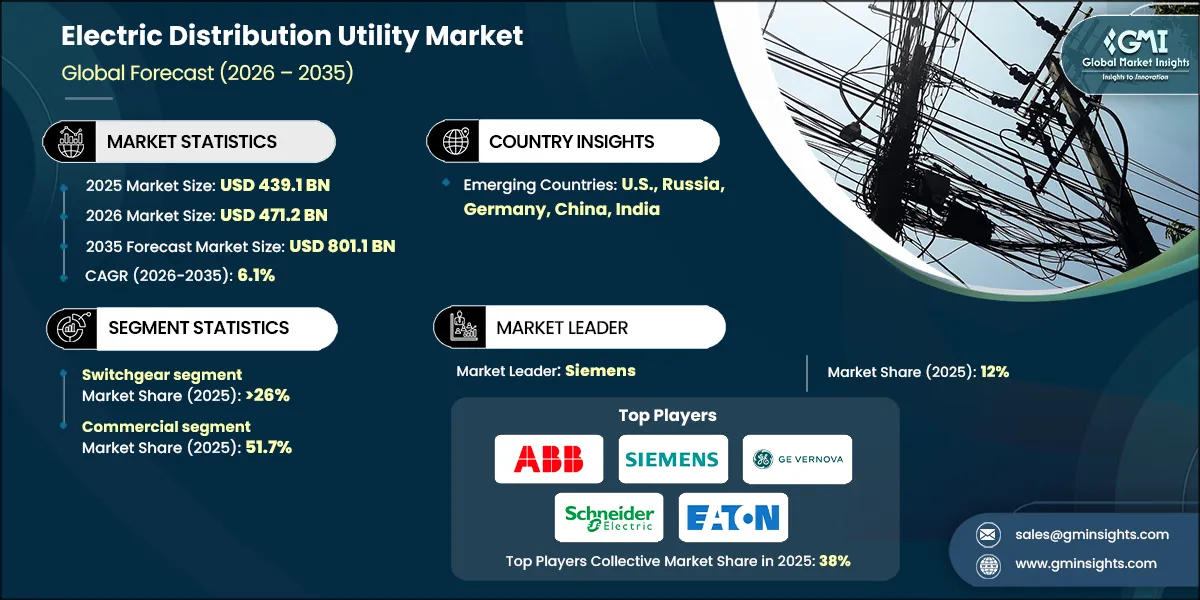
According to a recent study by Global Market Insights Inc., the electric distribution utility market was estimated at USD 439.1 billion in 2025. The market is expected to grow from USD 471.2 billion in 2026 to USD 801.1 billion in 2035, at a CAGR of 6.1%.
To get key market trends
The market observed significant momentum owing to the accelerating investments by the utilities across smart grid technologies, including advanced metering infrastructure, distribution automation, and real-time monitoring systems. These initiatives improve operational efficiency, enhance reliability, and support data-driven decision-making, creating sustained growth opportunities across the distribution value chain.
For instance, according to the study published by the International Energy Agency, in June 2025, global investments in grid infrastructure is set to exceed USD 400 billion annually by the end of 2025, with digital technologies accounting for an increasing share of capital expenditure. Moreover, smart grid deployments enable utilities to manage distributed energy resources more effectively, optimize asset utilization, and respond dynamically to changing load patterns, thereby catering to the industry expansion.
The electrification of transportation, heating, and industrial processes is increasing electricity demand at the distribution level along with development of commercial and residential infrastructure across various regions is contributing to industry growth. Electric vehicle charging infrastructure, electric heat pumps and other electrical equipment are becoming significant load contributors, requiring network expansion and reinforcement further augmenting business landscape.
For instance, in June 2024, the U.S. Department of Energy reported that the passenger electric vehicle adoption is accelerating across the country and the national light-duty PEV stock is projected to reach 42 million units by 2030. This electrification trend necessitates substantial upgrades to distribution infrastructure to accommodate higher peak loads and ensure grid stability.
Variations in climatic conditions, replacement of prevailing electrical components have led utilities to invest in advanced technologies to boost grid stability, automation, and resiliency. These investments support long-term growth in advanced protection systems, intelligent switchgear coupled with overhead and underground cabling, aiming to minimize outage duration and improve customer service quality, thereby augmenting the product demand.
The ongoing expansion of smart grid networks across the electric distribution utility market is being driven by a strategic shift toward digital, intelligent, and flexible infrastructure. Various scale utilities are deploying advanced distribution management systems, distributed energy resource management platforms, and customer engagement tools that enhance operational visibility and control.
For instance, in December 2025, the Office of Gas and Electricity Markets (OFGEM), UK, confirmed the funding of about USD 37.7 billion to the energy network companies aiming to boost the stability, resilience, and security of the grid networks. The investment is divided into two categories and around USD 13.8 billion to strengthen transmission networks, expand capacity, and enhance reliability.
Asia Pacific holds the dominant position across the electric distribution utility market owing to rapidly increasing electricity demand driven by population growth, industrial development and development of existing grid networks. Favorable policies by respective governments toward expansion of distribution networks, along with retrofitting of prevailing electricity infrastructure will positively influence business dynamics.
For instance, in November 2025, the Electricity (Amendment) Bill, 2025 aims to modernize India’s power sector by promoting competition, efficiency, and transparent use of existing infrastructure. It shifts from a monopoly‑based model to a performance‑driven framework while safeguarding subsidized tariffs for farmers and low‑income consumers. The Bill strengthens Centre‑State coordination and supports India’s long‑term growth ambitions, aligning with the nation’s vision for Viksit Bharat 2047.
Europe is one of the largest markets in the electric distribution utility industry driven by strong regulatory frameworks toward expansion of distribution networks, investment in grid modernization and stringent mandates toward decarbonization. Utilities across the region are rapidly upgrading existing and aging electrical infrastructure along with growing inclination toward electrification including electric mobility, industrial processes and EV infrastructure further augment industry outlook.
For instance, in December 2025, the European Commission introduced Grids Package and Energy Highways initiative, designed to improve cross‑border energy flows and accelerate electrification by integrating cost‑efficient clean energy across member states. The framework introduces a coordinated European approach to infrastructure planning, streamlines permitting processes, and promotes equitable cost allocation for cross‑border projects.
Electric Distribution Utility Market Report Attributes
| Key Takeaway | Details |
|---|---|
| Market Size & Growth | |
| Base Year | 2025 |
| Market Size in 2025 | USD 439.1 Billion |
| Market Size in 2026 | USD 471.2 Billion |
| Forecast Period 2026-2035 CAGR | 6.1% |
| Market Size in 2035 | USD 801.1 Billion |
| Key Market Trends | |
| Drivers | Impact |
| Ongoing expansion of smart grid networks | Enhances system efficiency, improves real-time monitoring, enables advanced automation, and drives significant investment in modern distribution technologies. |
| Development and refurbishment of prevailing grid infrastructure | Upgrading and refurbishing existing grid infrastructure enhance reliability, reduces outages, strengthen capacity for renewable integration, and accelerate expenditure in advanced electric distribution systems. |
| Rising peak load demand | Enables utilities to expand distribution capacity, adopt advanced load management technologies, and invest in resilient networks to maintain stability, efficiency, and uninterrupted electricity supply. |
| Pitfalls & Challenges | Impact |
| Substantial upfront capital investment | Significant initial capital investment may delay project deployment, increase financial risk for utilities, and slow adoption of modern distribution technologies, particularly across cost-sensitive regions. |
| Opportunities: | Impact |
| Growing renewable energy integration | Increasing renewable integration requires advanced distribution systems, creating opportunities for utilities to deploy smart inverters, energy storage, and grid balancing technologies to ensure stability. |
| Adoption of digital grid technologies | Advanced analytics, automation, and IoT platforms improve grid visibility, reduce outages, optimize asset utilization, and support utilities in delivering efficient, data‑driven distribution services. |
| Rising demand for grid resilience solutions | Extreme weather and higher reliability need push utilities to upgrade their systems by strengthening equipment, putting lines underground, improving protection technology, and adding resilient local power sources to keep services running smoothly. |
| Expansion of EV charging infrastructure | Increasing adoption of EV is driving the need for enhanced distribution networks, prompting utilities to invest in advanced load management systems and grid reinforcement to ensure dependable, high capacity power delivery. |
| Market Leaders (2025) | |
| Market Leader |
12% Market Share |
| Top Players |
Collective Market Share of 38% |
| Competitive Edge |
|
| Regional Insights | |
| Emerging countries | U.S., Russia, Germany, China, India |
| Future outlook |
|
What are the growth opportunities in this market?
Electric Distribution Utility Market Trends
The electric distribution utility industry is witnessing significant momentum owing to rising electricity demand, favorable policies toward development of grid networks and adoption of smart grids. Shifting focus toward development of distribution infrastructure, ongoing integration of renewable energy sources and rapid changes in technology is creating opportunities for equipment manufacturers, technology providers, and service companies further shaping business dynamics.
For instance, in October 2025, the Government of India is developing a new reform scheme to address persistent financial strain and operational inefficiencies in the power distribution sector. The initiative aims to introduce private participation through joint ventures or partial privatization to improve management and attract investment. The program is led by the Ministry of Power, with support from the Ministry of Finance, is anticipated to include concessional financing and performance-based incentives for participating states.
Growing emphasis on advanced metering, automation, renewable energy management systems, along with significant investments by utilities in efficient, reliable and smarter grid technologies to strengthen grid resilience will complement business landscape. For instance, according to the International Energy Agency (IEA), investment in smart grids must be doubled by 2030 to stay aligned with the NZE Scenario, with a particular emphasis on emerging and developing economies.
Increasing inclination toward distribution automation and grid modernization efforts have led utilities to deploy smart components including automated switchgear, and distribution management systems enabling real‑time monitoring and control grid conditions will shape industry dynamics. Varying climatic conditions, increasing microgrids and distributed energy resource configurations, enabling critical facilities and distribution systems to operate independently during grid disturbances further augmenting industry outlook.
Flourishing investments in grid resilience and reliability, expanding power backup solutions and ongoing deployment of microgrids and distributed energy storage systems have further strengthened the distribution network systems. Favorable policies by respective authorities toward expansion of existing networks along with development of new lines will augment industry outlook.
For instance, in January 2026, Japan planned to invest approximately USD 1.3 billion over five years beginning in fiscal 2026 to encourage corporate use of clean electricity. The programme offers subsidies covering up to 50% of capital expenditure for companies committing to 100% decarbonized power and contributing to regional development. Target sectors include data centers and manufacturing, with the initiative aimed at reducing fossil‑fuel dependence, strengthening long‑term clean‑energy investments.
Electric Distribution Utility Market Analysis
 Learn more about the key segments shaping this market
Learn more about the key segments shaping this market
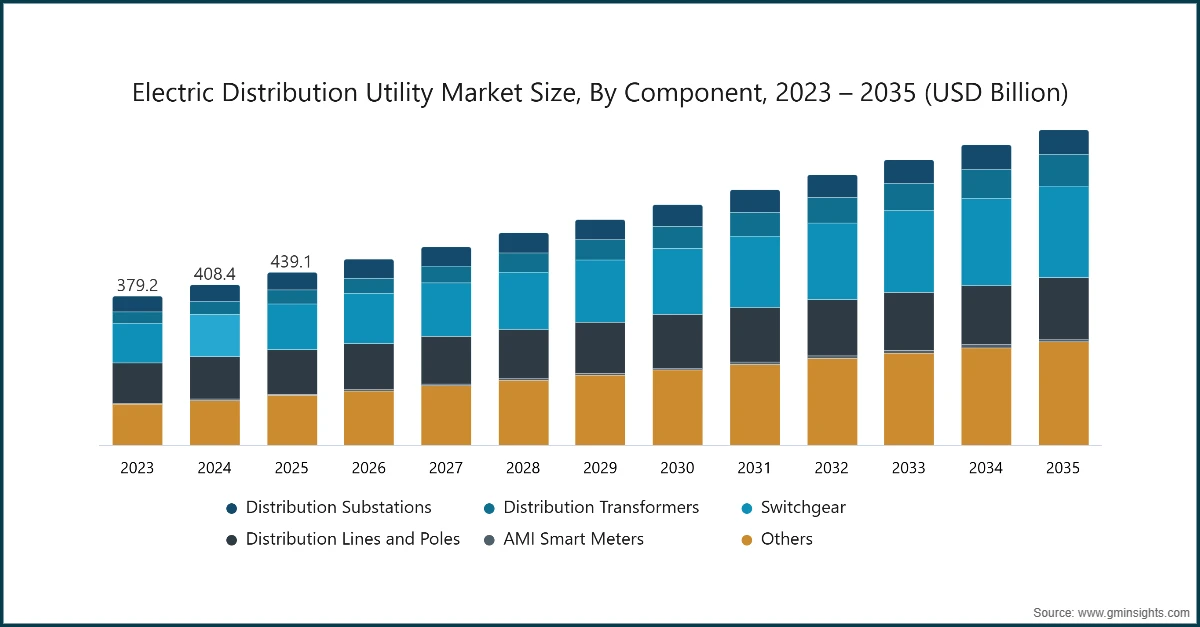
Based on component, the industry is segmented into distribution substations, distribution transformers, switchgear, distribution lines and poles, AMI smart meters and others. The switchgear segment dominated electric distribution utility market accounting for over 26% market share in 2025 and is set to grow at a CAGR of over 7% through 2035.
The switchgear segment is anticipated to witness strong growth driven by increasing adoption of smart grid solutions leveraging advanced communication and information technologies by improving efficiency across electricity generation, distribution, and consumption. Moreover, ongoing refurbishment of aging electrical infrastructure across both developed and emerging economies, along with ongoing expansion of power distribution networks, is further accelerating switchgear industry outlook.
For instance, in October 2025, CG Power & Industrial Solutions Ltd. announced plans to develop a greenfield, technology‑driven switchgear production facility in India, with an investment of over USD 81.8 million. The plant will significantly expand the company’s production capacity and product portfolio across MV, EHV, automation, and power electronics. The project is funded through internal accruals, equity, and debt, supports company’s growth strategy and India’s broader industrial and energy infrastructure development goals.
Distribution lines and poles segment across electric distribution utility market is set to grow at a CAGR of over 3% by 2035. Increasing demand for more reliable and widespread electricity, driven by urbanization, industrialization, and paradigm shift toward integration of renewable energy sources along with advancements in smart grid technology is contributing to industry growth. Rising need to modernize grid infrastructure is driven by increasing need to develop new distribution networks along with rising use of electric cars, and the trend to decentralized energy production will augment business dynamics.
For instance, in December 2025, in India, Kerala State Electricity Board Limited approved a capital investment plan of USD 705.9 million for 2026–27. The plan allocates funds for generation amounting to USD 92.6 million, transmission for USD 128.2 million, and distribution USD 182.8 million. Additional provisions include support for pumped‑storage DPRs, battery energy storage, EV‑charging infrastructure, and statewide smart‑meter deployment to integrate renewable energy and modernize grid operations.
Distribution substation market was evaluated at over USD 44.5 billion in 2025 and is set to grow owing to increased penetration of renewable energy sources requiring localized voltage control and transformation, continuous expansion of substations. Grid flexibility and reliability particularly in remote areas, adoption of smart grid technologies, enabling operators to monitor and control the system will accelerate product adoption. Rising need for modernization and replacement of existing equipment and enhance grid resilience during extreme climatic environments will contributes to industry growth.
For instance, in June 2025, NEDO, in collaboration with Nissin Electric, begun demonstration operations of a micro substation in India under Japan’s International Demonstration Project for Decarbonization and Energy Transition. Installed at a TATA Power‑DDL site near Delhi, the system uses Nissin’s power voltage transformer to convert extra‑high‑voltage transmission power directly to low voltage for local supply. The project aims to validate reliability and power‑quality benefits in regions with limited grid infrastructure.
Learn more about the key segments shaping this market
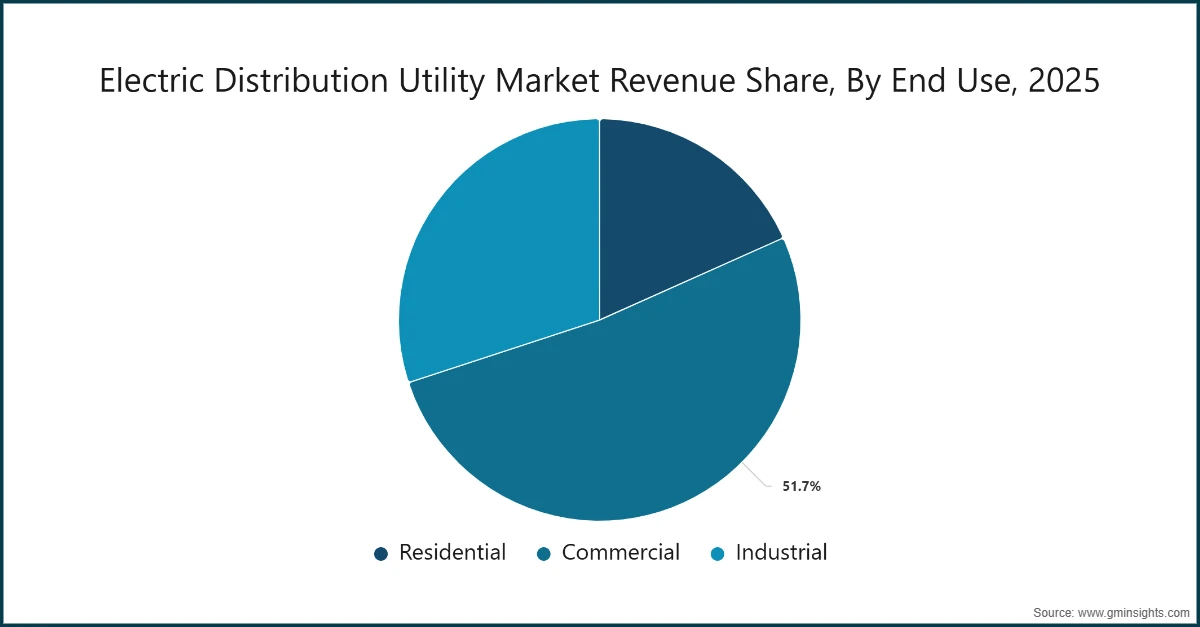
Based on end use, the electric distribution utility market is categorized into residential, commercial and industrial. The commercial segment accounted for around 51.7% market share in 2025 and is set to grow at a CAGR of over 5.5% through 2035.
Flourishing investments toward development of commercial establishments including educational facilities, hospitals, offices, shopping centers among others driven by robust urbanization rate along with rising demand for electricity will augment industry landscape. Rising need for reliable and efficient distribution infrastructure serving customers to accommodate diverse load profiles, seasonal variations, and peak demand along with rising need for expansion of distribution networks will contribute to industry growth.
For instance, in February 2025, the Government of Japan approved the Seventh Strategic Energy Plan, developed under the Basic Act on Energy Policy following consultations that began in May 2024. The plan reflects updated national goals, including a 73% reduction in greenhouse‑gas emissions by FY2040 from FY2013 levels. It aligned with the GX2040 Vision and the Global Warming Countermeasures Plan, aiming to balance stable energy supply, accelerated decarbonization and economic growth.
Industrial end use segment is set to grow a CAGR of above 6% by 2035. Ongoing expansion of manufacturing, processing, and other processes requiring high-reliability, high-power-quality electrical service along with expansion of industrial establishments across emerging economies will complement business landscape. Favorable policies by respective governments toward expansion of industrial infrastructure, increasing adoption of advanced manufacturing technologies and rising demand for substations and feeders designed to meet specific requirements will positively influence business dynamics.
For instance, in December 2025, CFE announced progress in initiatives that modernize Mexico’s National Transmission and Distribution System under the updated Electricity Sector Development Plan (PLADESE), which addresses long‑term grid expansion and strengthening needs. For 2025, PLADESE includes 15 expansion and two modernization projects aimed at easing restricted access and supporting industrial and urban growth. The highlight is a set of 66 transmission projects, amounting to USD 1.9 billion, to be implemented as a priority for 2025-2026.
Residential segment witnessed a revenue of over USD 80 billion in 2025. Robust population growth, increasing development of residential establishments, rising living standards, and growing electrification of household activities requiring advanced power distribution infrastructure, further shaping business landscape. Increasing adoption of smart home technologies, rising demand for advanced electrical solutions, increased capacity requirements and dynamic consumption patterns require safe, resilient, and reliable distribution infrastructure further contributing to industry growth.
For instance, in September 2025, the government of UAE introduced extensive housing initiatives in 2025 under the Year of Community scheme, aimed at enhancing family stability and improving living conditions. The Sheikh Zayed Housing Programme issued 2,971 approvals valued at USD 544.5 million, including grants and government-backed loans.
Looking for region specific data?
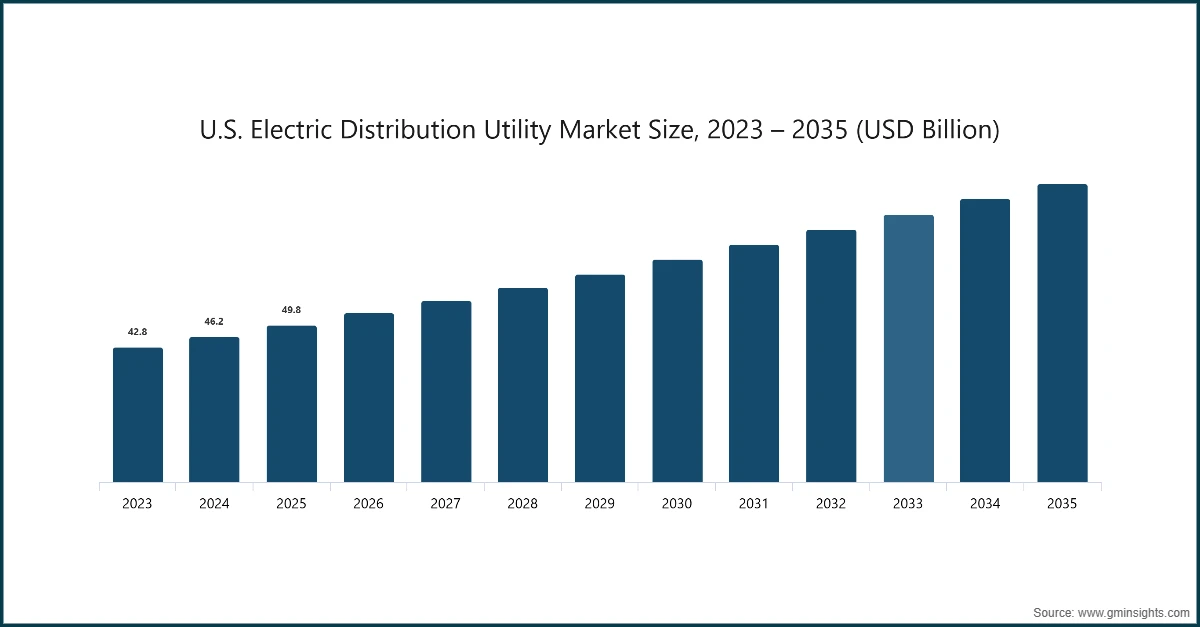
U.S. dominated the electric distribution utility industry in North America with around 70% market share in 2025 and was evaluated at over USD 49.8 billion in revenue. Rising electricity demand, favorable policies by respective authorities toward electrification toward implementation of advanced grid management solutions and widespread adoption of smart grid technologies further augmenting business landscape.
North America electric distribution utility market is set to grow owing to increasing investments toward grid modernization, significant efforts to support Industry 4.0 practices and focus toward decarbonization and transition to renewable energy sources. Favorable policies toward expansion of EV infrastructure, utilities pursuing extensive grid modernization programs and increasing demand response programs contributing to improved grid management and operational efficiency is complementing industry growth.
For instance, in July 2024, the U.S. Department of Energy launched its Grid Modernization Initiative, which describes how the DOE intends to invest in a smarter, safer, and more sustainable power grid. This initiative integrates research, development, demonstration, and deployment activities within the DOE to enhance the resilience and security of the power grid.
Europe electric distribution utility market is anticipated to grow over USD 162 billion by 2035. Growing emphasis on smart grid technologies, renewable energy integration, and stringent mandates toward achieving carbon neutrality targets require substantial distribution infrastructure investments to accommodate renewable energy integration. Rising investments toward development of advanced industrial infrastructure along with expansion of existing networks and adoption of smart grid, microgrid to cater to electricity requirements from various sectors will augment industry outlook.
For instance, in February 2025, the European Union announced plans to invest USD 58.6 billion into the InvestAI initiative to accelerate both development and deployment of artificial intelligence. This initiative aims to mobilize investment of USD 234.3 billion over next five years, when combining this expenditure with USD 175.7 billion from the private sector. This allocation will also be made towards gigafactories for large-scale applications of AI and will be equipped with high-performance infrastructure for training next-generation models.
Asia Pacific electric distribution utility market is set to witness a CAGR of over 5% from 2026 to 2035. Rapid population growth, urbanization rate, economic development momentum, and favorable programs by respective authorities toward expansion of distribution infrastructure, electrification initiatives will contribute to Asia Pacific electric distribution utility industry growth. Significant initiatives by governments toward expansion of distribution infrastructure across remote areas along with flourishing investments and extensive support by financial institutions and regulatory authorities toward strengthening electrical networks will shape industry dynamics.
For instance, in January 2026, in India, the Delhi government announced a USD 1.8 billion investment to upgrade the power infrastructure in response to growing electricity demand. The capital plan includes expanding electricity lines, grid substations, and distribution networks through Delhi Transco and power distribution companies to evaluate progress and finalize the roadmap through 2029.
Middle East & Africa electric distribution utility market was evaluated above USD 44 billion in 2025. Rapidly urbanizing economies, ongoing industrialization across emerging nations, growing infrastructure development and continuous demand for electricity have contributed to industry growth. Collaboration between government bodies and private-sector organizations has significantly accelerated investment in developing new electric distribution infrastructure, renewable integration and upgrading existing networks, further augmenting Middle East & Africa electric distribution utility industry landscape.
For instance, in September 2025, SEED Group and Reactive Technologies have formed a strategic partnership to accelerate renewable‑energy integration in the UAE. Reactive Technologies, a global Grid‑Enhancing Technologies provider, supports transmission and distribution operators with high‑precision grid analytics to strengthen system resilience and optimize renewable energy integration. The collaboration aims to improve stability across modern transmission and distribution networks and advance the UAE’s Net Zero 2050 objectives.
Electric Distribution Utility Market Share
Major 5 players operating across the electric distribution utility industry include Siemens, ABB, GE Vernova, Eaton and Schneider Electric contribute around 38% of the market share in 2025.
Leading industry manufacturers operating across electric distribution utility industry are advancing smart technologies with smart innovation and diversified energy solutions to strengthen their competitive advantage. These companies have a strong global presence along with excellent technical capability, and expanded product portfolios. Moreover, strategic collaborations and partnerships enable companies to serve evolving demand as utilities increasingly seek innovative technologies to enhance operational efficiency and improve customer service performance.
Over the past three years, the electric utility distribution industry has witnessed significant resilience despite broader economic volatility. By 2023 and 2024, improvements in project development, supply chain networks and a stronger focus on energy‑reduction initiatives have significantly influenced industry dynamics. In 2025, industrial infrastructure expansion, development of grid networks, and rising demand for reliable power solutions have led utilities to invest in advanced grid modernization technologies, renewable energy integration, and smart distribution systems to enhance efficiency, resilience, and sustainability of the electric distribution network.
Siemens provides solutions in power distribution, worldwide and has been developing reliable, efficient and flexible power distribution systems. The company offers wide range of medium voltage switchgear including NXPLUS C24 range, arc-resistant, gas-insulated switchgear for primary and secondary distribution applications.
Eaton provides wide range of products for distribution utilities including transformers, switchgear, substations, smart maters among others. Its medium‑voltage switchgear delivers centralized management and protection for MV electrical equipment and circuits across industrial, commercial, and utility environments. It supports applications involving generators, motors, feeder networks, and transmission & distribution systems by ensuring safe and reliable power control.
GE Vernova offers an extensive portfolio of distribution transformers, including pole‑ and pad‑mounted units, single‑ and three‑phase models, substation transformers, cast‑coil designs, network transformers, and voltage regulators. Built for utility, industrial, and contractor applications, these products are engineered with rigorous quality controls and advanced design systems to ensure dependable, cost‑efficient operation tailored to diverse electrical system requirements.
Schneider Electric provides a comprehensive portfolio of medium‑voltage equipment for primary and secondary distribution, engineered to control, protect, and isolate power distribution networks across electrical, commercial, and industrial environments. The SeT series includes versatile configurations with voltage ratings up to 36 kV and 72 kV, supporting a wide range of modern distribution system requirements.
Electric Distribution Utility Market Companies
Major players operating in the electric distribution utility industry are:
ABB
ACWA Power
China Yangtze Power
Coil Innovation
Duke Energy
Eaton
Enel
Engie
Fuji Electric
GE Vernova
Hitachi Energy
Iberdrola
Kansai Electric Power
Lucy Group
Mitsubishi Electric Corporation
National Grid
Orecco Electric
Schneider Electric
SGC
Siemens
Siemens Energy
Southern Company
Siemens offers low‑voltage switchgear which is engineered, tested, and manufactured to deliver high‑performance power distribution, monitoring, and control. Suitable for industrial, institutional, critical‑power, and commercial environments, the solution supports reliable, world‑class operations through advanced design and robust construction. The company’s revenue for the year 2025 was reported at USD 93.9 billion and revenue for the year 2024 was reported at USD 90.4 billion.
ABB offers wide range of products for distribution utilities including transformers, switchgear including air-insulated switchgear and gas insulated switchgear for primary and secondary distribution. The company’s ReliaGear range of low voltage transformers are suitable for distribution applications and are utilized by utilities. ABB reported revenue of USD 28.1 billion for the first nine months of year 2025 and for 2024 the revenue was reported at USD 32.9 billion.
GE Vernova’s mobile substation offers a fully integrated, transportable solution containing all major high‑ and medium‑voltage components, including a power transformer, switchgear, disconnect switches, metering transformers, surge protection, and comprehensive protection, control, and auxiliary power systems. The unit is self-contained and enables rapid deployment and reliable grid support during emergencies or planned outages. The company reported revenue of USD 27.1 billion for nine months of 2025 and revenue of USD 34.9 billion for whole year 2024.
Eaton provides power distribution solutions, supporting sectors including oil and gas, data centers, healthcare, and industrial operations. Its extensive portfolio of low and medium‑voltage equipment enables reliable distribution, monitoring, and management of electrical power across facilities, ensuring safe, efficient, and continuous operation. The company reported revenue of USD 20.3 billion of the nine months of 2025 and whole year revenue of USD 24.8 billion for the year 2024.
Electric Distribution Utility Industry News
In January 2026, ABB India has introduced its new ArTu Formula low‑voltage switchgear, engineered to meet the evolving power distribution needs of industrial facilities, critical infrastructure, and commercial and residential buildings. The system enhances safety, reliability, and performance and is compliant with IEC 61439‑1/2 and IEC 61641 standards. ArTu Formula offers a versatile, streamlined solution for power distribution, MCCs, and sub‑distribution applications.
In October 2025, POWERGRID, in collaboration with Toshiba Transmission & Distribution Systems (India) Pvt. Ltd., introduced India’s first indigenous 220 kV mobile GIS system. The m‑GIS enables rapid grid restoration, temporary power evacuation, and substation expansion with minimal civil infrastructure and is developed to meet POWERGRID’s operational standards. Its modular connect‑disconnect‑redeploy design, built on standard trailer dimensions, enhances mobility and resilience for emergency and flexible grid applications.
In June 2025, Hitachi Energy unveiled two major transformer‑component innovations at the CWIEME conference held in Berlin, Germany. The company’s GARIP Eco, next‑generation SF₆‑free transformer‑GIS bushing, and VUBB Compact, a space‑efficient on‑load tap‑changer suitable for new and retrofit transformer designs across multiple GIS platforms. Designed for both new installations and retrofits across multiple GIS platforms, these innovations support decentralized energy systems, renewable‑generation connections, and modernizing distribution networks.
In April 2025, R&S Group Holding AG has inaugurated its new 10,000 m² greenfield oil distribution transformer plant under the Rauscher & Stoecklin brand in Krzeczów, Poland. The facility strengthens the company’s expansion into key markets including the Baltics, Nordics, and Germany. The plant was targeted to produce over 1,000 transformers in 2025 and is designed with advanced manufacturing technologies supporting growth in new segments.
The electric distribution utility market research report includes in-depth coverage of the industry with estimates & forecast in terms of revenue (USD Million) from 2022 to 2035, for the following segments:
Market, By Component
Distribution substations
Distribution transformers
Switchgear
Distribution lines and poles
AMI smart meters
Others
Market, By End Use
Residential
Commercial
Industrial
Market, By Voltage
Low voltage
Medium voltage
The above information has been provided for the following regions and countries:
- North America
- U.S.
- Canada
- Mexico
- Europe
- Germany
- France
- Russia
- UK
- Italy
- Asia Pacific
- China
- Japan
- South Korea
- India
- Australia
- Middle East & Africa
- Saudi Arabia
- UAE
- Egypt
- South Africa
- Latin America
- Brazil
- Argentina
Frequently Asked Question(FAQ) :
Who are the major players in the electric distribution utility industry?
Major players include ABB, ACWA Power, China Yangtze Power, Coil Innovation, Duke Energy, Eaton, Enel, Engie, Fuji Electric, GE Vernova, and Hitachi Energy.
What was the market share of the commercial segment in 2025?
The commercial segment held approximately 51.7% of the market share in 2025 and is set to expand at a CAGR of over 5.5% till 2035.
What is the growth outlook for the industrial end-use segment by 2035?
The industrial end-use segment is projected to grow at a CAGR of above 6% up to 2035.
Which region dominated the electric distribution utility sector in North America in 2025?
The U.S. dominated the North American market with a 70% share, generating over USD 49.8 billion in revenue in 2025. This growth was driven by rising electricity demand, favorable policies, and the adoption of advanced grid management solutions.
What are the key trends shaping the electric distribution utility market?
Adoption of advanced metering and automation, renewable energy integration, grid modernization and microgrids, and rising investments in grid resilience and reliability.
What is the expected size of the electric distribution utility industry in 2026?
The market size is expected to grow to USD 471.2 billion in 2026.
What was the market share of the switchgear segment in 2025?
The switchgear segment accounted for over 26% of the market share in 2025 and is projected to grow at a CAGR of over 7% through 2035.
What is the projected value of the electric distribution utility market by 2035?
The market is poised to reach USD 801.1 billion by 2035, fueled by grid modernization, renewable energy integration, and automation technologies.
What was the market size of the electric distribution utility in 2025?
The market size was estimated at USD 439.1 billion in 2025, growing at a CAGR of 6.1% through 2035. The market is driven by investments in smart grid technologies, including advanced metering infrastructure, distribution automation, and real-time monitoring systems.
Electric Distribution Utility Market Scope
Related Reports