Summary
Table of Content

Data Center Construction Market
Get a free sample of this report
Form submitted successfully!
Error submitting form. Please try again.
Thank you!
Your inquiry has been received. Our team will reach out to you with the required details via email. To ensure that you don't miss their response, kindly remember to check your spam folder as well!
Request Sectional Data
Thank you!
Your inquiry has been received. Our team will reach out to you with the required details via email. To ensure that you don't miss their response, kindly remember to check your spam folder as well!
Form submitted successfully!
Error submitting form. Please try again.
Data Center Construction Market Size
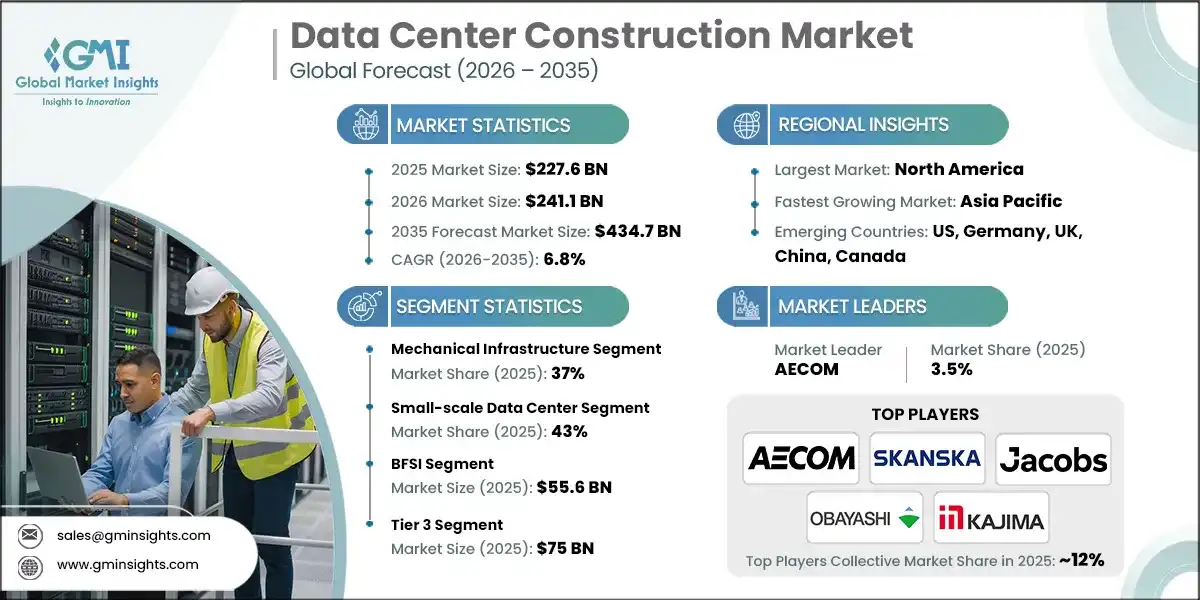
The global data center construction market was valued at USD 227.6 billion in 2025 and is set to expand from USD 241.1 billion in 2026 to USD 434.7 billion by 2035, growing at an 6.8% CAGR over 2026–2035, according to latest report published by Global Market Insights Inc.
To get key market trends
The expansion of public, private, and hybrid cloud services is a primary driver of data center construction, as enterprises migrate workloads away from on-premises infrastructure. Cloud service providers continuously add capacity through large-scale hyperscale campuses and regional facilities to meet demand for compute, storage, and resilience. This sustained cloud adoption directly fuels new builds, phased expansions, and standardized, repeatable data center designs.
AI, machine learning, and high-performance computing workloads are fundamentally reshaping data center design and construction requirements. These workloads demand significantly higher power density, advanced cooling systems, and robust electrical infrastructure, driving the development of AI-ready data centers. As organizations scale AI training and inference, construction activity accelerates to support next-generation, high-specification facilities.
Rapid growth in data generation from streaming, e-commerce, IoT, fintech, and enterprise digitalization is increasing demand for storage, processing, and redundancy. This surge in digital services requires expanded data center capacity across both core and regional markets. As a result, construction activity rises to support distributed architectures, disaster recovery, and low-latency service delivery.
Enterprises are increasingly shifting from owning and operating data centers to leasing capacity from colocation providers to reduce capital expenditure and operational complexity. This transition drives construction of multi-tenant, carrier-neutral facilities designed for scalability and high interconnection density. The growing preference for outsourced infrastructure accelerates demand for new colocation developments and rapid capacity expansion.
In February 2024, Amazon Web Services announced a multi-billion-dollar investment (approximately USD 8 billion) in Indiana to develop large-scale, AI-ready hyperscale data centers. The project was driven by growing AI training and cloud demand, requiring high-density power infrastructure, advanced cooling, and campus-style construction directly illustrating how AI- and cloud-driven hyperscale expansion is driving data center construction in North America.
In North America, rapid expansion by hyperscale cloud and AI service providers is the primary driver of data center construction. Large-scale AI training workloads, strong enterprise cloud adoption, and early AI commercialization are driving continuous hyperscale campus build-outs, particularly in the United States, to support high-density, power-intensive infrastructure.
Data Center Construction Market Report Attributes
| Key Takeaway | Details |
|---|---|
| Market Size & Growth | |
| Base Year | 2025 |
| Market Size in 2025 | USD 227.6 Billion |
| Market Size in 2026 | USD 241.1 Billion |
| Forecast Period 2026 - 2035 CAGR | 6.8% |
| Market Size in 2035 | USD 434.7 Billion |
| Key Market Trends | |
| Drivers | Impact |
| Rapid Growth in Cloud Computing | Cloud providers require large-scale, standardized facilities with high power availability, redundant infrastructure, and rapid deployment capabilities, directly increasing demand for greenfield builds and phased campus expansions. |
| Proliferation of AI, Machine Learning, and High-Performance Computing | AI and HPC workloads significantly increase rack densities, power consumption, and cooling requirements, driving the construction of next-generation data centers with advanced electrical systems, liquid or hybrid cooling architectures, and reinforced structural designs. |
| Explosion in Data Generation and Digital Services | Growth in streaming, e-commerce, fintech, IoT, and enterprise digitization fuels sustained demand for data storage, processing, and redundancy. This results in higher construction activity across hyperscale, colocation, and regional data centers to support capacity expansion, disaster recovery, and low-latency service delivery. |
| Shift Toward Colocation and Outsourced Data Centers | Enterprises increasingly outsource data center ownership to colocation providers to reduce capital expenditure and operational complexity. This shift accelerates construction of carrier-neutral, scalable, and modular data centers designed to support multi-tenant environments, high interconnection density, and flexible capacity provisioning. |
| Pitfalls & Challenges | Impact |
| Power Availability and Grid Constraints | Limited grid capacity, long utility approval timelines, and shortages of substations and transformers significantly delay data center projects and constrain site selection. |
| Rising Construction and Equipment Costs | Inflation in steel, concrete, copper, and specialized electrical and cooling equipment drives higher overall construction costs and increases cost per MW. Escalating labor expenses and volatile pricing for long-lead items such as generators, UPS systems, and switchgear. |
| Opportunities: | Impact |
| Expansion of AI-Ready and High-Density Data Center Infrastructure | Rising deployment of AI and high-performance computing workloads creates strong demand for purpose-built data centers with higher power density, advanced cooling (liquid and hybrid), and reinforced electrical infrastructure. |
| Adoption of Modular and Prefabricated Construction Models | Increasing preference for modular and prefabricated data center construction offers opportunities to reduce build timelines, mitigate skilled labor shortages, and improve cost predictability. |
| Market Leaders (2025) | |
| Market Leaders |
3.5% market share |
| Top Players |
|
| Competitive Edge |
|
| Regional Insights | |
| Largest Market | North America |
| Fastest growing market | Asia Pacific |
| Emerging countries | US, Germany, UK, China, Canada |
| Future outlook |
|
What are the growth opportunities in this market?
Data Center Construction Market Trends
Multi-building campuses with 200–500 MW footprints and in planning, gigawatt-scale sites are now common in the data center construction market as hyperscalers front-run demand with multi-year reservations and land banking of 100–200+ acres per phase. In North America, during this time period, there has been substantial growth in construction activity and an overall increase in the number of projects that are being pre-leased (over 70%). The increase in the overall number of new development projects reflects the current low supply environment. Due to the slow connection timeframes of electric distribution systems, a trend has developed of developers now expanding into areas with an abundance of renewable power to mitigate these extended waiting periods for project completion.
AI training clusters demand 30–100+ kW per rack, with leading AI systems approaching 120 kW per rack and roadmap discussions of 1 MW per rack by decade’s end in experimental contexts, which flips design from average to peak-load engineering. Cooling accounts for 35–40% of data center power, so direct-to-chip plates (60–100 kW/rack) and immersion tanks (100–150+ kW/rack) are scaling, with CDUs moving into critical-path procurement planning. Look closer and you’ll see medium-voltage distribution, 415V three-phase rack power, busway distribution, and selective UPS strategies (battery coverage for controls rather than full compute) spreading to cut losses and capex.
Prefabricated electrical rooms, skidded UPS/gensets, and modular data halls shift labor to factories, improving QA and cutting on-site duration from quarters to months for certain blocks in the data center construction market. The numbers tell us factory-built content can reach 40–80% on optimized projects, with 1–2 month deployments achievable for micro-modular configurations that meet edge and remote requirements. Because of this, emerging markets are leaning into modular to backfill scarce skilled trades, while AI-dense builds rely on precision-fabricated liquid cooling loops that are tough to field-assemble at scale.
Generative AI networks require over 10x more optical fiber than legacy facilities, which elevates bend-insensitive fiber, pre-connectorized harnesses, and dense tray management in new builds and retrofits. Take the explosion of 400/800 G interconnects and the move toward 1.6 Tbps fabrics network rooms and pathways are being sized differently to keep GPU clusters synchronized at scale.
Data Center Construction Market Analysis
Learn more about the key segments shaping this market
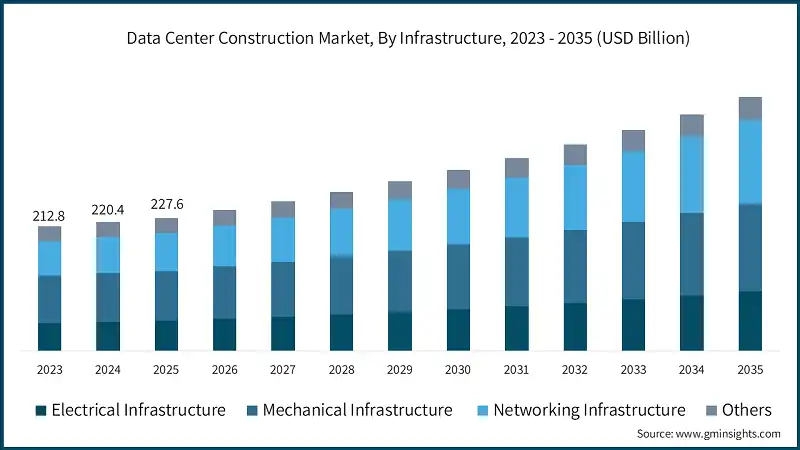
Based on infrastructure, the market is divided into electrical infrastructure, mechanical infrastructure, networking infrastructure, and others. The mechanical infrastructure segment dominated the market accounting by around 37% in 2025 and is expected to grow at a CAGR of 5.8% from 2026 to 2035.
- Liquid cooling technology adoption is accelerating rapidly, with over 40% of new hyperscale data centers in China expected to include liquid cooling capabilities by 2025. Direct-to-chip cooling solutions are most commonly deployed for AI infrastructure, effectively handling power densities of 60–100 kW per rack, while immersion cooling systems can support racks with power density exceeding 100 kW in single-phase configurations and 150+ kW in dual-phase systems.
- Regional construction trends reflect varying cooling approaches based on climate conditions and regulatory requirements. In the Middle East, where ambient temperatures regularly exceed 45°C, over 50% of new data center constructions incorporate liquid or hybrid cooling systems as a necessity for reliable operations. Germany’s Energy Efficiency Act requires all new data centers to achieve a minimum PUE of 1.3 by 2027, with approximately 40% of large German facilities incorporating waste heat recovery systems for local district heating networks.
- Fire suppression, plumbing, and auxiliary mechanical systems represent additional construction requirements, with advanced facilities implementing inert gas-based fire suppression systems to avoid water damage to sensitive equipment, sophisticated water quality monitoring and treatment systems for cooling tower operations, and heat recovery installations that capture waste heat for beneficial use in building heating or industrial processes.
- Construction specifications are evolving toward 415V three-phase rack-level distribution instead of traditional 208V single-phase configurations to improve power delivery efficiency and reduce copper infrastructure requirements. Facilities are implementing overhead busway systems replacing traditional raised-floor cable distribution to deliver higher amperage to smaller compute footprints characteristic of dense GPU clusters.
Learn more about the key segments shaping this market
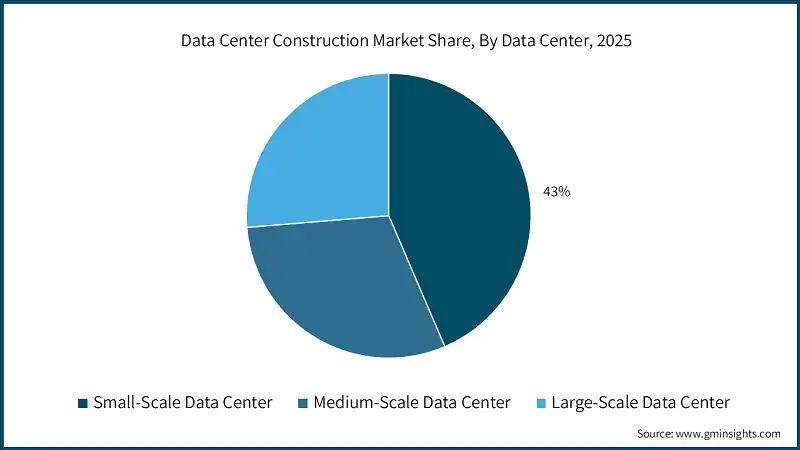
Based on data center, the data center construction market is categorized into small-scale, medium-scale, large-scale data center. Small-scale data center segment dominates the market with around 43% share in 2025, and the segment is expected to grow at a CAGR of 5% between 2026 & 2035.
- Small scale facilities typically range from 1–5 MW power capacity and 10,000–50,000 square feet of white space, serving small and medium enterprises, regional operations of larger organizations, and edge computing deployments requiring localized data processing capabilities. The segment continues to play a vital role in distributed computing architectures, particularly for applications demanding low latency including autonomous vehicles, smart city infrastructure, telemedicine platforms, and real-time manufacturing analytics.
- Medium-scale facilities are experiencing strong adoption in emerging markets across Latin America, the Middle East & Africa, and secondary Asia Pacific cities where large hyperscale deployments face regulatory constraints or insufficient power infrastructure, but robust demand exists from growing enterprises and regional cloud service requirements. Construction activity in these markets benefits from lower land costs, improving fiber connectivity, and government incentive programs designed to attract digital infrastructure investment.
- Construction specifications prioritize maximum density and efficiency, with AI-optimized configurations supporting rack densities of 80–120 kW and future roadmaps accommodating up to 1 MW per rack by 2028–2029. Large-scale facilities increasingly target Tier IV certification with fault-tolerant architectures featuring 2N+1 redundancy, multiple active power and cooling distribution paths, and no single points of failure to ensure 99.995% uptime guarantees essential for mission-critical applications.
- The primary users of large-scale facilities are the major hyperscalers including Amazon Web Services, Microsoft Azure, Google Cloud Platform, Meta, and Oracle, which collectively account for the majority of construction activity in this segment. Hyperscale operators maintained 1,189 large data centers globally by the end of Q1 2025, with over half of this capacity housed in own-built, owned facilities and the balance in leased colocation space.
Based on end use, the data center construction market is divided into BFSI, energy, government, healthcare, manufacturing, IT & telecom and others. BFSI segment dominate the market and was valued at USD 55.6 billion in 2025.
- BFSI prioritize security, compliance, and resilience requirements that exceed most other verticals. Facilities serving financial services implement stringent physical security measures, multi-layered cybersecurity infrastructure, and typically target Tier III or Tier IV certification to ensure maximum uptime guarantees essential for transaction processing and trading operations. The sector’s data sovereignty and regulatory compliance requirements drive construction of geographically distributed facilities, with hybrid cloud architectures maintaining core banking systems and sensitive customer data in private on-premise or colocation environments to comply with local regulations, while leveraging public cloud infrastructure for customer-facing applications including digital onboarding, mobile banking, and AI-powered chatbots.
- Edge computing capabilities are becoming essential in BFSI data center construction to support ultra-low latency requirements for real-time fraud detection, high-frequency trading operations, digital payment processing, and customer analytics services delivered at branch locations. A leading Indonesian bank case study demonstrated that hybrid cloud implementation with on-premise core banking systems for regulatory compliance combined with public cloud for customer applications enabled new digital services to launch 30% faster while optimizing costs and maintaining compliance.
- Construction specifications for energy sector facilities typically target Tier III or Tier IV standards with concurrent maintainability or full fault tolerance to ensure continuous operations supporting critical infrastructure monitoring and control systems. The sector’s unique requirements include specialized environmental controls to support industrial IoT sensor networks, process automation systems, and supervisory control and data acquisition infrastructure that bridges operational technology and information technology domains.
- Government data center construction emphasizes security, data sovereignty, and compliance with specific national requirements that often exceed commercial standards. Facilities serving defense and intelligence agencies implement the highest tier certifications, extensive physical security hardening, electromagnetic shielding, and compartmentalized network architectures that prevent lateral movement and ensure classified workload isolation.
Based on tier, the data center construction market is divided into tier 1, tier 2, tier 3, and tier 4. The tier 3 segment dominates the market and was valued at USD 75 billion in 2025.
- Tier 3 construction specifications mandate multiple paths for cooling and power distribution with measures for redundancy, implementing minimum N+1 redundancy across all critical infrastructure components including power distribution, cooling systems, and network connectivity. This architecture enables maintenance activities on one infrastructure path while the facility continues operating on alternate paths without impacting IT operations or requiring workload migration.
- Construction costs for Tier IV facilities typically exceed USD 500 million for hyperscale deployments, with build timelines of 18–24+ months reflecting the complexity of implementing and commissioning complete redundancy across all systems. Tier IV facilities typically cost twice as much to construct as Tier III facilities of equivalent IT capacity, creating significant capital requirements that limit adoption to applications where the business impact of downtime justifies the premium investment.
- Tier 1 serves as a tactical choice for businesses driven by cost and time-to-market considerations, or those not relying on real-time service outputs where brief outages can be tolerated without significant business impact. The simplicity of Tier 1 construction enables lower capital requirements and faster project execution, appealing to organizations in early growth stages or those operating non-critical workloads including backup storage, archive data, test and development environments, and secondary applications.
Looking for region specific data?
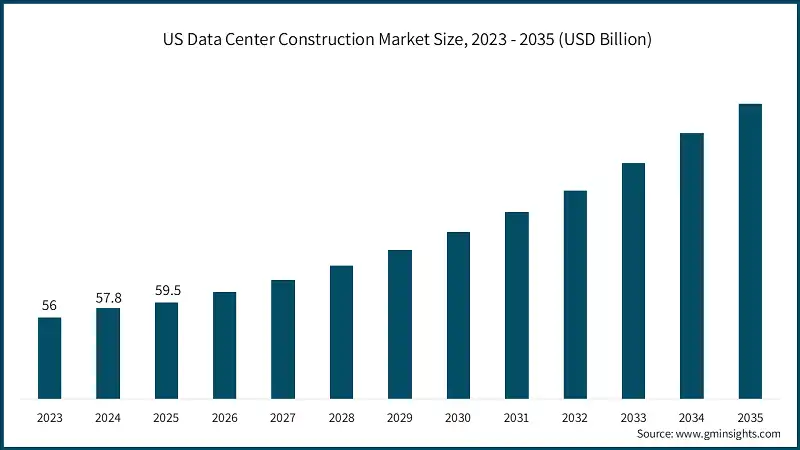
US dominated North America data center construction market with revenue of USD 59.5 billion in 2025.
- The concentration of global hyperscalers, advanced AI research organizations, robust digital infrastructure, and aggressive corporate technology spending supporting continuous facility expansion and modernization. The region accounts for more than 40% of projected global data center infrastructure spending through 2030. The United States specifically represents approximately 60% of global operating data center capacity as of 2024, with projections indicating capacity growth to approximately 132 GW by 2030.
- Northern Virginia remains the single largest data center market with over 3,046 MW of operational capacity and an additional 2,078 MW under construction as of H1 2025, experiencing an 80% increase in under-construction capacity demonstrating continued dominance despite power constraints. The market features preleasing commitments extending through 2028 as tenants compete for scarce capacity, with pricing for large deployments of 10 MW and above increasing by up to 19% due to tight supply of contiguous power blocks, elevated build costs, and fierce competition from cloud and AI occupiers.
- Canadian markets are benefiting from spillover demand from constrained US markets, with developers viewing Canada as offering more accessible power infrastructure and favorable regulatory environments. Construction activity concentrates in major metro areas including Toronto, Montreal, and Vancouver, with emerging activity in secondary markets closer to renewable energy sources and offering lower costs.
UK data center construction market will grow tremendously with CAGR of 4.1% between 2026 and 2035.
- London maintains its position as the largest European operational market with approximately 1.5 GW capacity. Major 2025 construction announcements include large-scale campus developments and new hyperscale facilities. Total UK investment attraction from 2016–2024 exceeded EUR 47 billion from the ten largest foreign investors, the highest in Europe. The UK, together with Spain, accounts for over 50% of upcoming rack capacity across Western Europe.
- The development pipeline in Europe grew 43% year-over-year between H1 2024 and H1 2025, including over 2.6 GW under construction and 11.5 GW in planning stages. However, operational capacity growth has slowed to 7.2% in recent periods compared to 20% growth in Q1 2024, reflecting increasing constraints in established markets and extended permitting processes.
- Construction is accelerating in Tier 2 and emerging markets including Spain and Portugal favored for renewable energy availability and lower power costs, Italy with expanding capacity in Milan, the Nordic regions attracting investment through cool climates enabling efficient free cooling, abundant renewable energy, and government incentives, and Central European markets including Poland, Berlin, and Leipzig gaining traction as alternatives to constrained primary hubs.
- Multiple European countries have implemented mandates on renewable energy usage, power efficiency targets, and energy reporting obligations for data centers. The EU-wide Energy Efficiency Directive requires data centers of 500 kW or greater to report energy performance metrics, while new facilities in cooler climates are required to meet PUE thresholds and existing facilities must comply by 2030.
The data center construction market in China will experience robust growth during 2026-2035.
- China expands its substantial large-scale facilities while implementing policies directing development toward inland provinces to improve efficiency. Over 40% of new hyperscale facilities in China are expected to include liquid cooling capabilities by 2025. The Greater Beijing area specifically has installed computing load projected to double to over 8 GW by 2030. Despite robust domestic demand, foreign participation remains limited due to regulatory and geopolitical considerations, creating a market dominated by domestic hyperscalers.
- The region is driven rapid economic development, accelerating digital transformation across emerging economies, government initiatives promoting data center investment, expanding cloud adoption, and the region’s role as a global manufacturing and technology hub generating massive data processing requirements.
- India represents one of the fastest-growing markets globally with multiple large-scale AI and hyperscale investment announcements. Indian data center capacity is projected to exceed 4,500 MW by 2030 supported by USD 20–25 billion in planned investment, with Mumbai expanding rapidly driven by cloud, BFSI, and technology sectors. Singapore maintains its role as a regional hub despite government-imposed capacity limitations, with sustainability-linked permitting and adoption of advanced cooling technologies, while high-latency AI training workloads shift to nearby Johor, Malaysia.
The data center construction market in Brazil will experience significant growth between 2026 & 2035.
- São Paulo remains the largest Latin American data center market with 493 MW of operational capacity and the region’s most competitive pricing structure. The city recorded 71.2 MW of net absorption demonstrating continued strong demand. Brazilian facilities face tropical climate challenges with over 45% of new data centers utilizing water-cooled or evaporative cooling systems to manage high ambient temperatures. Approximately 60% of Brazilian facilities benefit from access to hydroelectric power, providing cost-effective and sustainable energy supply.
- Santiago, Chile is experiencing rapid expansion though constrained by complex environmental permitting processes. The Chilean market is facing industry concerns over proposed AI regulations that could impact facility operations, despite the country ranking highly for AI preparedness. Guatemala saw KIO Data Centers launch its second facility, quadrupling total capacity with a new design incorporating two initial 500 kW rooms. Argentina represents an emerging market included in the regional aggregate, though specific construction activity remains more limited than in Brazil, Mexico, and Chile.
- Several Latin American countries are strengthening data protection, privacy, and sovereignty regulations, requiring sensitive data to be processed and stored domestically. These policies are compelling enterprises and cloud providers to construct in-country data centers, particularly in Brazil and Mexico, to ensure regulatory compliance and reduce legal risk.
- Ongoing investments in submarine cable systems and terrestrial fiber networks are significantly improving connectivity between Latin America, North America, and Europe. Enhanced bandwidth availability and reduced latency are making the region more attractive for hyperscale, colocation, and nearshore data center developments serving both local and international workloads.
The data center construction market in UAE is expected to experience robust growth between 2026 & 2035.
- UAE hosts over 70 operational facilities as of 2024. Construction in the UAE emphasizes advanced cooling solutions driven by extreme ambient temperatures regularly exceeding 45°C, with over 50% of new data center constructions incorporating liquid or hybrid cooling systems as essential infrastructure for reliable operations in the challenging climate.
- The UAE’s Net Zero 2050 initiative is encouraging sustainable cooling approaches, with approximately 40% of new projects incorporating renewable-powered cooling systems. Recent development activity includes collaborations to provide sustainable liquid cooling solutions for AI workloads in the Emirates. The market benefits from government backing of digital transformation initiatives, its strategic geographic position as a connectivity hub linking Europe, Asia, and Africa, and substantial investment in smart city infrastructure and AI development programs.
- Enterprise cloud adoption is accelerating across MEA as banks, telecom operators, oil & gas companies, and government entities migrate workloads from legacy IT environments. Hyperscalers and regional cloud providers are expanding local regions and availability zones, necessitating new data center construction to meet latency, compliance, and performance requirements.
- The oil & gas industry remains a critical demand driver in MEA, with operators deploying advanced analytics, AI, digital twins, and predictive maintenance platforms across upstream, midstream, and downstream operations. These applications generate massive data volumes and require highly reliable, low-latency data center infrastructure close to production and control environments.
Data Center Construction Market Share
- The top 7 companies in the market are AECOM, Skanska, Jacobs Engineering, Obayashi, Kajima, NTT Facilities and DPR Construction. These companies hold around 14% of the market share in 2025.
- AECOM: Provides end-to-end data center design, engineering, and program management with strong expertise in power, grid interconnection, and sustainability; leverages global scale and public–private project experience for hyperscale and mission-critical facilities.
- Skanska: Focuses on large-scale, sustainable data center construction with strong EPC and design-build capabilities; differentiates through low-carbon construction methods, lifecycle cost optimization, and deep experience delivering hyperscale campuses in North America and Europe.
- Jacobs Engineering: Delivers integrated consulting, engineering, and construction management for complex data center programs; strong advantage in power infrastructure planning, AI-ready facility design, and long-term owner advisory services for hyperscalers and governments.
- Obayashi: Specializes in high-reliability and seismic-resilient data center construction; leverages advanced structural engineering, precision construction methods, and deep experience in Japan’s mission-critical and technology-intensive infrastructure markets.
- Kajima: Known for advanced construction technologies, automation, and resilient design; strong competitive edge in delivering highly reliable, energy-efficient data centers with expertise in urban, space-constrained, and seismic environments.
- NTT Facilities: Provides integrated design, construction, and operations support for data centers with deep expertise in electrical systems, power reliability, and telecom-grade infrastructure; benefits from close alignment with NTT Group’s global data center and network ecosystem.
- DPR Construction: Pure-play mission-critical contractor specializing in fast-track delivery of hyperscale and colocation data centers; differentiates through deep MEP expertise, prefabrication-led execution, and strong relationships with leading hyperscalers.
Data Center Construction Market Companies
Major players operating in the data center construction industry include:
- AECOM
- DPR Construction
- DSCO
- Jacobs Engineering
- Kajima
- Mace
- NTT Facilities
- Obayashi
- Skanska
- Turner & Townsend
- AECOM large-scale data center design, engineering, and program management capabilities across hyperscale, enterprise, and government projects. Its strength in power infrastructure planning, sustainability integration, and global delivery makes it a preferred partner for complex, multi-site data center programs.
- Skanska leadership in sustainable, large-scale data center construction with strong EPC and design-build execution. Its expertise in low-carbon construction, cost certainty, and delivery of hyperscale campuses positions it as a trusted contractor for long-term digital infrastructure investments.
- Jacobs Engineering integrated consulting, engineering, and construction management for mission-critical facilities. Its deep capabilities in AI-ready data center design, grid interconnection, and owner advisory services enable delivery of highly complex, power-intensive data center developments.
- Obayashi advanced structural and seismic engineering expertise applied to high-reliability data center construction. Its precision construction methods and experience in technology-intensive projects make it a preferred contractor for mission-critical facilities in seismic and urban environments.
- Kajima leadership in resilient, high-quality data center construction supported by advanced automation and construction technologies. Its ability to deliver energy-efficient, space-constrained, and disaster-resilient facilities strengthens its position in premium data center projects.
- NTT Facilities deep specialization in electrical systems, power reliability, and telecom-grade data center infrastructure. Its close integration with the NTT Group ecosystem enables delivery of highly reliable, network-centric data centers for hyperscale and enterprise clients.
- DPR Construction pure-play mission-critical contractor focused on hyperscale and colocation data center delivery. Its strength in fast-track execution, prefabrication, and MEP coordination positions it as a go-to builder for schedule-sensitive data center projects.
- Mace program and construction management expertise across large, complex data center portfolios. Its strengths in cost management, risk control, and governance enable owners to execute multi-phase, multi-region data center expansion programs efficiently.
- Turner & Townsend global cost consultancy and project management leadership in data center construction. Its capability to control capital expenditure, manage procurement complexity, and benchmark costs across markets provides strategic advantage for large-scale data center investors.
- DSCO specialized construction and engineering services for data centers and mission-critical facilities. Its focus on disciplined execution, regional market knowledge, and coordination of complex trade packages supports reliable delivery of high-specification data center projects.
Data Center Construction Industry News
- In Nov 2025, Meta detailed plans for a gigawatt-scale data center in El Paso; OpenAI, Oracle, and Vantage announced nearly 1 GW of AI capacity in Wisconsin; Equinix secured 85 acres in the UK for approximately 250 MW; Telehouse broke ground on a new London site; and Google advanced a 1,000-acre campus in Arkansas.
- In Oct 2025, ABB and NVIDIA partnered on gigawatt-scale electrical systems, UAE deployments advanced liquid cooling through the Submer–Zero Two collaboration, and research signaled a more disciplined capex phase for hyperscalers.
- In Sep 2025, Blackstone completed the A$24 billion acquisition of AirTrunk, and Johnson Controls launched the Silent-Aire CDU designed to handle AI-driven thermal loads.
- In Aug 2025, AirTrunk secured USD 16 billion in sustainability-linked financing tied to water and energy performance, while Asia Pacific data center construction cost inflation eased to approximately 3.8%.
- In Jul 2025, Pennsylvania announced a USD 70 billion initiative to attract AI data center investment, and academic research highlighted community-level grid and economic impacts of large-scale data center development.
- In Apr 2025, Schneider Electric introduced the Galaxy VXL UPS platform rated at 500–1,250 kW, specifically designed to support AI-ready, high-density data center environments.
- In Mar 2025, Partners Group acquired GreenSquareDC for A$1.2 billion, and Schneider Electric invested USD 140 million to expand medium-voltage manufacturing capacity in the United States.
- In Jan 2025, the Stargate program was unveiled with up to USD 500 billion earmarked for AI-ready data centers, as Azure and AWS reported strong 2024 growth supporting continued pipeline expansion.
- In Dec 2024, liquid-cooling portfolios expanded through acquisitions and reference designs aligned to NVIDIA AI clusters, alongside major platform financing initiatives to scale global data center builds.
The data center construction market research report includes in-depth coverage of the industry with estimates & forecasts in terms of revenue ($Bn) from 2021 to 2034, for the following segments:
Market, By Data Center
- Small-scale data center
- Medium data center
- Large data center
Market, By Infrastructure
- Electrical infrastructure
- UPS
- Power distribution units (PDUs)
- Backup generators
- Others
- Mechanical infrastructure
- Cooling systems
- Hvac
- Computer room air conditioning (CRAC) units
- Fan arrays
- Air flow measurement damper
- DOAS
- Precision air conditioning (PAC) units
- Face mounted plenum fan with EC motor
- MAU
- ERV
- Chilled water systems
- Dampers
- Condenser fans
- Ventilation systems
- Direct expansion (DX) systems
- Others
- Computer room air conditioning (CRAC) units
- Racks
- Ductwork
- Raised flooring
- Others
- Networking Infrastructure
- Others
Market, By End Use
- BFSI
- Energy
- Government
- Healthcare
- Manufacturing
- IT & telecom
- Media & entertainment
- Retail
- Others
Market, By Tier
- Tier 1
- Tier 2
- Tier 3
- Tier 4
The above information is provided for the following regions and countries:
- North America
- US
- Canada
- Europe
- Germany
- UK
- France
- Italy
- Spain
- Russia
- Nordics
- Benelux
- Asia Pacific
- China
- India
- Japan
- Australia
- South Korea
- Thailand
- Indonesia
- Singapore
- Latin America
- Brazil
- Mexico
- Argentina
- Chile
- MEA
- South Africa
- Saudi Arabia
- UAE
Frequently Asked Question(FAQ) :
Which region leads the data center construction market?
North America leads the global market, with the U.S. generating USD 59.5 billion in revenue in 2025. The region’s dominance is driven by hyperscale cloud providers, AI commercialization, and large-scale campus developments.
What are the upcoming trends in the data center construction industry?
Key trends include development of AI-ready and high-density facilities, adoption of liquid and hybrid cooling systems, modular and prefabricated construction methods, expansion into secondary markets, and increased focus on energy efficiency and sustainability.
Who are the key players in the data center construction market?
Major players include AECOM, Skanska, Jacobs Engineering, Obayashi, Kajima, NTT Facilities, and DPR Construction. These companies compete through large-scale project execution, advanced engineering capabilities, and expertise in mission-critical infrastructure.
What was the market share of small-scale data centers in 2025?
Small-scale data centers held approximately 43% market share in 2025. Their growth is supported by edge computing adoption, regional digitalization, and demand from SMEs and localized enterprise operations.
What is the growth outlook for the BFSI end-use segment?
The BFSI segment was valued at USD 55.6 billion in 2025 and remains a key growth driver. Rising security requirements, regulatory compliance needs, and expansion of digital banking platforms continue to fuel construction demand.
What is the projected value of the data center construction market by 2035?
The market size is expected to reach USD 434.7 billion by 2035, growing at a CAGR of 6.8% from 2026 to 2035. This growth is fueled by hyperscale expansion, AI and HPC workloads, and increasing colocation investments.
How much revenue did the mechanical infrastructure segment generate in 2025?
The mechanical infrastructure segment accounted for around 37% of the market in 2025, making it the largest infrastructure category. Its dominance is driven by advanced cooling systems, liquid cooling adoption, and rising power density requirements.
What is the data center construction market size in 2025?
The global market size for data center construction is valued at USD 227.6 billion in 2025. Strong growth in cloud computing, hyperscale deployments, and enterprise digital transformation is driving sustained construction activity worldwide.
What is the market size of the data center construction industry in 2026?
The data center construction market is estimated to reach USD 241.1 billion in 2026, reflecting steady expansion supported by rising demand for AI-ready and high-density data center facilities.
Data Center Construction Market Scope
Related Reports