Summary
Table of Content

Chlorosilane Market
Get a free sample of this report
Form submitted successfully!
Error submitting form. Please try again.
Thank you!
Your inquiry has been received. Our team will reach out to you with the required details via email. To ensure that you don't miss their response, kindly remember to check your spam folder as well!
Request Sectional Data
Thank you!
Your inquiry has been received. Our team will reach out to you with the required details via email. To ensure that you don't miss their response, kindly remember to check your spam folder as well!
Form submitted successfully!
Error submitting form. Please try again.
Chlorosilane Market for Solar Grade Silicone Size
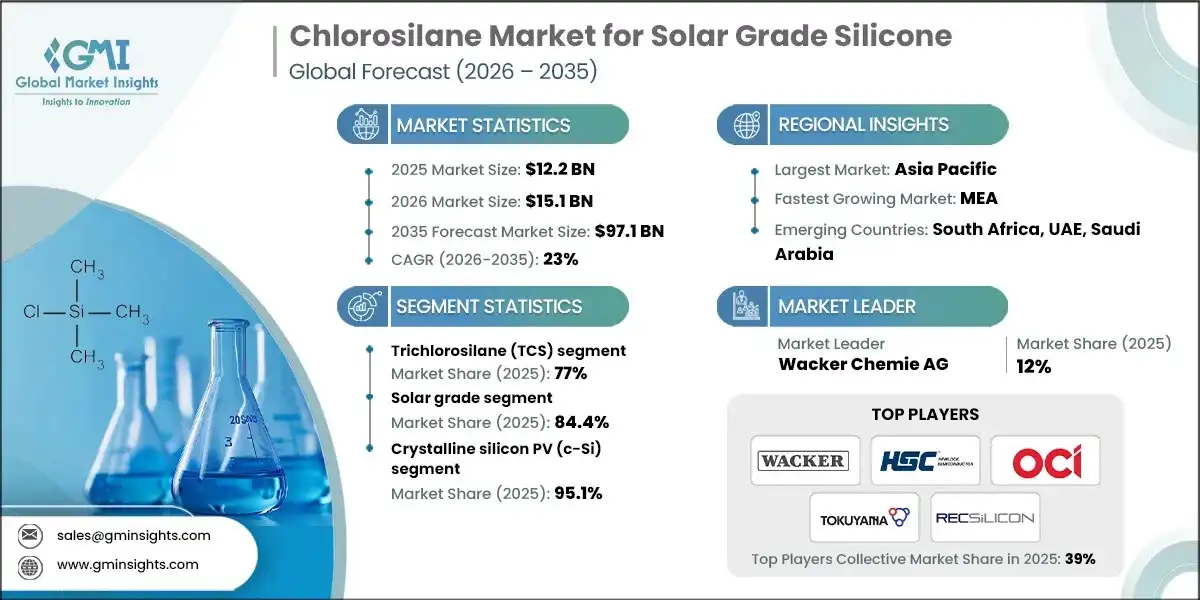
The global chlorosilane market for solar grade silicone was valued at USD 12.2 billion in 2025. The market is expected to grow from USD 15.1 billion in 2026 to USD 97.1 billion in 2035, at a CAGR of 23% according to latest report published by Global Market Insights Inc.
To get key market trends
- Chlorosilanes act as intermediates in ultra-pure silicon and silicone production – vital components in the supply chain for solar-grade silicon. From 2021-2025, the demand for silicone was locally supplied and built out upstream by the global scaling of PV and supply chain localization. There were no major changes in the PV component chemistry.
- The rapid deployment of solar generation in 2021, which increased from 821 TWh in 2020 to 1,032 TWh, was the main benefit of the market in 2021. This increase in solar generation further reinforced investment in polysilicon and other upstream material chains, which chlorosilanes and polysilicon recycling loops were/ are central to.
- From 2022-2023, the cycle was characterized by tightness and build out. Global solar PV generation further increased in 2022 and 2023 to 1,289 and 1,631 TWh, respectively. As chlorosilane manufacturers increased capacity and improved yields, the importance of by-product recovery for cost and reliability increased.
- From 2024-2025, vertical integration and efficiency dominated. Solar PV generation increased to 2,131 TWh and installed solar capacity increased to 1,865 GW in 2024. This widespread growth of solar generation and capacity demand sustained reliance on polysilicon for chlorosilane production and solar silicon applications.
Chlorosilane Market Report Attributes
| Key Takeaway | Details |
|---|---|
| Market Size & Growth | |
| Base Year | 2025 |
| Market Size in 2025 | USD 12.2 Billion |
| Market Size in 2026 | USD 15.1 Billion |
| Forecast Period 2026-2035 CAGR | 23% |
| Market Size in 2035 | USD 97.1 Billion |
| Key Market Trends | |
| Drivers | Impact |
| Rapid solar PV capacity additions | Expanding installations intensify demand for solar?grade chlorosilanes globally |
| Rising decarbonization and net?zero commitments | Climate policies accelerate polysilicon investments and upstream chlorosilane consumption |
| Advances in high?efficiency cell technologies | Higher purity requirements increase value of premium chlorosilane grades |
| Pitfalls & Challenges | Impact |
| High capital and operational intensity | Large upfront investments and energy costs limit new entrants |
| Stringent environmental and safety regulations | Compliance obligations slow permitting and capacity scale up timelines |
| Opportunities: | Impact |
| Expansion of polysilicon recycling and upgrading | By‑product conversion enhances economics and strengthens circular value chains |
| Emerging markets building domestic PV manufacturing | Local fabs create new regional hubs for chlorosilane demand |
| Market Leaders (2025) | |
| Market Leaders |
12% |
| Top Players |
|
| Competitive Edge |
|
| Regional Insights | |
| Largest Market | Asia Pacific |
| Fastest Growing Market | MEA |
| Emerging Country | South Africa, UAE, Saudi Arabia |
| Future Outlook |
|
What are the growth opportunities in this market?
Chlorosilane Market for Solar Grade Silicone Trends
- Upgrades to technology within polysilicon and photovoltaic (PV) manufacturing: With the development of PERC, TOPCon, and heterojunction cell lines, which require higher purity silicon, manufacturers are tightening their chlorosilane process control. For example, the most prominent polysilicon players have reported higher efficiencies and lower defect rates resulting from the improvement of trichlorosilane distillation, tail gas recycling, and STC to TCS conversion. They have shown the chlorosilane improvements to be directly correlated to cell performance and yield.
- Improvements in integrated and localized solar supply chains: The energy and policy security concerns have created more integrated PV clusters of co-located chlorosilane, polysilicon, ingots, and modules. While China has developed these hubs, the U.S., India, and Europe are incentivizing the development of domestic polysilicon and module manufacturers, which develops chlorosilane capacity within the region and minimizes the risk of cross-border supply disruption.
- Increasing emphasis on circularity and by-product valorization: Leading markets are prioritizing investments in closed-loop systems where end-of-life tetrachlorosilane is converted back to chlorosilanes (or higher-value derivatives). These types of systems can eliminate waste treatment, in turn, reducing chlorine consumption and increasing profitability. In many of the recent expansions, STC conversion units have been integrated along with new reactors, demonstrating that recycling economics are now core design considerations.
- Environmental, safety, and energy concerns: Chlorosilane plants are increasingly required to reduce emissions, improve worker safety, and decrease electricity consumption, particularly in regions with carbon-intensive power grids. Consequently, new projects focus on more advanced gas scrubbing, leak detection, and heat recovery technologies. In order to achieve low operating costs and reduced carbon costs, some producers are collocating with renewable and hydropower.
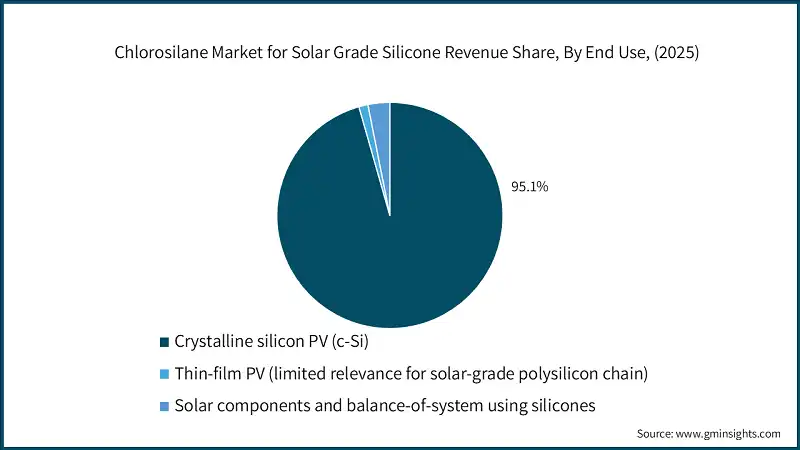
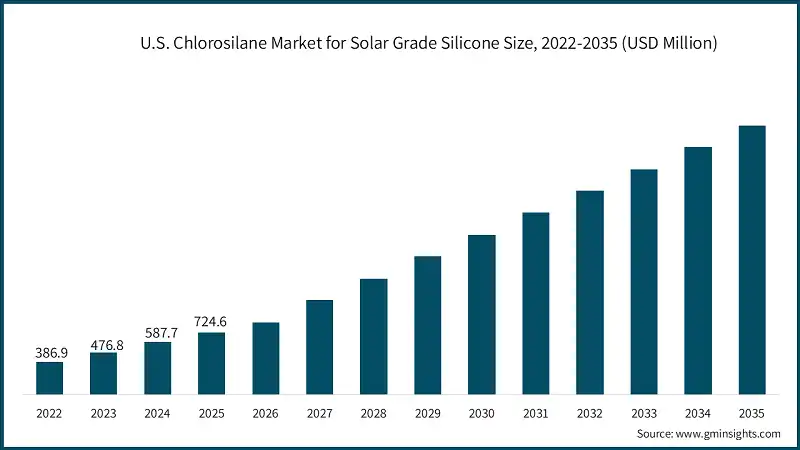
Chlorosilane Market for Solar Grade Silicone Analysis Based on product type, the market is segmented into Trichlorosilane (TCS), Dichlorosilane (DCS), Tetrachlorosilane (STC), Monochlorosilane (MCS), and other chlorosilanes. Trichlorosilane (TCS) dominated the market with an approximate market share of 77% in 2025 and is expected to grow with a CAGR of 22.1% by 2035. Based on purity grade, the chlorosilane market for solar grade silicone is segmented into solar grade, electronic grade, industrial grade. Solar grade held the largest market share of 84.4% in 2025 and is expected to grow at a CAGR of 22.6% during 2026-2035. Based on end use, the chlorosilane market for solar grade silicone is segmented into crystalline silicon PV (c-Si), thin-film PV (limited relevance for solar-grade polysilicon chain), solar components and balance-of-system using silicones. Crystalline silicon PV (c-Si) segment dominated the market with an approximate market share of 95.1% in 2025 and is expected to grow with the CAGR of 22.8% by 2035. North America continues to expand steadily from USD 864 million in 2025 to USD 7.05 billion in 2035, mainly driven by advanced PV deployments and technology upgrades. North America benefits from robust R&D, supportive policy frameworks, and a strong base of integrated polysilicon manufacturers, ensuring steady chlorosilane off?take and improving recycling economics. Europe region grows consistently from USD 1.21 billion in 2025 to USD 9.07 billion in 2035, supported by decarbonization mandates and supply?chain diversification. Europe’s emphasis on energy security, low?carbon manufacturing and strict ESG standards encourages regional polysilicon and specialty silicone projects, driving demand for high?purity chlorosilanes with traceable, lower?emission production footprints. Asia Pacific region represents the largest market, expanding from about USD 9.57 billion in 2025 to USD 76.33 billion in 2035, supported by a CAGR above 20%. Asia Pacific hosts most global polysilicon and module capacity, with massive solar installations and integrated clusters that tightly couple chlorosilane, polysilicon, wafer and module production, reinforcing scale advantages and continuous process optimization. Latin America region advances from around USD 356 million in 2025 to USD 2.53 billion in 2035, underpinned by rising solar adoption and grid decarbonization efforts. Latin America’s market is smaller but increasingly attractive, as utility?scale solar in high?irradiance countries encourages module assembly, localized component manufacturing and long?term interest in upstream materials participation. MEA region grows from roughly USD 248 million in 2025 to USD 2.07 billion in 2035, emerging as one of the fastest?growing regions by CAGR. MEA’s expansion is fueled by large utility solar projects, industrial diversification and early moves to host energy?intensive materials production, opening space for niche chlorosilane and polysilicon investments. The chlorosilane industry for solar grade silicone is moderately concentrated, with the top five players controlling a significant share anchored by integrated polysilicon operations and advanced purification capabilities. Wacker Chemie AG leads with 12%, followed by Hemlock Semiconductor at 9%, OCI Company Ltd. at 8%, Tokuyama Corporation at 6% and REC Silicon ASA at 4%. These leaders benefit from technology depth, long?term contracts with major PV manufacturers and strong positions in high?purity chlorosilane and closed?loop STC recycling, giving them cost, quality and reliability advantages versus smaller regional producers. Major players operating in the chlorosilane industry for solar grade silicone include: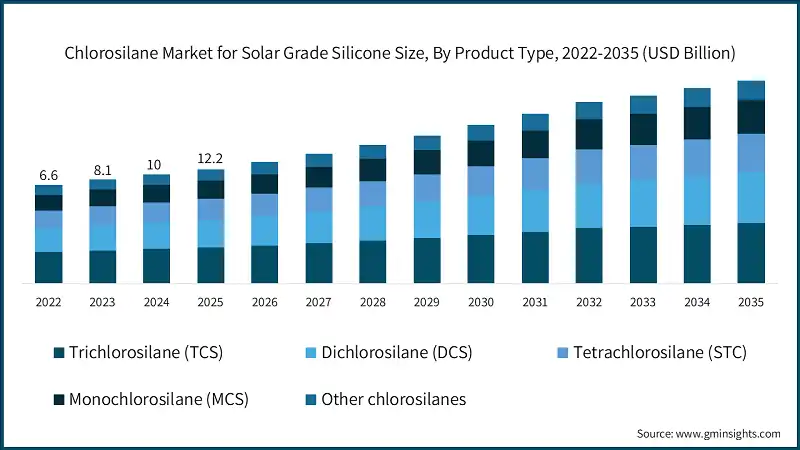 Learn more about the key segments shaping this market
 Learn more about the key segments shaping this market
 Looking for region specific data?
Chlorosilane Market for Solar Grade Silicone Share
Chlorosilane Market for Solar Grade Silicone Companies
Chlorosilane Industry for Solar Grade Silicone News
This chlorosilane market for solar grade silicone research report includes in-depth coverage of the industry, with estimates & forecasts in terms of revenue (USD Billion) and volume (Kilo Tons) from 2026 to 2035, for the following segments:
Market, By Product Type
- Trichlorosilane (TCS)
- Dichlorosilane (DCS)
- Tetrachlorosilane (STC)
- Monochlorosilane (MCS)
- Other chlorosilanes
Market, By Purity Grade
- Solar grade
- Electronic grade
- Industrial grade
Market, By End Use
- Crystalline silicon PV (c-Si)
- Mono c-Si
- Multi c-Si
- Thin-film PV (limited relevance for solar-grade polysilicon chain)
- Solar components and balance-of-system using silicones
- Modules (lamination, junction box sealing)
- Inverters and power electronics (potting, TIMs)
- Mounting systems and trackers (sealants, coatings)
The above information is provided for the following regions and countries:
- North America
- U.S.
- Canada
- Europe
- Germany
- UK
- France
- Spain
- Italy
- Rest of Europe
- Asia Pacific
- China
- India
- Japan
- Australia
- South Korea
- Rest of Asia Pacific
- Latin America
- Brazil
- Mexico
- Argentina
- Rest of Latin America
- Middle East and Africa
- Saudi Arabia
- South Africa
- UAE
- Rest of Middle East and Africa
Frequently Asked Question(FAQ) :
What are the key trends in the chlorosilane industry for solar grade silicone?
Major trends include higher-purity requirements driven by TOPCon and heterojunction cell technologies, increased by-product recycling, and integration of localized solar supply chains.
Who are the key players in the chlorosilane market for solar grade silicone?
Key players operating in the market include Wacker Chemie AG, Hemlock Semiconductor, OCI Company Ltd., Tokuyama Corporation, REC Silicon ASA, Dow, Momentive, Shin-Etsu Chemical, Evonik Industries AG, and Mitsubishi Chemical Group.
What is the growth outlook for the crystalline silicon PV (c-Si) end-use segment through 2035?
The crystalline silicon PV (c-Si) segment held about 95.1% share in 2025 and is expected to grow at a CAGR of 22.8% through 2035, supported by mono c-Si technology adoption and efficiency improvements.
Which region leads the chlorosilane market for solar grade silicone?
The U.S. market was valued at USD 864 million in 2025 and forms the core of North America’s regional demand. Growth is driven by federal solar incentives, advanced PV deployments, and integrated polysilicon manufacturing capacity.
What was the valuation of the solar-grade purity segment in 2025?
Solar-grade purity accounted for 84.4% market share in 2025, reflecting strong demand from high-efficiency mono crystalline silicon PV manufacturing.
How much revenue did the trichlorosilane (TCS) segment generate in 2025?
Trichlorosilane (TCS) dominated the market with approximately 77% share in 2025, making it the leading revenue-generating product type in the chlorosilane industry for solar grade silicone.
What is the projected value of the chlorosilane market for solar grade silicone by 2035?
The market is expected to reach USD 97.1 billion by 2035, growing at a CAGR of 23% through the forecast period due to large-scale solar installations and demand for high-purity silicon materials.
What is the industry size of the chlorosilane market for solar grade silicone in 2025?
The chlorosilane industry for solar grade silicone was valued at USD 12.2 billion in 2025, driven by rapid solar PV capacity additions and upstream polysilicon investments.
What is the current chlorosilane market for solar grade silicone size in 2026?
The chlorosilane industry for solar grade silicone size is projected to reach USD 15.1 billion in 2026, supported by expanding crystalline silicon PV manufacturing and supply chain localization.
Chlorosilane Market Scope
Related Reports